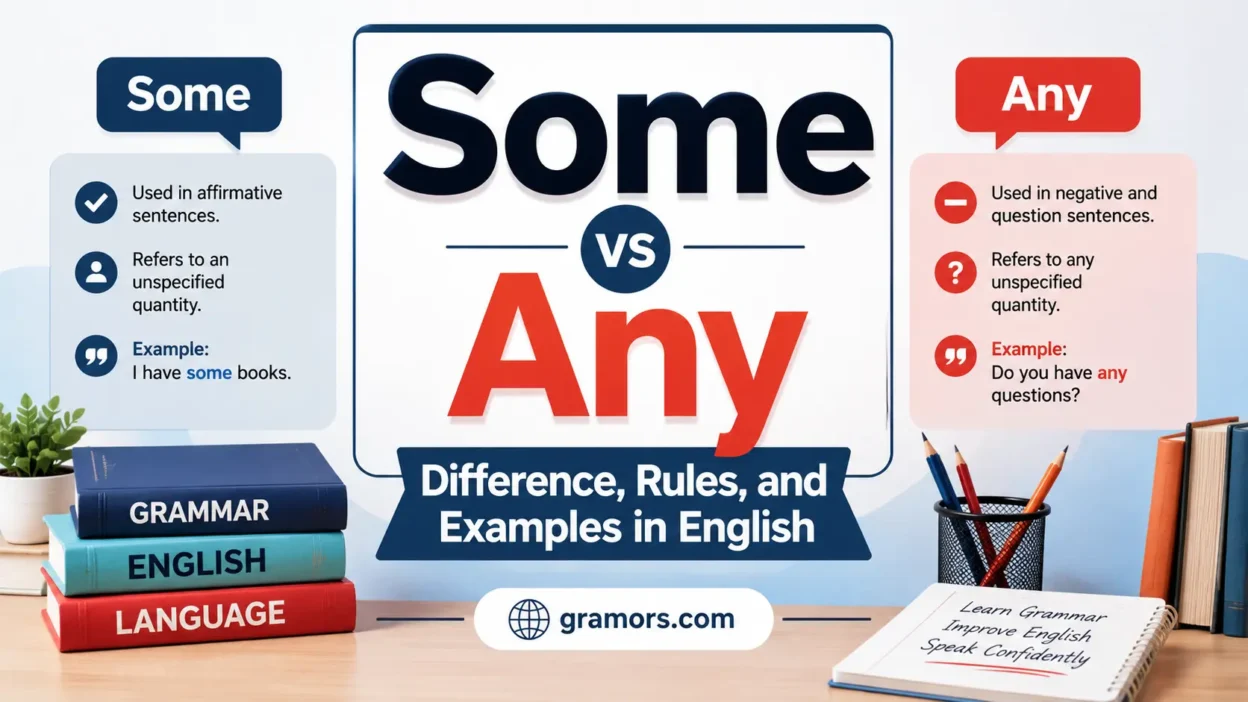
Some and any are both correct standard English words used for indefinite or unspecified people, things, amounts, and numbers.
A useful beginner rule is:
- some is common in affirmative statements
- any is common in negatives and neutral questions
For example:
“We bought some fruit.”
“We didn’t buy any fruit.”
“Do you have any fruit?”
However, this rule is only a starting point. English also commonly uses some in offers and requests:
“Would you like some fruit?”
It uses any in affirmative sentences when the meaning is unrestricted choice:
“You can choose any fruit you like.”
The best choice depends on sentence structure, meaning, and what the speaker intends to communicate.
Quick Answer
Use some most commonly in affirmative statements:
“I need some help.”
Use any most commonly in negatives and neutral questions:
“I don’t need any help.”
“Do you have any questions?”
Use some in many offers and requests:
“Would you like some help?”
Use any for unrestricted choice:
“Choose any color.”
Why People Confuse Them
Both some and any can refer to unspecified quantities or numbers.
Compare:
“I bought some apples.”
“Did you buy any apples?”
Both expressions refer to apples without giving an exact number.
They can also stand alone when the noun is already understood:
“I bought some.”
“Did you buy any?”
The confusion often comes from simplified rules. Learners may be taught that some belongs in positive sentences and any belongs in questions and negatives.
That rule works frequently, but not always.
Compare:
“Did you buy any bread?”
This is a neutral question about whether bread was purchased.
“Did you buy some bread?”
This can suggest that the speaker expects or suspects that bread was purchased.
Both are grammatical, but the conversational implication differs.
Key Differences At A Glance
| Situation | Some | Any |
|---|---|---|
| Ordinary affirmative statement | Usually natural | Usually not for simple quantity |
| Negative statement | Possible with special subset meaning | Usually natural |
| Neutral question | Possible depending on context | Usually natural |
| Offer or request | Very common | Possible with a different nuance |
| Expected-positive question | Common | More neutral |
| Unrestricted choice | Usually not equivalent | Very common |
| Plural count nouns | Yes | Yes |
| Uncount nouns | Yes | Yes |
| Singular count nouns | Possible in special senses | Common in free-choice uses |
Examples:
“Some books are missing.”
“Do you have any books on this topic?”
“We need some water.”
“We don’t have any water.”
“Some person called earlier.”
“Any person can make a mistake.”
Meaning and Usage Difference
Some: An Unspecified Amount or Number
Use some when referring to an unspecified quantity or number that the speaker presents as existing.
“I bought some apples.”
“We need some information.”
“Some students left early.”
The exact amount or number is not stated.
- Some: A Subset
- Some can mean part of a larger group:
- “Some students passed the test.”
This means a portion of the students passed, not necessarily all of them.
It can even appear in a negative sentence when the speaker means a particular subset:
“I don’t agree with some of these ideas.”
This means there are certain ideas the speaker disagrees with. It does not mean the speaker disagrees with all of them.
Some: A Particular but Unidentified Person or Thing
Before a singular count noun, some can refer to an unidentified person or thing:
“Some woman called earlier.”
“Some guy left this package for you.”
The speaker does not identify exactly who the person is.
Any: Questions and Negatives
Use any naturally in neutral questions:
“Do you have any information?”
“Are there any seats available?”
It is also common with negatives:
“We don’t have any information.”
“She didn’t buy any tickets.”
Here, negation creates the meaning of none.
Any itself does not inherently mean zero.
Any: Unrestricted Choice
In affirmative sentences, any often means whichever one, whatever one, or one without restriction.
“Any student may apply.”
“Choose any route.”
“You can sit in any seat.”
The meaning is not “some unspecified quantity.” Instead, every available option qualifies.
Noun Patterns
Both words work with plural count nouns:
“some books”
“any books”
Both work with uncount nouns:
“some information”
“any information”
Special singular-count uses also occur:
“Some person left a message.”
“Any student can join.”
Both words commonly function as determiners or quantifiers before nouns and can also stand independently as pronouns.
Tone, Context, and Formality
Neither some nor any is inherently more formal.
Both are neutral and standard in casual, professional, academic, and everyday American English.
The important difference often involves speaker assumptions.
Compare:
“Do you have any coffee?”
This is a neutral question about whether coffee is available.
“Do you have some coffee?”
This may suggest that the speaker has reason to believe coffee is available.
Offers commonly use some:
“Would you like some coffee?”
The speaker presents coffee as something available to offer.
Requests also frequently use some:
“Could I have some water?”
By contrast, any often keeps the question more open:
“Is there any way to fix this?”
The difference comes from conversational framing and meaning rather than formality.
Which One Should You Use?
Use this practical guide.
Ordinary affirmative statement
Usually choose some:
“We have some time.”
“She bought some groceries.”
Negative statement
Usually choose any:
“We don’t have any time.”
“She didn’t buy any groceries.”
Neutral yes/no question
Usually choose any:
“Do we have any time?”
“Did you receive any emails?”
Offer or request
Usually choose some:
“Would you like some tea?”
“Could I have some help?”
Question where existence is expected
Some may sound natural:
“Did you bring some food?”
The speaker may expect that food was brought.
Unrestricted choice
Use any:
“Choose any time that works.”
“You can select any option.”
Specific subset under negation
Use some when you mean certain members, not all:
“I don’t agree with some of these points.”
Compare:
“I don’t agree with any of these points.”
This means the speaker agrees with none of them.
When One Choice Sounds Wrong
Using the wrong word can create unnatural English or change the intended meaning.
Incorrect for an ordinary affirmative quantity:
“I have any questions.”
Natural:
“I have some questions.”
Incorrect for unrestricted choice:
“You can choose some seat you like.”
Natural:
“You can choose any seat you like.”
For an ordinary negative:
“I didn’t buy some groceries.”
Usually natural:
“I didn’t buy any groceries.”
However, some becomes correct when a subset is intended:
“I didn’t buy some of the items on the list.”
This means certain listed items were not purchased, while others may have been.
For a straightforward offer:
“Would you like some cake?”
This is usually more natural than:
“Would you like any cake?”
The second can work in special contexts, but it does not have the same ordinary offer-like feel.
The important question is often not whether a sentence is theoretically possible, but whether the word expresses the intended meaning naturally.
Common Mistakes (and Quick Fixes)
Mistake: Using “some” in every affirmative sentence
Incorrect for unrestricted choice:
“You may choose some color.”
Better:
“You may choose any color.”
Here, any means whichever color you prefer.
Mistake: Using “any” in every question
Less natural for a normal offer:
“Would you like any water?”
Natural:
“Would you like some water?”
Offers and requests commonly use some.
Mistake: Thinking “some” cannot appear in negatives
Correct:
“I don’t like some of these songs.”
This means there are particular songs the speaker dislikes.
Compare:
“I don’t like any of these songs.”
This means the speaker likes none of them.
Mistake: Thinking “any” always means none
In a positive sentence:
“Any applicant can apply.”
Here, any means every applicant is eligible without restriction.
Mistake: Treating the words as interchangeable
Compare:
“I have some questions.”
The speaker has an unspecified number of questions.
“Do you have any questions?”
The speaker asks neutrally whether questions exist.
Meaning and sentence context determine the choice.
Everyday Examples
Food
“We bought some milk.”
“We didn’t buy any milk.”
“Would you like some milk?”
“Is there any milk left?”
Work
“I have some questions about the report.”
“Do you have any questions?”
“We need some additional information.”
“Any employee can submit feedback.”
School
“Some students stayed after class.”
“Did any students ask for help?”
“Could I borrow some paper?”
“Any student may join the club.”
Shopping
“I need some new shirts.”
“They didn’t have any in my size.”
“Could you show me some cheaper options?”
“Choose any item from this shelf.”
Travel
“We have some time before boarding.”
“Do you have any luggage to check?”
“Could I get some information about the train?”
“Any route will get us there.”
Offers and Requests
“Would you like some coffee?”
“Could I have some water?”
“Do you need any help?”
“Is there any way I can assist?”
Different Meanings
“I don’t like some of these options.”
The speaker dislikes certain options.
“I don’t like any of these options.”
The speaker likes none of them.
“Some student left a notebook.”
One unidentified student did it.
“Any student can borrow a notebook.”
Every student is eligible.
Dictionary-Style Word Details
Verb
Some
This category does not normally apply.
Some is not a verb in the meaning relevant to this comparison.
Any
This category also does not apply.
Any is not a verb.
Noun
Neither comparison word is normally classified as an ordinary noun in these uses.
Both can function independently as pronouns.
Some:
“Some were missing.”
The understood noun might be students, books, tickets, or another previously mentioned group.
Any:
“Do you have any?”
Again, the noun is understood from context.
Synonyms
Exact synonyms do not work across every use.
Closest context-dependent alternatives for some include:
- a few, with plural count nouns
- a little, with uncount quantities
- certain, for particular unidentified members
- an unspecified amount or number
Example:
“Some students stayed.”
“A few students stayed.”
The meanings may be close but are not always identical.
Closest alternatives for any depend strongly on meaning:
- whichever
- whatever
- one or more
- at all, in certain negative or emphatic constructions
Example:
“Choose any option.”
“Choose whichever option you prefer.”
No single synonym replaces either word in every construction.
Example Sentences
Some
“I bought some apples.”
“We need some information.”
“Would you like some coffee?”
“Some students stayed late.”
“I don’t agree with some of those ideas.”
Any
“I didn’t buy any apples.”
“Do you have any information?”
“Any student can join.”
“Choose any seat.”
“She left without any money.”
These examples show that the distinction goes beyond a simple positive-versus-negative formula.
Word History
Some has deep roots in English. It developed through Middle English from Old English sum, with uses extending back before the twelfth century.
Any developed through Middle English from Old English ǣnig, historically connected with the idea of one.
Both words have been part of English for centuries.
Their historical origins do not provide a simple explanation for every modern usage distinction, so present-day sentence patterns remain the most useful guide.
Phrases Containing
Common expressions with some include:
- some of
- some more
- and then some
- for some reason
- for some time
- some kind of
Examples:
“Some of the students left.”
“Would you like some more?”
Common expressions with any include:
- any of
- any more
- any longer
- any number of
- in any case
- at any rate
- hardly any
Examples:
“Do any of these belong to you?”
“There’s hardly any time left.”
These expressions show the broad grammatical range of both words.
FAQ
What is the main difference between “some” and “any”?
Use some most commonly in affirmative statements and any in negatives and neutral questions. Important exceptions include some in offers and requests and any for unrestricted choice: “Choose any seat.”
Can “some” be used in questions?
Yes. It is especially natural in offers, requests, and questions where the speaker expects or assumes something may exist: “Would you like some tea?”
Can “any” be used in positive sentences?
Yes. It commonly expresses unrestricted choice: “You can choose any dessert.” Here, every available dessert is an acceptable option.
Can “some” be used in negative sentences?
Yes, especially when referring to a particular subset: “I don’t agree with some of their ideas.” This means certain ideas are rejected, not necessarily all of them.
Can “some” and “any” be used with countable and uncountable nouns?
Yes. Both work with plural count nouns—“some books,” “any books”—and uncount nouns—“some water,” “any water.” Special singular-count uses also occur, such as “some person” and “any student.”
Are “some” and “any” interchangeable?
No. Sometimes both are grammatically possible, but the meaning or speaker assumption changes. “Did you buy any bread?” is neutral, while “Did you buy some bread?” may suggest the speaker expects that you did.
Conclusion
Both some and any are correct standard English words.
Start with this useful default:
Affirmative statement → usually some
“I have some time.”
Negative or neutral question → usually any
“I don’t have any time.”
“Do you have any time?”
Then remember two major exceptions:
Offers, requests, and many expected-positive questions → often some
“Would you like some help?”
Unrestricted choice → any
“Choose any option.”
The best choice ultimately depends on meaning and conversational intent, not on an absolute positive-versus-negative rule.