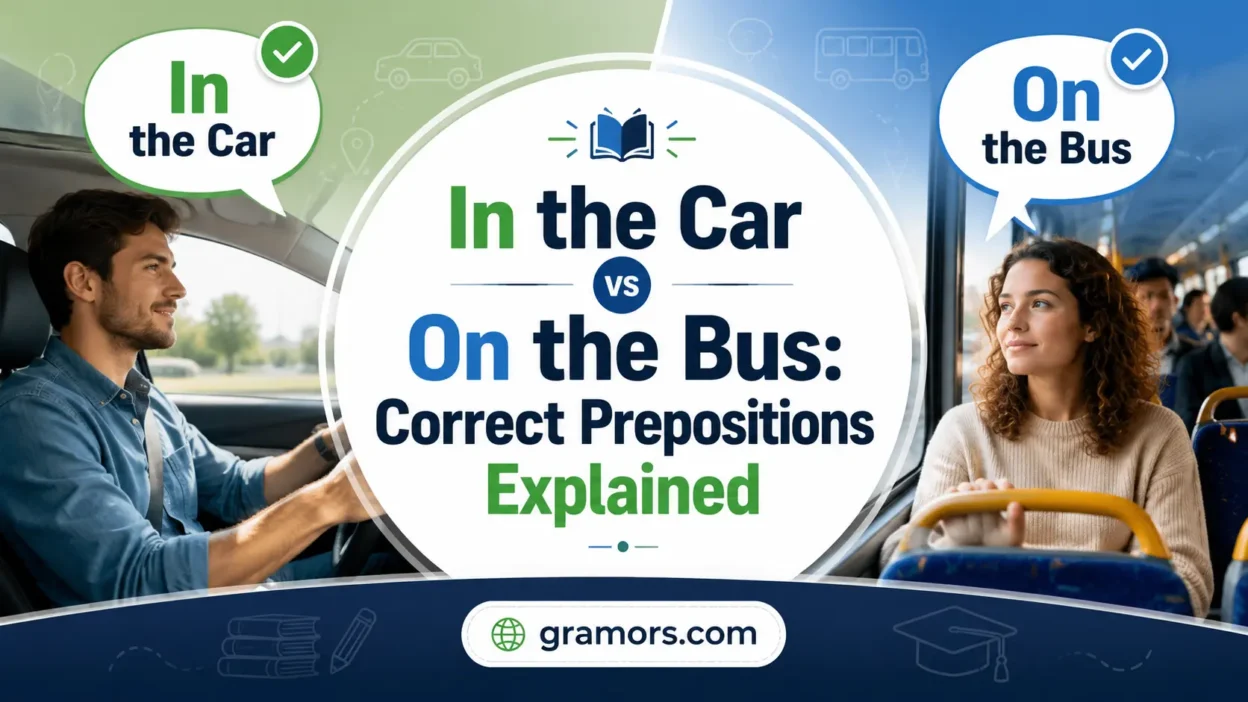
The choice between in the car vs on the bus can seem illogical. A passenger is physically inside both vehicles, yet ordinary English uses different prepositions.
Use in the car for a driver, passenger, animal, or object inside a car. Use on the bus for someone traveling as a bus passenger.
“I’m waiting in the car.”
“I’m already on the bus.”
Both expressions are correct in their proper contexts. However, speakers cannot freely exchange in and on without changing the meaning or making the sentence sound unnatural.
Quick Answer
Use in the car when someone or something is inside a car. Use on the bus when someone is aboard or traveling by bus.
The movement forms follow the same pattern:
“Get in the car.”
“Get on the bus.”
Incorrect: “I’m on the car.”
Correct: “I’m in the car.”
Why People Confuse Them
A passenger sits inside both a car and a bus. Based only on physical space, in the bus may therefore appear more logical.
English transportation expressions are partly conventional. A bus is usually treated as a vehicle that passengers board, travel on, and get off. A car is generally treated as a smaller enclosed space that people get into and out of.
“Inside the bus” is correct when the physical interior is important:
“The temperature inside the bus was uncomfortable.”
For ordinary passenger status, on the bus sounds more natural:
“We met on the bus.”
The common size guideline can help, but it is not a complete rule. Transportation expressions developed through usage rather than one perfectly logical system.
Key Differences At A Glance
| Context | Best Choice | Why |
|---|---|---|
| Driver or passenger inside a car | in the car | Treats the car as an enclosed space |
| Passenger traveling by bus | on the bus | Standard passenger expression |
| Entering a car | get in the car | Matches the enclosed-space pattern |
| Leaving a car | get out of the car | Standard paired expression |
| Boarding a bus | get on the bus | Standard boarding expression |
| Leaving a bus | get off the bus | Matches the boarding pattern |
| General travel method | by car or by bus | Names transportation without identifying a particular vehicle |
| Physical bus interior | in the bus | Possible when the interior itself is emphasized |
| Exterior of a car | on the car | Usually means on its roof, hood, or another outer surface |
A simple memory pair is:
- Car: in, get in, get out of
- Bus: on, get on, get off
Meaning and Usage Difference
In the car presents the car as an enclosed space or container. The phrase can describe a driver, passenger, pet, or object.
“My mother is waiting in the car.”
“The children fell asleep in the car.”
“We left the groceries in the car.”
In each sentence, in is a preposition and car is a singular count noun introduced by the.
On the bus presents the bus as a form of transportation that passengers board and ride.
“My daughter is on the school bus.”
“I read the news on the bus.”
“Several passengers were still on the bus.”
Here, on is the preposition and bus is a singular count noun introduced by the.
The ordinary passenger expression is on the bus, even though the passenger is physically inside it. However, in the bus can work when the speaker focuses specifically on the interior.
“The mechanic found water in the bus.”
“A child was hiding in the parked bus.”
Those sentences describe what was physically within the vehicle rather than presenting someone as a normal passenger.
Tone, Context, and Formality
Both main expressions are neutral. They work naturally in conversation, news reports, instructions, narratives, and professional writing.
Casual phone call:
“I’m in the car outside your apartment.”
Transit announcement:
“Please keep your belongings with you while on the bus.”
Police description:
“The suspect remained in the car.”
Travel narrative:
“We met an interesting family on the bus.”
Formal safety instruction:
“Children must remain seated while on the bus.”
Aboard the bus is a more formal alternative to on the bus. Meanwhile, inside the car places stronger emphasis on physical interior position than in the car.
Neither main phrase is limited to American or British English.
Which One Should You Use?
First, identify the vehicle and the meaning.
For a normal car driver or passenger, use in the car:
“We waited in the car.”
For a normal bus passenger, use on the bus:
“We talked on the bus.”
Match the movement verb to the same pattern:
“Please get in the car.”
“Get out of the car carefully.”
“We need to get on the bus.”
“They got off the bus downtown.”
Use by car or by bus when naming the general method of travel:
“We came by car.”
“They came by bus.”
Do not confuse by car with by the car. The second expression normally means beside or near a particular vehicle:
“Your suitcase is by the car.”
When One Choice Sounds Wrong
“I am on the car” usually sounds as though the speaker is sitting or standing on the car’s exterior.
Normal passenger meaning:
Incorrect: “I am on the car.”
Correct: “I am in the car.”
However, on the car becomes correct when the exterior meaning is intended:
“There is snow on the car.”
“The mechanic was leaning on the car.”
Similarly, “I got on the car” is unsuitable for entering the passenger compartment.
Incorrect: “We got on the car.”
Correct: “We got in the car.”
In the bus is not always grammatically wrong, but it sounds marked when ordinary travel is intended.
Less natural for passenger status:
“We talked in the bus during the trip.”
More natural:
“We talked on the bus during the trip.”
The interior-focused form works in a suitable context:
“The child hid in the empty bus.”
Common Mistakes
Incorrect: “I’m on the car.”
Correct: “I’m in the car.”
Use in for a driver or passenger inside a car.
Incorrect: “Get on the car.”
Correct: “Get in the car.”
People normally get into the passenger compartment.
Usually unnatural: “Get in the bus.”
Natural: “Get on the bus.”
Use the standard boarding expression for a bus passenger.
Incorrect: “Get out from the car.”
Correct: “Get out of the car.”
The natural expression is get out of.
Incorrect: “We traveled by the bus.”
Correct: “We traveled by bus.”
Use no article when naming the transportation method.
Also correct: “We traveled on the bus.”
This refers to being aboard a particular bus rather than only naming the method.
Everyday Examples
In the Car
- “I’m in the car near the main entrance.”
- “Her father waited in the car during the appointment.”
- “The ride-share driver has two passengers in the car.”
- “We left the phone in the car.”
- “The dog stayed in the car for a few minutes.”
- “Please get in the car before it starts raining.”
- “Everyone got out of the car safely.”
- “The emergency operator asked whether anyone was trapped in the car.”
On the Bus
- “My children are already on the school bus.”
- “She listens to podcasts on the bus.”
- “Traffic kept us on the bus for nearly an hour.”
- “I left my umbrella on the bus.”
- “Several commuters got on the bus at the next stop.”
- “We got off the bus near the museum.”
- “A passenger became sick on the bus.”
- “They met while traveling on a city bus.”
Dictionary-Style Word Details
Verb
In the car: The complete expression is not a verb. It contains no verb and usually follows one such as be, wait, sit, ride, or leave.
On the bus: The complete expression is also not a verb. Although bus can function as a verb elsewhere, it is a noun here.
Other verbal meanings of bus are outside this comparison.
Noun
In the car: Car is a singular count noun governed by the determiner the.
On the bus: Bus is also a singular count noun governed by the.
The complete expressions are prepositional phrases. They commonly function as location or transportation-related complements.
Synonyms
In the car: The closest plain alternative is inside the car. Riding in the car may fit some sentences, but it adds the idea of travel.
On the bus: Closest alternatives include aboard the bus and, in some contexts, riding the bus.
No alternative preserves every grammatical meaning. Outside the car and off the bus are useful location contrasts rather than exact lexical opposites.
Example Sentences
In the Car
“The driver is in the car.”
“Three passengers were in the car.”
“My wallet is in the car.”
“The puppy slept in the car.”
“They sat in the parked car and talked.”
On the Bus
“I saw Maya on the bus.”
“The students got on the bus quietly.”
“He left his backpack on the bus.”
“We traveled to school on the bus.”
“Everyone remained on the bus during the delay.”
Word History
Neither complete phrase has a separate dictionary history.
Car has referred to carts, wagons, and other wheeled vehicles for centuries. Its history does not explain why modern English uses in the car.
Bus is a shortened form of omnibus and entered English transportation vocabulary during the nineteenth century. That origin does not prove why modern passengers travel on the bus rather than in the bus.
The preposition choices are best learned as established usage patterns.
Phrases Containing
Common patterns with in the car include:
- get in the car
- wait in the car
- sit in the car
- leave it in the car
- ride in the car
Common patterns with on the bus include:
- get on the bus
- sit on the bus
- leave it on the bus
- fall asleep on the bus
- get off the bus
Ride the bus and ride on the bus use different sentence structures. In “I ride the bus to work,” the bus directly follows the verb. In “I read while riding on the bus,” it follows the preposition on.
FAQs
Why do we say “in the car” but “on the bus”?
English treats a car as a smaller enclosed space that people get into. A bus is conventionally treated as transportation that passengers get on and ride on.
“She is in the car, but her brother is on the bus.”
Is “in the bus” ever correct?
Yes, when the physical interior is the focus.
“There was smoke in the bus.”
For normal passenger status, on the bus is more natural: “Twenty passengers were on the bus.”
Does “on the car” always mean on its roof?
No. It can mean on any outer surface, including the roof, hood, trunk, or side.
“There is a dent on the car.”
For someone inside the passenger compartment, use in the car.
Do you get in or get on a car?
Normally, you get in the car and get out of the car.
“Get in the car before the rain starts.”
Use get on the car only for unusual exterior movement.
Do you get in or get on a bus?
Passengers normally get on the bus and get off the bus.
“We got on the bus downtown and got off near the airport.”
What is the difference between “by bus” and “on the bus”?
By bus names the transportation method:
“We traveled by bus.”
On the bus describes someone aboard a particular bus:
“We ate lunch on the bus.”
Does the stand-and-walk guideline always work?
No. The idea that people use on for vehicles where they can stand or walk may help with buses and trains, but it does not explain every transportation expression.
Treat it as a memory aid rather than a fixed rule.
Is the rule different in American and British English?
The main pattern is the same in both: in the car, on the bus, get in the car, and get on the bus are standard.
Conclusion
Use in the car and get in the car for normal car passengers. Use on the bus and get on the bus for normal bus passengers. When naming only the transportation method, choose by car or by bus.
“We waited in the car, but our friends were already on the bus.”