People often confuse see and watch because both involve using your eyes. At first glance, they seem similar, but they work differently in real English.
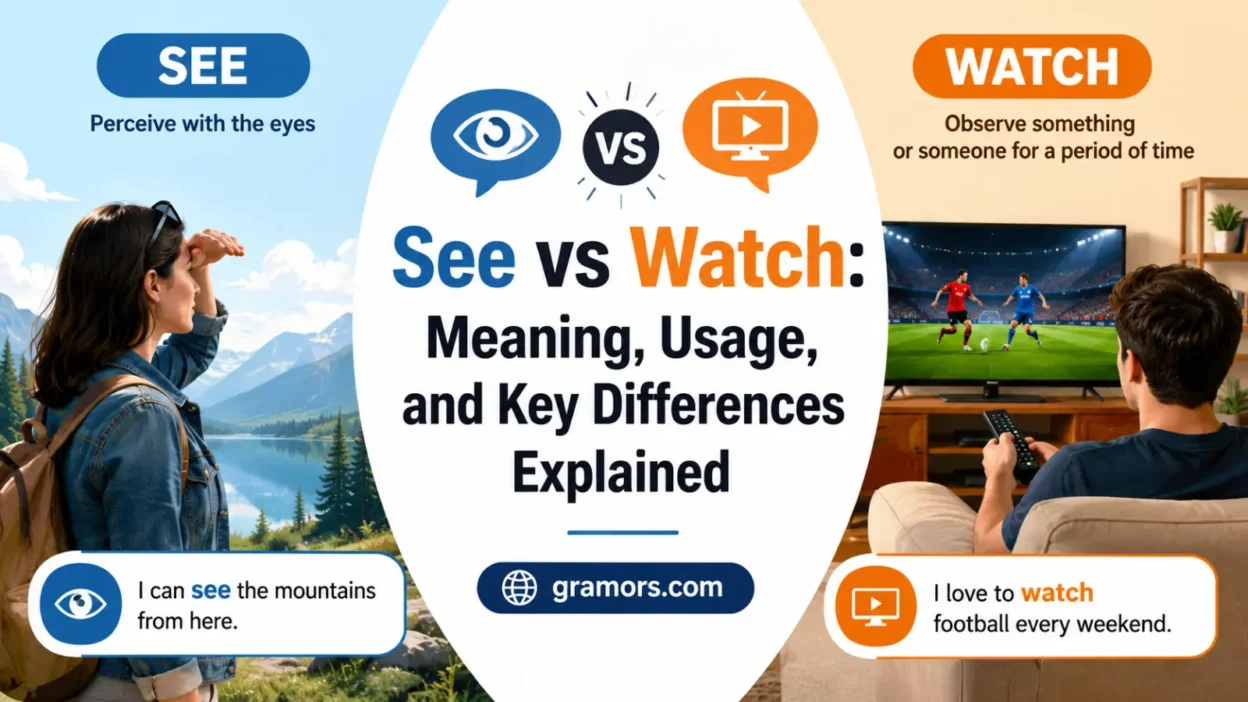
In see vs watch, the main difference is attention and control. One happens naturally. The other requires focus over time.
For example:
- “I saw a movie.”
- “I watched a movie.”
Both sound familiar, but they don’t always mean the same thing in everyday usage.
2. Quick Answer
See means something enters your vision without effort. It is often passive.
Watch means you focus on something for a period of time. It is active and intentional.
- “I saw him outside.”
- “I watched him run across the street.”
In most cases, they are not interchangeable because intention changes the meaning.
3. Why People Confuse Them
The confusion happens because both verbs involve eyesight. In real life, the actions often overlap.
For example, when you are at a movie theater, you both see and watch the screen. In some expressions, both words appear natural depending on region or habit.
This overlap makes learners think they mean the same thing, but context changes everything.
4. Key Differences At A Glance
| Context | Best Choice | Why |
|---|---|---|
| Natural perception | See | Happens without effort |
| Focused attention | Watch | Requires attention over time |
| Movies, TV, sports | Watch | Continuous action |
| Noticing something | See | Instant perception |
5. Meaning and Usage Difference
See refers to noticing or perceiving something visually. It does not require effort.
Examples:
- “I saw a bird in the tree.”
- “Did you see that car?”
Watch refers to paying attention to something as it happens. It often involves movement or change.
Examples:
- “We watched the game last night.”
- “She watched the sunset.”
A simple way to remember it:
see = notice
watch = observe over time
6. Tone, Context, and Formality
Watch is common in entertainment and monitoring situations:
- “Watch TV.”
- “Watch the baby.”
See is common in perception and expressions:
- “I see a light.”
- “I see what you mean.”
- “See a doctor.”
Some phrases are fixed in English, so usage becomes natural rather than optional.
7. Which One Should You Use?
Use see when something is noticed or happens naturally.
Use watch when you are focusing on something over time.
Quick guide:
- Instant perception → see
- Ongoing attention → watch
Examples:
- “I saw an accident on the road.”
- “I watched the accident unfold.”
8. When One Choice Sounds Wrong
Some sentences sound unnatural because the type of attention doesn’t match the verb.
Incorrect:
- “See TV.”
- “Watch a flash in the sky.”
Correct:
- “Watch TV.”
- “I saw a flash in the sky.”
The key issue is duration: quick moments use see, ongoing actions use watch.
9. Common Mistakes (and Quick Fixes)
Mistake → Fix
- “I see a movie last night” → “I watched a movie last night”
- “I am watching a bird suddenly appear” → “I saw a bird suddenly appear”
- “See TV” → “Watch TV”
A simple rule:
- see = no control over timing
- watch = controlled attention over time
10. Everyday Examples
- “I saw him at the store.”
- “I watched him leave.”
- “Did you see that light?”
- “We watched the football match.”
- “I saw a message pop up.”
- “She watched the kids play.”
- “I saw a car pass by.”
- “They watched the fireworks show.”
- “I saw my friend yesterday.”
- “I watched a tutorial online.”
- “Did you see that?”
- “We watched the sunset together.”
- “I saw something strange outside.”
- “He watched me carefully.”
11. Dictionary-Style Word Details
Verb
- watch: intentional observation over time or continuous action
- see: passive perception or noticing something visually
Noun
- watch: also means a timepiece or act of watching
- see: not commonly used as a noun in modern usage
Synonyms
- watch: observe, monitor (closest alternatives)
- see: notice, perceive (closest alternatives)
Example Sentences
- watch: “I watched the game until midnight.”
- see: “I saw a bright light in the sky.”
Word History
- watch: comes from Old English meaning “to guard or observe carefully”
- see: comes from Old English meaning “to perceive with the eyes”
Phrases Containing
- watch: watch TV, watch closely, watch out
- see: see a doctor, see clearly, see someone off
12. FAQ + Conclusion
Can I use see and watch interchangeably?
Not usually. Changing the verb often changes the meaning.
Why do we say “see a doctor” but “watch TV”?
Because “see” is about visiting or perceiving, while “watch” is about ongoing attention.
Which is more common?
Both are common, but they are used in different situations.
Final takeaway:
- see = noticing something
- watch = paying attention over time
In see vs watch, the correct choice always depends on how much attention and time the action involves.