Look at and look for begin with the same common verb, but changing the preposition changes the meaning.
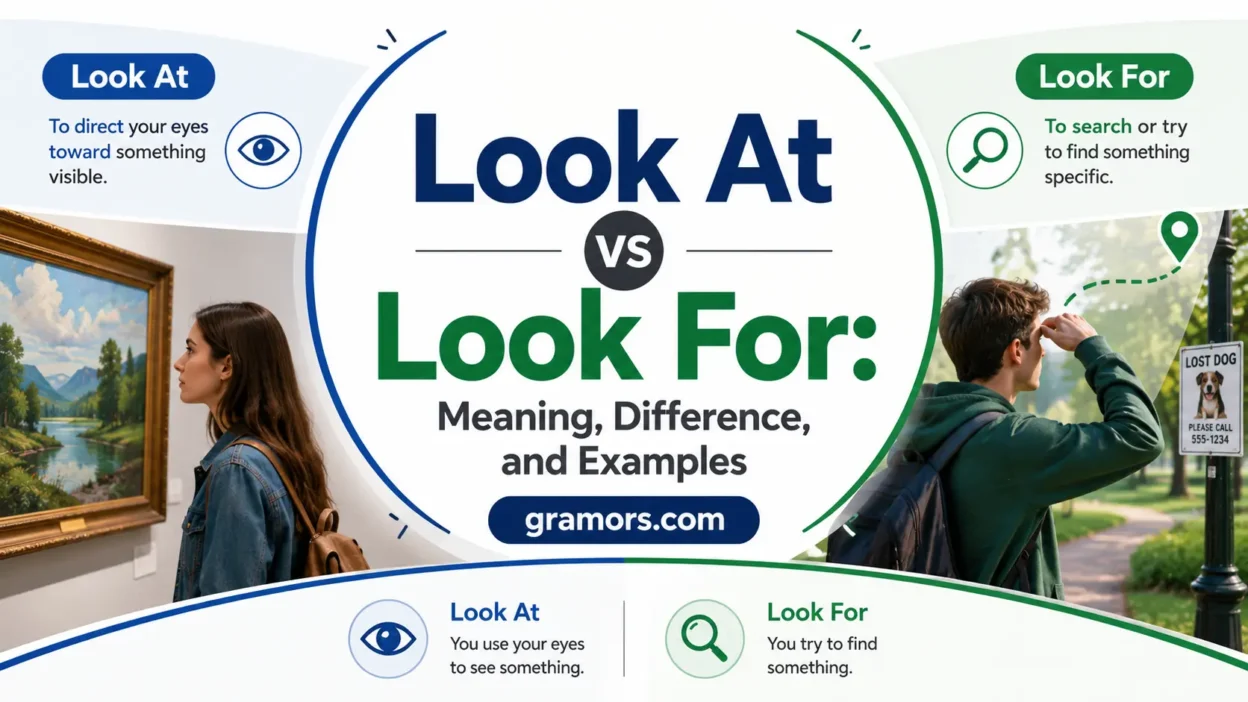
Use look at when directing your eyes or attention toward something, examining it, or considering it:
“Look at my keys.”
Use look for when trying to find, locate, obtain, or identify something:
“I’m looking for my keys.”
The difference is not merely stylistic. The two expressions describe different actions, although both have broader uses beyond literal seeing and searching.
Quick Answer
Use look at when directing your eyes or attention toward something or when examining or considering it:
“Look at the photo.”
Use look for when trying to find, obtain, or identify something:
“Look for the photo.”
A useful memory rule is: something is available to examine → look at; something needs to be found or identified → look for.
Why People Confuse Them
Both expressions contain the verb look, and only the following preposition changes on the surface.
However, that small change creates an important difference in meaning.
Compare:
“She looked at her bag.”
This means she directed her attention toward the bag.
“She looked for her bag.”
This means she tried to find the bag.
Learners may associate look simply with seeing and expect the same construction to work in both situations. Translation can also create confusion because another language may use one broad verb where English uses several different patterns.
Both expressions involve attention, but the purpose of that attention differs.
With look at, attention is directed toward a target.
With look for, attention is part of an effort to find, obtain, or identify a target.
Key Differences At A Glance
| Feature | Look At | Look For |
|---|---|---|
| Core idea | Direct attention toward something | Try to find or seek something |
| Target status | Known, available, or under consideration | Not yet found, obtained, or identified |
| Literal use | View something | Search for something |
| Extended use | Examine, review, consider | Seek, obtain, identify, expect |
| Picture | “Look at the picture.” | “Look for the picture.” |
| Keys | “Look at the keys on the table.” | “Look for the missing keys.” |
| Report | “Look at the report.” | “Look for the report.” |
| Job | “Look at the job posting.” | “Look for a job.” |
| Evidence | “Look at the evidence.” | “Look for evidence.” |
The target does not have to be physically visible in every look at sentence. Likewise, look for is not limited to lost physical objects.
Meaning and Usage Difference
Both expressions use the verb look, but the following preposition changes the relationship between the action and its target.
Look At: Direct Your Eyes Toward Something
The most literal meaning of look at is to direct your eyes toward a person or thing.
“Look at that bird.”
“She looked at the clock.”
“Everyone looked at the screen.”
Unlike see, which can describe simple visual perception, look at usually involves deliberately directing attention.
- Look At: Examine or Check
- Look at can also mean examine, inspect, or review something.
- “Look at the numbers again.”
“The doctor looked at the injury.”
“Can you look at this document before I send it?”
The action may involve much more than simply seeing something.
Look At: Consider
In abstract contexts, look at can mean consider or study an issue, option, proposal, or situation.
“We’re looking at three possible solutions.”
“The committee will look at the proposal tomorrow.”
“Let’s look at the problem from another perspective.”
No literal visual action is required in these examples.
Look For: Search
The most familiar meaning of look for is to try to locate someone or something.
“I’m looking for my wallet.”
“She looked for her phone everywhere.”
“We’re looking for Daniel.”
The search may or may not succeed.
Look For: Seek or Try to Obtain
Look for also works with things that are not lost physical objects.
“She’s looking for work.”
“They’re looking for a better apartment.”
“We are looking for new opportunities.”
“The company is looking for an experienced editor.”
Here, look for means seek or try to obtain.
Look For: Try to Identify
The expression can also describe searching for signs, patterns, clues, errors, or evidence.
“Researchers looked for evidence of change.”
“Look for unusual patterns in the data.”
“The technician looked for signs of damage.”
The target may be unknown or not yet confirmed.
The verb itself follows normal forms in both constructions:
- look
- looks
- looked
- looking
Tone, Context, and Formality
Both look at and look for are neutral, standard expressions used naturally in conversation and professional writing.
Casual:
“Look at this.”
Workplace:
“Let’s look at the budget.”
Hiring:
“We’re looking for an editor.”
More precise alternatives can change the tone.
Instead of look at, a writer may use:
- examine
- review
- consider
- observe
- inspect
- analyze
For example:
“Let’s look at the data.”
A more technical version might be:
“Let’s analyze the data.”
Instead of look for, alternatives include:
- search for
- seek
- identify
- try to find
“Researchers looked for evidence.”
A more formal version might be:
“Researchers sought evidence.”
These alternatives may be more precise in certain contexts, but neither look at nor look for is inherently unsuitable for professional writing.
Which One Should You Use?
Ask what you are trying to do.
Is the target available for attention or examination?
Use look at:
- “Look at the menu.”
- “Look at the website.”
- “Look at the data.”
- “Look at this apartment.”
Are you trying to locate, obtain, discover, or identify something?
- Use look for:
- “Look for a vegetarian option.”
- “Look for the contact page.”
- “Look for a pattern.”
- “Look for an apartment.”
Compare these pairs:
“Look at the menu.”
Direct your attention to the menu.
“Look for a vegetarian option.”
Search the menu for a suitable choice.
“Look at the data.”
Examine the available information.
“Look for a pattern.”
Try to identify a pattern within that information.
The noun itself does not automatically determine the expression. The intended action does.
When One Choice Sounds Wrong
Sometimes both expressions are grammatically possible, but switching the preposition changes the meaning.
“I’m looking at my keys.”
This normally means the keys are available and you are directing your attention toward them.
“I’m looking for my keys.”
This means you are trying to find them.
Compare more examples:
“Look at me.”
Direct your attention or eyes toward me.
“Look for me.”
Try to find me.
“Look at a job posting.”
Examine or consider the posting.
“Look for a job.”
Seek employment.
“Look at the evidence.”
Examine evidence that already exists or has been presented.
“Look for evidence.”
Try to discover or identify evidence.
“Look at the answer.”
Examine the answer.
“Look for the answer.”
Try to find or discover it.
“Look at an apartment.”
View or consider a specific apartment.
“Look for an apartment.”
Search for a place to live.
The sentences are not necessarily grammatically wrong when the preposition changes. Instead, the intended meaning often changes completely.
Common Mistakes
Mistake: Omitting “at” before a direct target
Incorrect:
“Look the picture.”
Correct:
“Look at the picture.”
When look means deliberately direct your eyes toward something, use at before the target.
Mistake: Using “look at” when searching
Wrong for the intended meaning:
“I’m looking at my missing phone.”
Correct:
“I’m looking for my missing phone.”
Use for when searching.
Mistake: Treating “look for” and “find” as identical
“I’m looking for my keys” describes the search process.
“I found my keys” means the search succeeded.
You can look for something without finding it.
Mistake: Assuming “look for” applies only to physical objects
It also works with abstract targets:
“She is looking for a job.”
“We’re looking for a solution.”
“Scientists are looking for evidence.”
Mistake: Assuming “look at” always means literal vision
It can also mean examine or consider:
“We need to look at our options.”
No literal act of viewing is required.
Mistake: Choosing the preposition without considering the intended action
Compare:
“Look at the answer.”
“Look for the answer.”
The first means examine it. The second means try to find it.
Everyday Examples
At Home
“Look at the keys on the table.”
“Help me look for my keys.”
“Look at this photo from our vacation.”
“I’m looking for the charger.”
School
“Look at this answer and tell me what is wrong.”
“Look for the answer in the text.”
“The teacher asked us to look at the diagram.”
“Students looked for evidence to support their conclusions.”
Work
“Let’s look at the monthly report.”
“We’re looking for a new manager.”
“The team looked at several candidates.”
“The company is looking for someone with more experience.”
Shopping
“Look at these shoes.”
“I’m looking for running shoes.”
“We looked at several laptops before choosing one.”
“She is looking for a less expensive option.”
Travel
“Look at the map before we leave.”
“Look for the nearest train station.”
“We looked at several hotels online.”
“They’re looking for a hotel near the airport.”
Technology
“Look at the file I sent you.”
“I’m looking for the missing file.”
“Can you look at the settings?”
“Look for the security option in the menu.”
Problem-Solving and Data
“Look at the data carefully.”
“Look for unusual patterns.”
“Let’s look at the problem from a different angle.”
“The investigators are looking for evidence.”
Dictionary-Style Word Details
Verb
Look At
This category fully applies.
The expression uses the normal forms of look:
- look at
- looks at
- looked at
- looking at
Its main senses include:
- direct visual attention
- observe
- examine
- inspect
- consider
- review
Examples:
“Look at the screen.”
“She looked at the report.”
“We’re looking at several options.”
Look For
This category also fully applies.
Its forms include:
- look for
- looks for
- looked for
- looking for
Its main senses include:
- search for
- seek
- try to obtain
- try to identify
- watch or expect for something in suitable contexts
Examples:
“I’m looking for my phone.”
“They are looking for a solution.”
“Look for signs of damage.”
Grammar references may describe these constructions with slightly different labels. For practical use, the important point is that changing the preposition changes the relationship between look and its target.
Noun
Look at itself is mainly a verb construction, but the noun look appears in expressions such as:
“Take a look at the report.”
“The article offers a closer look at the problem.”
Here, look is a noun.
A noun construction involving a look for something can describe an attempt to search:
“I had a look for the receipt.”
However, this pattern is less central to the main comparison than the common verb expression look for.
Synonyms
Closest alternatives for look at vary by meaning:
- observe
- view
- examine
- inspect
- consider
- review
Examples:
“Look at the document.” → “Examine the document.”
“Look at the proposal.” → “Consider the proposal.”
Closest alternatives for look for include:
- search for
- seek
- try to find
- hunt for, where appropriate
Examples:
“Look for a solution.” → “Seek a solution.”
“Look for your keys.” → “Search for your keys.”
No alternative works perfectly in every sentence.
Example Sentences
Look At
“Look at the picture on the wall.”
“She looked at the contract carefully.”
“We need to look at another option.”
“The analysts looked at the latest data.”
Look For
“I’m looking for my wallet.”
“She looked for him in the crowd.”
“He is looking for a new job.”
“Look for the answer in the final paragraph.”
“Researchers looked for evidence of contamination.”
“We’re looking for an opportunity to expand.”
Word History
The relevant history belongs mainly to the base word look, rather than to two independently created modern expressions.
Look has roots in Old English lōcian, connected with seeing or directing one’s attention.
Over time, English developed many constructions using look with different prepositions and particles. In the modern expressions discussed here, at directs attention toward a target, while for creates the searching or seeking relationship.
No precise independent origin date is needed for either complete phrase to understand current usage.
Phrases Containing
Common expressions with look at include:
- take a look at
- have a look at
- take a closer look at
- look at the facts
- look at it this way
Examples:
“Take a closer look at the figures.”
“Look at it this way.”
Common expressions with look for include:
- look for work
- look for trouble
- look for signs of
- look for ways to
- what to look for
Examples:
“She is looking for work.”
“Look for signs of damage.”
“We need to look for ways to reduce costs.”
These patterns reinforce the broader meanings of attention and examination with look at, and searching or seeking with look for.
FAQs
What is the main difference between “look at” and “look for”?
- Look at directs attention toward or examines something. Look for means search for or seek something.
- “Look at the keys.”
- “Look for the keys.”
Is “look at” the same as “see”?
No. See can describe visual perception without deliberate effort, while look at usually involves intentionally directing attention: “Look at the sign.”
Is “look for” the same as “find”?
No. Look for describes searching; find describes successfully discovering something.
“I looked for my phone and finally found it.”
Can “look at” mean “consider”?
Yes. It commonly means examine or consider an issue, proposal, option, or situation:
“We’re looking at several solutions.”
Can “look for” describe things that are not lost?
Yes. You can look for jobs, opportunities, answers, qualities, patterns, evidence, or solutions:
“We’re looking for a better solution.”
Are “look at” and “look for” interchangeable?
No. Switching the preposition normally changes the meaning:
“Look at the evidence” means examine it.
“Look for evidence” means try to discover it.
Conclusion
Use look at when directing attention toward something, examining it, or considering it.
Use look for when searching, seeking, or trying to identify or obtain something.
A useful memory rule is:
Something is there to examine → look at it.
Something needs to be found → look for it.
Compare the final pair:
“Look at the answer.”
“Look for the answer.”
The first means examine the answer; the second means try to find it.