Many writers confuse “affect” and “effect” because the words sound similar and both relate to change or results. The mistake is common in school papers, workplace emails, and everyday writing.
For example:
- Incorrect: “The weather had a bad affect on traffic.”
- Correct: “The weather had a bad effect on traffic.”
In most situations, one word acts like a verb and the other acts like a noun. Once you understand that pattern, choosing the correct word becomes much easier.
The good news is that the distinction is usually straightforward in real sentences.
Quick Answer
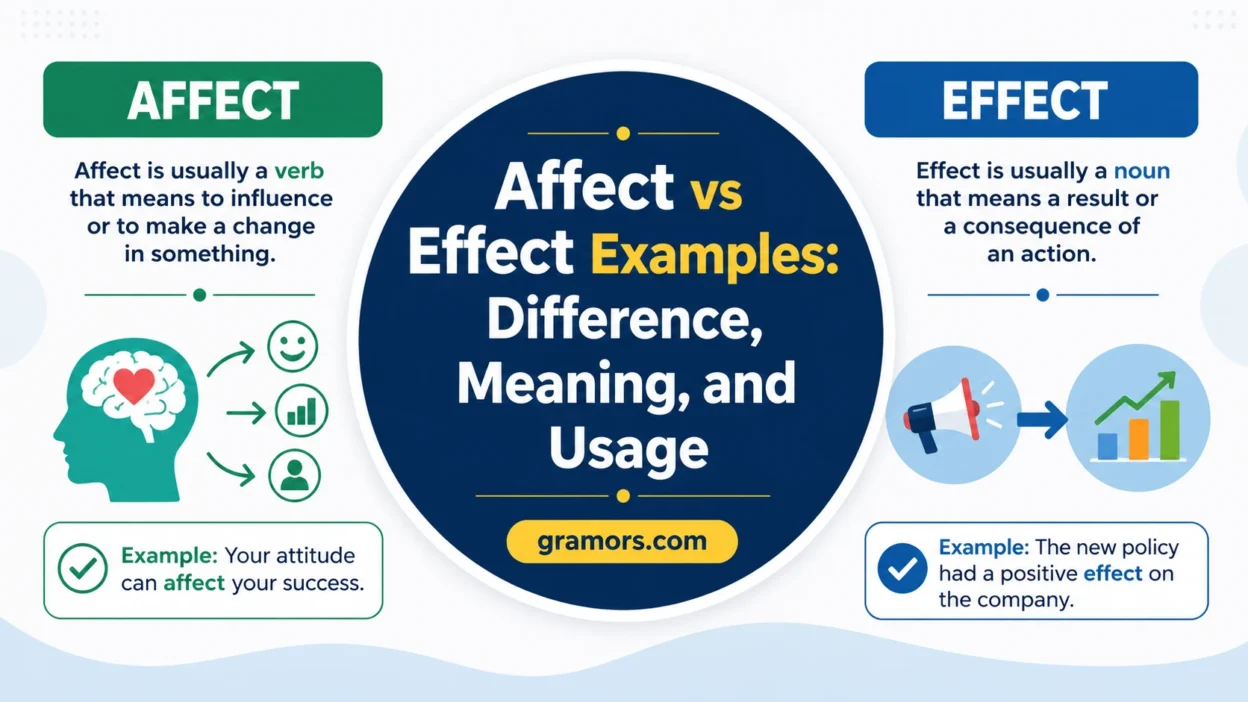
“Affect” usually means “to influence.”
Example:
- “The weather affected our plans.”
“Effect” usually means “a result” or “an outcome.”
Example:
- “The weather had an effect on our plans.”
A quick memory shortcut:
- Affect = Action
- Effect = End result
There are a few exceptions, but this rule works for most everyday writing.
Why People Confuse Them
The two words look and sound very similar, especially in fast speech.
They also relate to connected ideas:
- something influences something else
- a result happens afterward
That connection makes the mix-up easy.
People also see these words often in:
- academic writing
- workplace communication
- healthcare discussions
- news reporting
Common typo examples include:
- “This will effect your grade.”
- “The medicine had side affects.”
Correct versions:
- “This will affect your grade.”
- “The medicine had side effects.”
Even native English speakers pause to double-check these words.
Key Differences At A Glance
| Context | Best Choice | Why |
|---|---|---|
| Influencing something | affect | Usually a verb |
| Talking about a result | effect | Usually a noun |
| Workplace communication | affect | Describes impact |
| Scientific outcomes | effect | Describes results |
| Emotional influence | affect | Shows change or impact |
| Consequences or outcomes | effect | Names the result |
Compact Comparison Block
- Affect → usually means “to influence”
- Effect → usually means “a result”
- Affect → “Stress can affect sleep.”
- Effect → “Stress can have serious effects.”
Meaning and Usage Difference
In everyday English, “affect” is usually a verb meaning “to influence,” “change,” or “impact.”
Examples:
- “Lack of sleep affects concentration.”
- “The new policy affected employees.”
- “Rain could affect the game tonight.”
“Effect” is usually a noun meaning “result,” “outcome,” or “consequence.”
Examples:
- “The medicine had positive effects.”
- “The new law had little effect.”
- “One effect of stress is fatigue.”
There are also less common exceptions.
“Effect” can sometimes work as a verb meaning “to bring about.”
Example:
- “The company hopes to effect change.”
This usage appears more often in formal, legal, or business writing.
“Affect” can also be a noun in psychology, where it refers to emotional expression.
Example:
- “The patient displayed a flat affect.”
Most everyday writers will rarely need that meaning.
Pronunciation similarity also contributes to confusion because the words often sound close in casual American speech.
Tone, Context, and Formality
Both words appear in formal and informal English.
In casual conversation, people often focus more on meaning than grammar accuracy. In professional writing, however, the distinction matters more.
Casual example:
- “That movie really affected me.”
Academic example:
- “Researchers studied the effects of sleep deprivation.”
Business example:
- “The changes may affect quarterly sales.”
- “The policy took effect in January.”
Legal and corporate writing sometimes uses the formal verb form of “effect.”
Example:
- “The agreement will effect major operational changes.”
That usage is correct but less common in everyday conversation.
Which One Should You Use?
A quick way to choose is to check whether the sentence needs:
- an action
- or a thing/result
Use “affect” if the word means “influence.”
Example:
- “Will this affect my grade?”
Use “effect” if the word names a result.
Example:
- “What effect will this have?”
Quick sentence test:
- If you can replace the word with “impact,” “influence,” or “change,” try “affect.”
- If you can replace it with “result” or “outcome,” try “effect.”
Fill-in-the-blank examples:
- “The storm may ___ travel plans.” → affect
- “The storm had a major ___ on traffic.” → effect
These shortcuts help in most normal writing situations.
When One Choice Sounds Wrong
Some mistakes create immediate grammar problems.
Incorrect:
- “The speech had a strong affect on voters.”
Correct:
- “The speech had a strong effect on voters.”
Why? The sentence needs a noun naming a result.
Incorrect:
- “The delay will effect our schedule.”
Correct:
- “The delay will affect our schedule.”
Why? The sentence needs a verb meaning “influence.”
Another example:
Incorrect:
- “The medicine produced several affects.”
Correct:
- “The medicine produced several effects.”
Using the wrong word can confuse readers because the sentence structure no longer matches the grammar role.
Common Mistakes
One of the most common errors is using “effect” as a regular action verb.
Incorrect:
- “The budget cuts will effect students.”
Correct:
- “The budget cuts will affect students.”
Another frequent mistake:
- “The new rules had little affect.”
Correct:
- “The new rules had little effect.”
Some writers memorize only:
- “affect = verb”
- “effect = noun”
That shortcut helps most of the time, but it is not universal.
Advanced exceptions:
- “effect change” ✔
- “flat affect” ✔
Still, beginners should focus mainly on the common usage pattern first.
Quick proofreading tip:
- Look for articles like “an,” “the,” or “a” before “effect.”
- Look for action structures before “affect.”
Everyday Examples
School:
- “Missing homework can affect your grade.”
- “The tutoring program had a positive effect.”
Workplace:
- “The delay affected the project timeline.”
- “The changes had an immediate effect on sales.”
Healthcare:
- “Stress affects blood pressure.”
- “One side effect is dizziness.”
News and media:
- “High gas prices affect commuters.”
- “The policy had a nationwide effect.”
Daily conversation:
- “That comment affected her mood.”
- “The movie had a strong emotional effect.”
Technology:
- “Slow internet affects productivity.”
- “The update had little effect on battery life.”
Weather:
- “Heavy rain affected traffic downtown.”
- “The storm had devastating effects.”
Paired comparison:
- “The teacher’s feedback affected his confidence.”
- “The feedback had a lasting effect.”
Dictionary-Style Word Details
Verb
- Affect: Fully applies. It usually means “to influence,” “change,” or “impact.”
Examples:- “Noise affects concentration.”
- “The decision affected everyone.”
- Effect: Partly applies. In formal usage, it can mean “to bring about.”
Example:- “The new policy will effect change.”
Noun
- Affect: Partly applies in psychology, where it refers to emotional expression.
Example:- “The patient showed little affect.”
- Effect: Fully applies. It commonly means “result,” “outcome,” or “consequence.”
Examples:- “The medicine had side effects.”
- “The law had little effect.”
Synonyms
- Affect: Closest alternatives include “influence,” “impact,” or “alter,” depending on context.
- Effect: Closest alternatives include “result,” “outcome,” or “consequence.”
No synonym works perfectly in every sentence.
Example Sentences
- Affect:
- “Lack of sleep affects memory.”
- “The speech affected public opinion.”
- “The patient displayed a calm affect.”
- Effect:
- “The changes had little effect.”
- “The medication caused side effects.”
- “The organization hopes to effect reform.”
Word History
- Affect: Comes through Latin and French roots connected to influence, emotion, and action.
- Effect: Shares related historical roots connected to results, completion, and outcomes.
The words developed related meanings over time, which partly explains modern confusion.
Phrases Containing
- Affect:
- “affect behavior”
- “affect performance”
- “flat affect” (psychology)
- Effect:
- “cause and effect”
- “take effect”
- “side effects”
- “effect change”
Some of these expressions are much more common in formal writing than casual conversation.
FAQs
Is affect a verb?
Usually, yes.
Example:
- “Cold weather affects plants.”
Is effect a noun?
Usually, yes.
Example:
- “The storm had a serious effect.”
Can affect be a noun?
Yes, but mainly in psychology.
Example:
- “The patient showed a flat affect.”
Can effect be a verb?
Yes. In formal usage, it can mean “to bring about.”
Example:
- “The committee hopes to effect reform.”
Are they interchangeable?
No. Swapping them usually creates a grammar or meaning mistake.
What is the easiest memory trick?
Think:
- Affect = Action
- Effect = End result
That rule works for most everyday situations.
Conclusion
The difference between affect vs effect examples becomes easier once you focus on sentence structure.
“Affect” usually means to influence something. “Effect” usually means a result or outcome.
For example:
- “The storm affected traffic.”
- “The storm had a major effect on traffic.”
The uncommon exceptions are real, but most everyday writing follows the standard verb-versus-noun pattern. Learning the words through real sentence examples is the easiest way to remember the difference.