
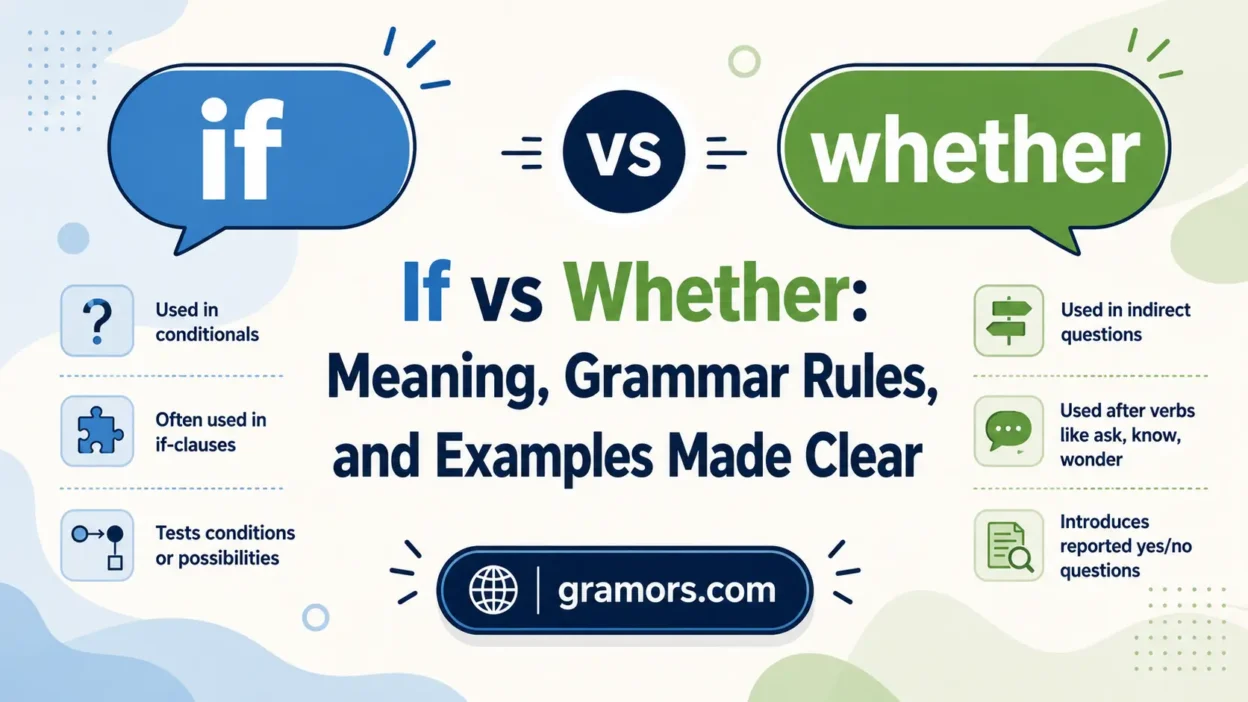
Many writers confuse if vs whether because both words can introduce uncertainty. You may see them after verbs like ask, know, wonder, and decide.
Still, they are not always interchangeable. If often introduces a condition. Whether often introduces a choice, alternative, or indirect question.
Compare these examples:
“Call me if you need help.”
“Tell me whether you need help.”
The first sentence means your need for help is the condition for calling. The second asks which possibility is true: you need help or you do not.
Quick Answer
Use if when the sentence means “on the condition that.”
Example: “If it rains, we’ll stay inside.”
Use whether when the sentence asks about a choice, alternative, or uncertain possibility.
Example: “I don’t know whether it will rain.”
They can overlap after verbs like ask, know, and wonder, but whether is required or clearer in some sentence patterns.
Why People Confuse Them
People confuse if and whether because both can introduce subordinate clauses. Both can also appear after verbs of doubt, inquiry, or uncertainty.
Examples:
“I asked if she was ready.”
“I asked whether she was ready.”
Both sentences are acceptable in many everyday contexts. They ask about the same yes-or-no question.
However, that overlap does not mean the words work the same everywhere. If is stronger for conditions. Whether is stronger for choices, alternatives, and certain formal structures.
In some languages, both ideas may translate into one word. That can make the English difference harder to see.
Key Differences At A Glance
| Context | Best Choice | Why |
|---|---|---|
| A condition | if | It means something happens only under that circumstance. |
| An indirect yes-no question | if or whether | Both can work after verbs like ask, know, and wonder. |
| A choice between alternatives | whether | It points to two or more possible outcomes. |
| More polished formal writing | whether | It often sounds more precise in indirect questions. |
| Before an infinitive | whether | Use “whether to,” not “if to.” |
| After a preposition | whether | Phrases like “about whether” sound standard. |
| Directly before “or not” | whether | “Whether or not” is the normal form. |
| As a subject clause | whether | “Whether he agrees is unclear” sounds natural. |
Meaning and Usage Difference
If introduces a condition. It means one thing will happen only under a certain circumstance.
Examples:
“If you finish early, send the report.”
“If the store is open, I’ll stop by.”
“If you agree, sign here.”
In these sentences, the action depends on the condition.
Whether introduces uncertainty, a choice, or possible outcomes.
Examples:
“Let me know whether you finished the report.”
“We need to decide whether to accept the offer.”
“I’m not sure whether the meeting is still on.”
In many sentences, the second possibility is implied. “I don’t know whether she is coming” means the speaker does not know which possibility is true: she is coming or she is not.
Compact comparison:
• If: condition; “on the condition that”
• Whether: choice or uncertainty; “which possibility is true”
• If: “Email me if the file won’t open.”
• Whether: “Please confirm whether the file opens on your laptop.”
Pronunciation is simple: if is /ɪf/, and whether is usually /ˈweð.ɚ/ in US English. The real issue is meaning, not sound.
Tone, Context, and Formality
If often sounds natural and conversational in everyday indirect questions.
Example:
“Do you know if he’s coming?”
That sentence is normal in speech, texting, and casual work messages.
Whether often sounds more precise or more polished in edited writing, especially when the sentence involves alternatives or a formal request.
Example:
“Please confirm whether he will attend.”
This does not mean if is always casual or wrong. It also does not mean whether is always better. In ordinary indirect yes-no questions, both may work.
Use whether when clarity matters, especially in business, school, legal, policy, or formal instructions.
Examples:
“Please confirm whether the payment was received.”
“The committee discussed whether the plan should continue.”
“We need to know whether the customer wants a refund or replacement.”
Which One Should You Use?
Choose if when the sentence means “on the condition that.”
Examples:
“If you agree, sign here.”
“If the package arrives, call me.”
“If traffic gets worse, we’ll leave earlier.”
Choose whether when the sentence means “which of two possibilities is true.”
Examples:
“We need to decide whether to sign.”
“I don’t know whether the price will change.”
“She asked whether the event was still happening.”
Choose whether before to.
Example:
“I can’t decide whether to apply.”
Choose whether after prepositions.
Example:
“It depends on whether the price changes.”
Choose whether when the clause is the subject of the sentence.
Example:
“Whether he agrees is still unclear.”
Do not replace every if with whether in formal writing. That can sound stiff. Use the word that fits the meaning and sentence pattern.
When One Choice Sounds Wrong
Some structures clearly need whether, not if.
Wrong: “I can’t decide if to go.”
Right: “I can’t decide whether to go.”
Use whether to, not if to.
Wrong: “We talked about if the plan would work.”
Better: “We talked about whether the plan would work.”
After a preposition like about, whether is the stronger and more standard choice.
Wrong: “I need to know if or not she agrees.”
Right: “I need to know whether or not she agrees.”
Use whether or not, not if or not.
Wrong: “If he agrees is unclear.”
Right: “Whether he agrees is unclear.”
When the whole clause acts as the subject, whether sounds natural. If does not fit that structure well.
Common Mistakes
Mistake: using if to.
Wrong: “She asked if to wait.”
Correct: “She asked whether to wait.”
Mistake: using if or not.
Wrong: “Tell me if or not you can come.”
Correct: “Tell me whether or not you can come.”
Mistake: using depends on if in polished writing.
Weak: “The result depends on if he pays.”
Better: “The result depends on whether he pays.”
Mistake: confusing a condition with a choice.
Conditional meaning:
“Call me if you need help.”
Choice or uncertainty:
“Tell me whether you need help.”
Mistake: using if when the sentence gives clear alternatives.
Less clear: “Tell me if you want tea or coffee.”
Better: “Tell me whether you want tea or coffee.”
The second sentence makes the choice clearer.
Everyday Examples
“Email me if the file won’t open.”
“Please confirm whether the file opens on your laptop.”
“We’ll leave if traffic gets worse.”
“We’re deciding whether to leave tonight or tomorrow.”
“Call me if you get lost.”
“Let me know whether your flight is delayed.”
“If the teacher posts the notes, I’ll study tonight.”
“I asked whether the test would include chapter five.”
“If the store is open, we can stop there.”
“Check whether the store is open before we drive across town.”
“If you need a receipt, I can print one.”
“Please choose whether you want a receipt by email or text.”
“If it rains, the game will move indoors.”
“The coach has not said whether the game will move indoors.”
These examples show the core pattern. If often sets a condition. Whether often asks which possibility is true.
Dictionary-Style Word Details
Verb
• If: Does not commonly apply. If is not a verb in standard modern use.
• Whether: Does not commonly apply. Whether is not a verb in standard modern use.
Do not use either word as an action word.
Noun
• If: Applies partly. If can be used as a noun meaning a condition, doubt, or uncertainty.
Example: “There are too many ifs in this plan.”
• Whether: Does not commonly apply in modern everyday English. Some dictionary entries note older uses, but they are not useful for normal writing.
Synonyms
• If: Closest plain alternatives depend on meaning. For conditional use, possible alternatives include provided that, assuming that, and on condition that.
Example:
“I’ll go if you go.”
“I’ll go provided that you go.”
In indirect questions, whether may be the closest alternative.
Example:
“Ask if she is ready.”
“Ask whether she is ready.”
• Whether: The closest plain alternative is sometimes if in indirect yes-no questions, but not in every structure.
Example:
“I don’t know whether he called.”
“I don’t know if he called.”
For whether or not, a close paraphrase can be regardless of whether.
Example:
“We’re going whether or not it rains.”
“We’re going regardless of whether it rains.”
Example Sentences
• If:
“If the store is open, I’ll stop by.”
“Ask if the room is available.”
“There are too many ifs in this plan.”
“If you finish early, send me the draft.”
• Whether:
“Ask whether the room is available.”
“I can’t decide whether to apply.”
“Whether she agrees is still unknown.”
“Please confirm whether the address is correct.”
Word History
• If: If has Old English roots and has long been used for conditions and indirect questions.
• Whether: Whether also has Old English roots and has historically been tied to choosing between alternatives.
The history helps explain why whether fits choices so well, but modern sentence structure matters most.
Phrases Containing
• If:
if not
if only
as if
what if
ifs and buts
if anything
• Whether:
whether or not
whether…or
regardless of whether
decide whether to
whether by accident or design
These phrases show why whether often fits alternatives and why if often fits conditions, doubts, and imagined situations.
FAQs
Are if and whether interchangeable?
Sometimes, but not always. They can overlap in indirect yes-no questions.
Example: “I asked if she was ready.” / “I asked whether she was ready.”
But use whether in structures like “whether to,” “about whether,” and “whether or not.”
Is whether more formal?
Often, yes. Whether can sound more precise in formal writing, especially with alternatives.
Example: “Please confirm whether you will attend.”
Still, if is not wrong in many everyday indirect questions.
Is “I don’t know if” correct?
Yes. “I don’t know if she is coming” is common and acceptable in everyday English.
A more formal version is: “I don’t know whether she is coming.”
Should I write “whether or not” or “if or not”?
Use whether or not.
Correct: “Tell me whether or not you agree.”
Avoid: “Tell me if or not you agree.”
Can I use if before to?
No. Use whether to.
Wrong: “I don’t know if to wait.”
Correct: “I don’t know whether to wait.”
Which is better after depends on?
Use whether after depends on, especially in clear or polished writing.
Better: “It depends on whether the price changes.”
Conclusion
Use if when something depends on a condition. Use whether when the sentence asks which possibility is true.
Final rule:
“If you agree, sign here.”
“Tell me whether you agree.”
The words can overlap in ordinary indirect questions, but for choices, alternatives, and required structures, whether is usually the safer choice.


