Good and well are closely related words, but they usually perform different grammatical jobs.
The basic rule is useful:
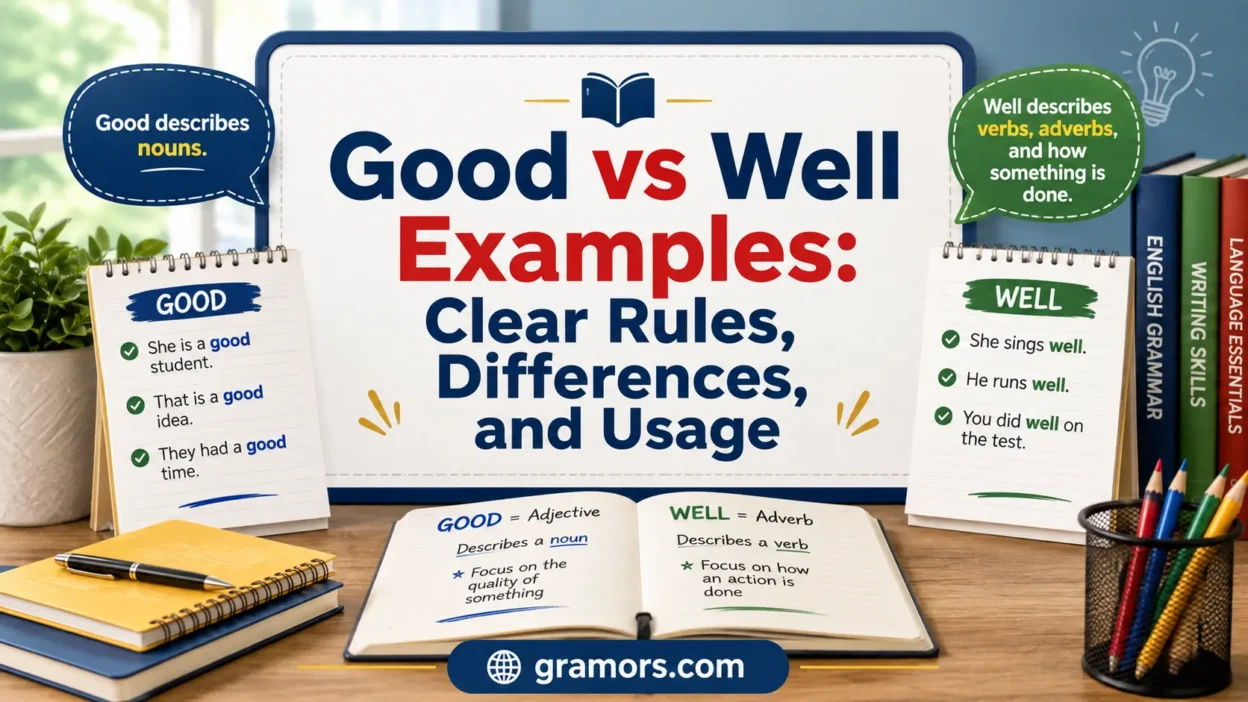
- Good usually describes a noun or subject.
- Well usually describes how an action happens.
For example:
- She is a good singer.
- She sings well.
However, the distinction becomes more complicated with linking verbs, health expressions, and informal American speech.
Compare:
- The food tastes good.
- I don’t feel well.
Both sentences are correct even though good follows a verb in the first sentence and well acts as an adjective in the second.
The easiest way to master good vs well is to focus on what each word describes rather than simply looking for a verb.
2. Quick Answer
Use good mainly to describe a noun, person, thing, or subject:
- a good student
- a good idea
- The soup tastes good.
Use well mainly to describe how an action happens:
- She studies well.
- The machine works well.
Well can also mean healthy:
- I don’t feel well today.
Good sometimes appears informally as an adverb in American speech, but well is usually the safer choice when an action needs an adverb in edited writing.
3. Why People Confuse Them
Good and well cause confusion because their meanings overlap closely.
A good singer normally sings well. A good driver normally drives well. A good employee may work well.
That relationship makes the words feel interchangeable even though their grammar is often different.
Linking verbs create another complication:
- You look good.
- The dinner smells good.
- The idea sounds good.
Good follows a verb in each sentence, but it is still an adjective because it describes the subject.
Well also has more than one grammatical function:
- She performed well.
Adverb. - She is well now.
Adjective meaning healthy.
Informal American English adds another layer:
- Standard edited usage: You performed well.
- Informal speech: You did good.
Adverbial good has a real place in informal usage, but it is not normally the preferred choice in careful writing.
Both words also share the irregular comparison forms better and best:
- a good result → a better result → the best result
- performs well → performs better → performs best
4. Key Differences At A Glance
| Feature | Good | Well |
|---|---|---|
| Primary comparison role | Adjective | Adverb |
| Describes nouns | Usually yes | Limited |
| Describes actions | Normally not in edited prose | Yes |
| Health adjective | Possible in broader positive-condition uses | Common |
| Noun use | Yes | Yes, separate meaning |
| Verb use | Not relevant/common here | Yes, separate meaning |
| Informal adverb use | Yes | Standard adverb |
| Example | a good player | plays well |
Compare these pairs:
- She is a good writer. / She writes well.
- He is a good driver. / He drives well.
- That is a good laptop. / It works well.
The main contrast is adjective versus adverb, but secondary uses of both words create important exceptions.
5. Meaning and Usage Difference
Good as an adjective
Good commonly describes favorable quality, ability, suitability, benefit, morality, or condition.
Examples:
- a good mechanic
- a good presentation
- a good decision
- a good person
- a good meal
It can also follow linking verbs:
- The soup smells good.
- The plan sounds good.
- You look good.
In these sentences, good describes the subject rather than the action.
Well as an adverb
Well commonly tells us that an action is performed satisfactorily, effectively, properly, or skillfully.
Examples:
- The mechanic repairs cars well.
- She presented the material well.
- This laptop works well.
- He explained the rule well.
Compare:
- She is a good cook.
- She cooks well.
Good describes the person. Well describes the action.
Good after linking verbs
A verb does not automatically require an adverb.
Consider:
- The soup tastes good.
- The flowers smell good.
- The idea sounds good.
Taste, smell, and sound can function as linking verbs. In these examples, the adjective describes the subject.
“The soup tastes good” means the soup has a pleasant taste.
Well with action meanings
Now compare:
- My nose isn’t working well.
- She can smell well despite her cold.
- The microphone works well.
Here, well describes how effectively an action or process occurs.
Well as an adjective for health
Well can also function as an adjective meaning healthy or in satisfactory physical condition:
- I don’t feel well.
- She hasn’t been well lately.
- He is finally well again.
This is one of the most important exceptions to the basic adjective/adverb shortcut.
Feel good vs feel well
Both expressions can be correct.
- I feel good.
Often means I feel happy, comfortable, confident, or generally positive. - I feel well.
Commonly means I feel healthy.
Context determines the intended meaning.
6. Tone, Context, and Formality
Adverbial well is neutral and standard across conversation and careful writing:
- She performed well.
- The system works well.
- He handled the situation well.
Informal American speech sometimes uses good where edited writing would normally use well:
- Informal: She performed good.
- Standard edited form: She performed well.
Similar conversational uses include:
- He played good today.
- I was seeing the ball good.
- You did good.
These forms occur in real speech, but well is usually preferred in formal, academic, business, and carefully edited contexts when the word modifies an action.
Good remains standard when it functions as an adjective:
- She gave a good performance.
- That was a good presentation.
Informal usage should therefore be distinguished from neutral edited usage rather than treated as meaningless or nonexistent.
7. Which One Should You Use?
Use this practical sequence.
Does the word describe a noun?
Choose good in most cases:
- a good athlete
- a good cook
- a good plan
Does it describe how an action happens?
Choose well:
- runs well
- cooks well
- works well
Is the verb linking the subject to a description?
An adjective may be required:
- The food tastes good.
- The idea sounds good.
- You look good.
Are you talking specifically about health?
Well is common:
- She doesn’t feel well.
- He is well enough to return to work.
Does “do good” mean perform beneficial actions?
Then good may function as a noun:
- Volunteers do good in the community.
Compare that with performance:
- He did well on the exam.
The first concerns beneficial acts. The second concerns successful performance.
8. When One Choice Sounds Wrong
Some substitutions change the grammar or intended meaning.
- Incorrect: He is a well writer.
- Correct: He is a good writer.
Good describes the noun writer.
- Informal: She writes good.
- Standard edited form: She writes well.
Well describes how she writes.
- Unnatural for the intended meaning: The coffee tastes well.
- Natural: The coffee tastes good.
If the meaning is that the coffee has a pleasant flavor, taste functions as a linking verb and takes an adjective.
Similarly:
- Incorrect: He is a well basketball player.
- Correct: He is a good basketball player.
However, well can appear before some participles and adjectives in established combinations:
- well trained
- well prepared
- well known
Those patterns are different from “a well basketball player.”
9. Common Mistakes (and Quick Fixes)
Did good vs did well
For performance:
- He did well on the test.
For beneficial action:
- He did good for the community.
The meaning determines the choice.
Doing good vs doing well
- She is doing well at her new job.
Meaning: She is succeeding. - She is doing good in her neighborhood.
Meaning: She is helping others.
Feel good vs feel well
Both can be correct:
- I feel good about the decision.
- I don’t feel well today.
Good often refers to emotional or general condition. Well commonly refers to health.
Look good vs look well
- You look good.
General positive appearance. - You look well.
Often suggests that you appear healthy.
Taste good vs taste well
For the flavor of food:
- Dinner tastes good.
When taste refers to a person’s ability to detect flavors, well can describe the action:
- After recovering, she could taste well again.
Good at vs well
Use good at before a skill or activity:
- She is good at tennis.
Use well to describe the action:
- She plays tennis well.
Smell good vs smell well
- Dinner smells good.
The food has a pleasant smell. - My sense of smell works well.
The ability functions effectively.
10. Everyday Examples
School
- Maya is a good student.
- Maya studies well.
Work
- Daniel is a good manager.
- Daniel handles pressure well.
Driving
- He is a good driver.
- He drives well in heavy traffic.
Sports
- She is a good soccer player.
- She plays well under pressure.
Cooking
- Maya is a good cook.
- Maya cooks well.
- The tacos smell good.
Health
- I haven’t been feeling well.
- I feel good after getting some rest.
- She looks well after her recovery.
Conversation
- “How are you?”
“I’m good, thanks.”
This response is common and natural in American conversation.
Technology
- That is a good laptop.
- It still works well after three years.
Music
- She is a good pianist.
- She plays well in front of an audience.
Presentations
- That was a good presentation.
- You presented the material well.
Projects
- The project went well.
- We got a good result.
Hobbies
- He is good at photography.
- He photographs wildlife well.
11. Dictionary-Style Word Details
Good and well have additional lexical uses beyond the main adjective-versus-adverb comparison.
Verb
Good
Good is not commonly used as a modern standard verb in the sense relevant to this comparison.
Well
Well can function as a separate verb meaning to rise, gather, or flow upward or outward:
- Tears welled in her eyes.
This verb sense is unrelated to the good-versus-well usage problem.
Noun
Good
Good can function as a noun meaning benefit, welfare, virtue, or something beneficial:
- The program serves the public good.
- Volunteering can do some good.
Well
A well can be a shaft or source used to obtain water or another substance:
- The farm gets water from a well.
This noun meaning is unrelated to adverbial well.
Synonyms
Good, depending on meaning:
- fine
- favorable
- suitable
- satisfactory
- excellent
Well, as an adverb:
- properly
- satisfactorily
- effectively
- skillfully
Well, for health:
- healthy
- fine
No single alternative works for every meaning.
Example Sentences
Good
- She is a good employee.
- The plan sounds good.
- Exercise can do you good.
- She did a good job.
These examples include adjective and noun-related uses.
Well
- She works well under pressure.
- The presentation went well.
- He isn’t feeling well.
- Well, I’m not sure.
The final example uses well as a discourse marker rather than as the adverb in the main comparison.
Word History
Good goes back to Old English gōd and has long been used for favorable quality, virtue, suitability, and related ideas.
Well also has Old English ancestry. Its adverbial and adjective uses have long histories, while the separate noun meaning referring to a water source also developed from old Germanic forms.
Word history does not determine which form belongs in a modern sentence.
Phrases Containing
Good
- good at: skilled in an activity
- good enough: sufficiently good
- for good: permanently
- do good: perform beneficial acts
- good job: praise or description of successful work
- good for you: expression of approval or benefit
Well
- do well: perform successfully
- feel well: feel healthy
- as well: also
- well done: performed successfully
- well-known: widely recognized
- all well and good: acceptable as far as it goes, often before a qualification
These expressions should be learned according to their established meanings rather than treated as interchangeable patterns.
12. FAQ
What is the difference between good and well?
Good usually describes a noun or subject. Well usually describes how an action happens.
- She is a good dancer.
- She dances well.
Is it correct to say “I’m good”?
Yes. “I’m good” is completely natural in American English and can mean you are fine, satisfied, or do not need anything.
- “Need more coffee?”
“No, I’m good.”
Is “I’m well” more correct than “I’m good”?
No. They can express different meanings.
“I’m well” often refers specifically to health, while “I’m good” is common for general condition or conversational responses.
Is it “I did good” or “I did well”?
For successful performance, use did well:
- I did well on the exam.
“Did good” can mean performed beneficial acts:
- The charity did good in the community.
Informal speech also uses “did good” for performance.
Is it “doing good” or “doing well”?
Both can be correct.
- She is doing well at work.
She is succeeding. - She is doing good in her community.
She is helping others.
Should I say “feel good” or “feel well”?
Both are possible.
- I feel good about the decision.
- I don’t feel well today.
Well commonly refers to health, while good can describe emotional or general condition.
Why do we say “tastes good”?
Because taste functions as a linking verb in this sentence, and good describes the food.
- The soup tastes good.
Can good be an adverb?
Yes, in some informal American usage.
- Informal: He played good.
In edited prose, well is generally preferred when modifying an action:
- He played well.
Can well be an adjective?
Yes. Well can mean healthy:
- She is well again.
Is it “good at something” or “well at something”?
Use good at:
- She is good at math.
To describe performance with a verb, use well:
- She performs well in math class.
Conclusion
The most useful rule is simple: good usually describes a noun or subject, while well usually describes how an action happens.
- She is a good dancer, and she dances well.
- The dinner tastes good.
- Everything went well.
Remember the important exceptions. Linking verbs can correctly take good, well can function as an adjective when discussing health, and informal American speech sometimes uses good adverbially. In carefully edited writing, however, well remains the usual choice when an action needs an adverb.