Many writers hesitate when choosing between “which” and “that” because the difference can affect both clarity and punctuation.
Both words act as relative pronouns, but they are often used in different kinds of clauses. In formal American English, style guides usually separate their usage more carefully than everyday speech does.
Examples:
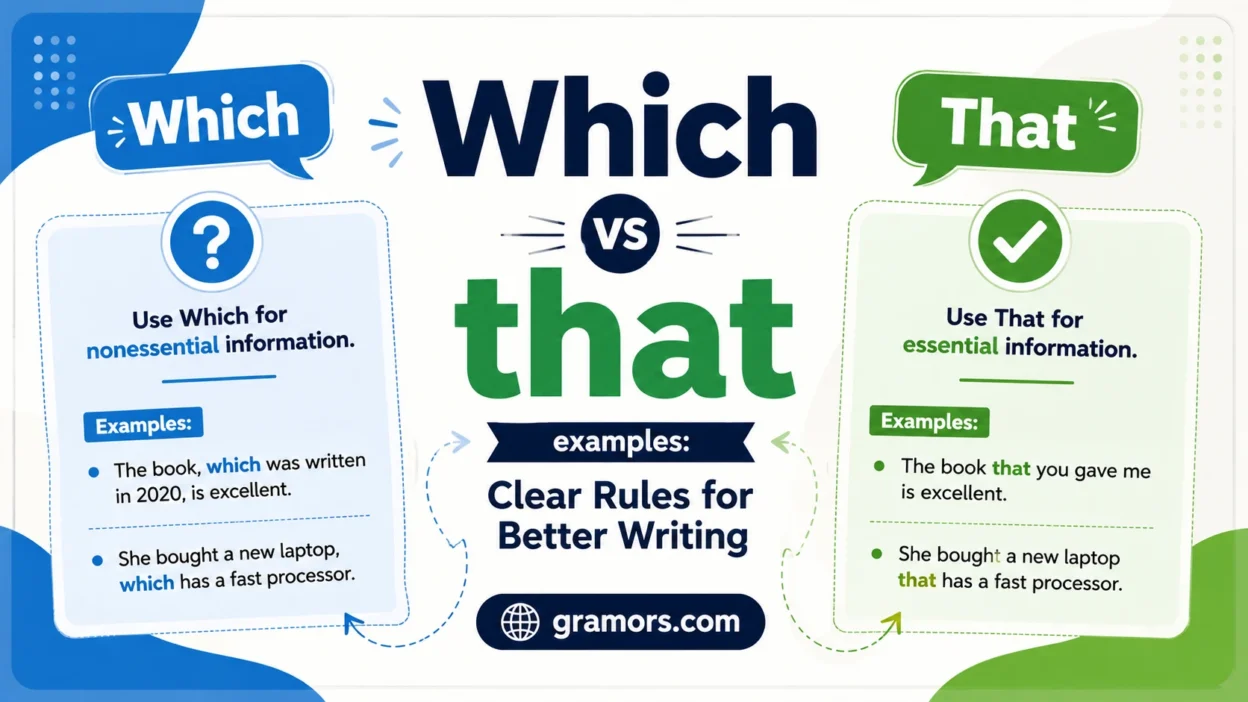
- The book that I bought is on the table.
- The book, which I bought yesterday, is excellent.
The distinction matters because it changes whether the information is essential or simply extra detail.
2. Quick Answer
Use that for information that is essential to the meaning of the sentence.
Example:
- The laptop that has the broken screen belongs to Jake.
Use which for extra information that can be removed without changing the core meaning. These clauses usually use commas.
Example:
- My laptop, which has a broken screen, still works fine.
In formal American English, this distinction is followed more consistently, although real-world usage is sometimes more flexible.
3. Why People Confuse Them
People confuse “which” and “that” because both introduce clauses and often sound natural in conversation.
Spoken English usually does not stress the difference strongly:
- The movie which we watched last night…
- The movie that we watched last night…
Both may sound acceptable in casual speech.
British English also allows more overlap, while many American editors prefer stricter separation in formal writing.
This is usually a style issue rather than a sign of “bad grammar.”
4. Key Differences At A Glance
Context | Best Choice | Why
Essential information | that | identifies the noun clearly
Extra information | which | adds nonessential detail
Clause with commas | which | signals removable information
Formal US editing | that for restrictive clauses | follows common style preference
Casual speech | either may appear | natural speech is flexible
| Feature | Which | That |
|---|---|---|
| Clause type | nonrestrictive | restrictive |
| Comma usage | usually with commas | usually without commas |
| Tone | slightly more formal in some contexts | direct and common |
| US editorial preference | limited in restrictive clauses | preferred in restrictive clauses |
5. Meaning and Usage Difference
A restrictive clause gives information that is necessary to identify the noun.
Example:
- Cars that are electric often cost more upfront.
The clause “that are electric” tells us exactly which cars we mean. Removing it changes the meaning.
A nonrestrictive clause adds extra information.
Example:
- My car, which is electric, charges overnight.
The sentence still identifies the car without the clause. The extra detail is simply additional information.
Commas matter because they show whether the information is essential or extra.
Compare:
- Employees that work remotely meet online every Friday.
- Employees, which work remotely, meet online every Friday.
The second sentence sounds awkward because the clause is identifying the employees, not adding extra information.
6. Tone, Context, and Formality
Formal American writing often follows the “that for restrictive / which for nonrestrictive” pattern closely.
Examples:
- The report that the manager requested was submitted early.
- The report, which was revised twice, was approved yesterday.
In casual conversation, many people use either word naturally:
- The restaurant which we tried was great.
- The restaurant that we tried was great.
British English tends to allow “which” more freely in restrictive clauses, though the distinction still exists.
7. Which One Should You Use?
A simple way to decide:
- Ask whether the clause is essential.
- Remove the clause mentally.
- Check whether the sentence still keeps the same identity.
If the meaning changes strongly, use that.
Example:
- The shoes that are on sale sold out quickly.
Not all shoes sold out — only the discounted ones.
If the sentence still makes sense without the clause, use which with commas.
Example:
- My shoes, which were on sale, sold out quickly online.
The sentence still identifies the shoes without the extra detail.
8. When One Choice Sounds Wrong
Some sentences sound awkward because the clause type and punctuation do not match.
Awkward:
- My phone that I bought yesterday is already broken.
Better:
- My phone, which I bought yesterday, is already broken.
Incorrect punctuation:
- The students, that arrived early, got better seats.
Correct:
- The students that arrived early got better seats.
Overly formal in casual conversation:
- The coffee shop which I visit every morning…
More natural:
- The coffee shop that I visit every morning…
9. Common Mistakes
Mistake → Fix
- Using commas with restrictive clauses
→ The car that needs repairs is mine. - Using “which” without commas in strict US formal writing
→ The car that needs repairs is mine. - Using “that” after commas
→ My car, which needs repairs, is parked outside. - Forgetting the “remove the clause” test
→ Ask whether the sentence still identifies the noun clearly.
10. Everyday Examples
School writing:
- The article that I cited was published last year.
- My textbook, which costs too much, is already outdated.
Emails:
- The file that you requested is attached.
- The file, which was updated this morning, is attached.
Workplace:
- Employees that miss the deadline must notify HR.
- The meeting, which lasted two hours, finally ended.
Conversation:
- The movie that we watched was hilarious.
- My brother’s car, which is electric, is surprisingly fast.
Media-style writing:
- The company that launched the app gained attention quickly.
- The app, which launched yesterday, already has thousands of downloads.
11. Dictionary-Style Word Details
Verb
• WHICH: Not commonly used as a verb.
• THAT: Not commonly used as a verb.
• Applicability: Rarely applies to either term.
Noun
• WHICH: Not commonly used as a noun.
• THAT: Rare noun-like usage appears in limited expressions or references.
• Applicability: Mostly not applicable.
Synonyms
• WHICH: Closest alternatives may include “that” or “who,” depending on the clause structure.
• THAT: Closest alternatives may include “which” or “who” in some relative clauses.
• Applicability: Context matters, so exact substitution is not always possible.
Example Sentences
• WHICH:
- My bike, which I bought last month, already needs repairs.
- The package, which arrived late, was damaged.
• THAT:
- The bike that needs repairs is in the garage.
- The package that arrived today is mine.
Word History
• WHICH: Comes from Old English relative pronoun forms and historically overlapped with “that” in many clauses.
• THAT: Has Germanic roots and has long served multiple grammatical functions in English.
• Applicability: Both words have shared usage history in relative clauses.
Phrases Containing
• WHICH:
- Which is why
- At which point
- Which means
• THAT:
- That is
- Now that
- So that
12. FAQs
Is “which” always incorrect without commas?
No. Real English usage sometimes allows restrictive “which,” especially outside strict American editorial styles.
Example:
- The house which overlooks the lake was sold.
Can “that” replace “which”?
Sometimes. “That” often replaces “which” in restrictive clauses.
Example:
- The laptop that I bought…
- The laptop which I bought…
Both may appear in natural usage, though American editors often prefer “that.”
Is the rule different in British English?
Yes, British English is generally more flexible with restrictive “which.”
Example:
- The team which won the match celebrated all night.
Why do editors change “which” to “that”?
Many American style guides prefer:
- “that” for essential information
- “which” for extra information with commas
This improves clarity and consistency in formal writing.
Are “which” and “that” interchangeable in speech?
Often, yes. In casual conversation, many speakers use either word naturally.
Example:
- The song that I like
- The song which I like
Both may sound acceptable in everyday speech.
13. Conclusion
The main difference in which vs that examples comes down to one idea: essential information versus extra information.
Use that when the clause identifies the noun clearly. Use which with commas when adding extra detail.
Example:
- The students that studied passed the test.
- The students, which had studied all week, felt confident.
Remember that many modern style rules are conventions rather than absolute laws. Focus on clarity, natural flow, and correct comma usage.