People often pause when writing sentences like “Who called you?” or “Whom did you invite?” because the difference between who and whom examples isn’t always obvious in everyday English.
Both words refer to people, but they serve different grammatical roles. The confusion comes from how English treats subject and object forms, especially in questions and longer sentences.
In modern American English, who is more common in casual speech, while whom still appears in formal writing and fixed expressions.
Examples:
- Who called you?
- Whom did you invite?
This guide makes the choice simple and practical so you can use both confidently.
2. Quick Answer
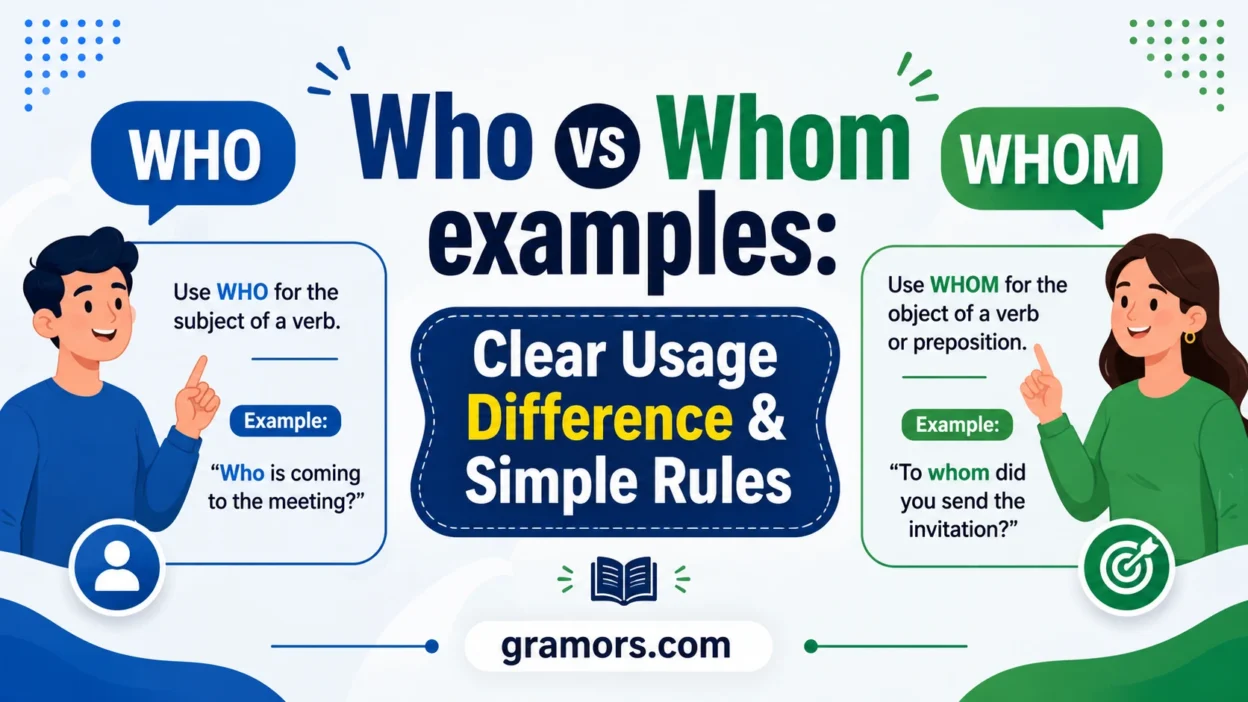
- Who = subject (the one doing the action)
- Whom = object (the one receiving the action)
Simple trick:
- Replace with he/she → who
- Replace with him/her → whom
Examples:
- He called → Who called?
- You invited him → Whom did you call?
This trick works most of the time, but complex sentences may still need careful reading.
3. Why People Confuse Them
The confusion exists because modern English often avoids “whom” in everyday speech. Many speakers naturally use “who” in both roles, especially in casual conversation.
Another issue is question structure. When sentences are flipped, it becomes harder to identify subject and object roles.
Examples:
- Who/whom do you think will win?
- The person who/whom I met yesterday
Embedded clauses also blur the rules, making it harder to decide which form fits.
4. Key Differences At A Glance
Context | Best Choice | Why
Subject of sentence | who | acts as the subject
Object of verb/preposition | whom | receives the action
Formal writing | whom | preferred in structured English
Casual speech | who | more natural in conversation
After prepositions | whom | grammatically traditional usage
| Feature | Who | Whom |
|---|---|---|
| Role | Subject | Object |
| Substitute | he/she/they | him/her/them |
| Formality | casual + formal | mostly formal |
| Usage today | very common | less common in speech |
5. Meaning and Usage Difference
Who is used when the pronoun performs the action.
Examples:
- Who wants coffee?
- Who is calling you?
Whom is used when the pronoun receives the action or follows a preposition.
Examples:
- To whom should I address the letter?
- The teacher whom we admired retired.
In questions, word order can hide the role, which is why many people default to “who.”
A key point: object position does not always make “whom” necessary in modern informal English.
6. Tone, Context, and Formality
In casual American English, “who” is often preferred even when “whom” would be traditionally correct.
Examples:
- Who are you talking to? (casual)
- To whom are you speaking? (formal)
Some fixed expressions still use “whom”:
- To whom it may concern
In professional or academic writing, “whom” can still sound precise and traditional, but it may feel overly formal in conversation.
7. Which One Should You Use?
Use who when:
- speaking casually
- writing everyday messages
- the sentence sounds natural with “he/she”
Use whom when:
- writing formal letters or essays
- after prepositions in strict grammar contexts
- you want a more formal tone
Examples:
- Email: Who should I contact about this issue?
- Academic writing: The candidate to whom the award was given…
- Conversation: Who are you meeting tonight?
8. When One Choice Sounds Wrong
Some usages sound incorrect or unnatural.
Incorrect:
- Whom is calling you?
Awkward (casual context):
- Whom are you going with?
More natural:
- Who is calling you?
- Who are you going with?
Overusing “whom” in casual speech can sound stiff or unnatural, even if it is technically correct.
9. Common Mistakes
Mistake → Fix:
- Using “whom” as subject → Who is calling?
- Overcorrecting in questions → Who are you talking to? (not “whom are you talking to” in casual speech)
- Forgetting object role → Whom did you see? (him/her test)
Quick rewrite practice:
- Wrong: Whom is there?
- Correct: Who is there?
10. Everyday Examples
Workplace:
- Who sent the report?
- Whom should I contact for approval?
School:
- Who answered the question?
- The student whom the teacher praised.
Casual:
- Who are you texting?
- Who did you meet at the mall?
Email:
- Who is responsible for this task?
- To whom it may concern
Conversation:
- Who are you waiting for?
- Whom did you see yesterday?
11. Dictionary-Style Word Details
Verb
• WHO: Not used as a verb.
• WHOM: Not used as a verb.
• Applicability: Not applicable to either term.
Noun
• WHO: Not typically a noun; functions as a pronoun.
• WHOM: Not typically a noun; functions as a pronoun.
• Applicability: Not applicable in standard usage.
Synonyms
• WHO: Closest alternatives include “the person who” in rephrased sentences.
• WHOM: Closest alternatives include “the person whom” or sentence restructuring.
• Applicability: Limited; depends on sentence rewrite.
Example Sentences
• WHO:
- Who is at the door?
- Who made this decision?
• WHOM:
- The person whom we met was kind.
- To whom did you speak?
Word History
• WHO: Comes from Old English forms used for subject pronouns referring to people.
• WHOM: Developed as the object form of “who,” preserving older case distinctions that are less common in modern speech.
• Applicability: Both share historical roots but differ in grammatical case development.
Phrases Containing
• WHO:
- Who knows
- Who cares
- Who are you
• WHOM:
- To whom it may concern
- For whom the bell tolls
12. FAQs
Is “whom” outdated in modern English?
Not completely. “Whom” is still correct, but it is used less often in everyday speech. You’ll mostly see it in formal writing, academic texts, and fixed phrases like “To whom it may concern.”
Can “who” replace “whom” in all situations?
In casual American English, yes, often it can. People regularly use “who” even when traditional grammar would prefer “whom.”
However, in formal writing, especially after prepositions, “whom” is still preferred.
Is “whom” required after prepositions?
Traditionally, yes:
- Correct: To whom are you speaking?
But in modern conversation, many native speakers say:
- Who are you talking to?
Both are understood; the second is more natural in speech.
Which one is more formal: who or whom?
“Whom” is more formal.
It is commonly used in:
- official writing
- academic essays
- professional documents
While “who” is used in both formal and informal contexts.
How do native speakers use “who” and “whom” today?
Most native speakers:
- Use “who” almost all the time in speech
- Use “whom” mainly in writing or formal situations
- Sometimes avoid “whom” completely in conversation because it sounds stiff
What is the simple trick to choose between them?
Use the he/him test:
- If “he/she” fits → use who
- If “him/her” fits → use whom
Example:
- He called → Who called?
- You invited him → Whom did you invite?
Is “whom” grammatically necessary?
Yes in strict grammar rules, especially in formal writing. But in real-life conversation, it is often optional and replaced by “who.”
Can “whomsoever” or similar words still be used?
Yes, but they are very formal or old-fashioned. You’ll mostly find them in legal or religious language, not everyday English.
12. Conclusion
The difference in who vs whom examples comes down to a simple idea: who acts, and whom receives.
In modern American English, “who” is used more often, but “whom” still matters in formal writing and structured grammar.
Use the rule, trust natural speech, and choose the form that fits your audience with confidence.