
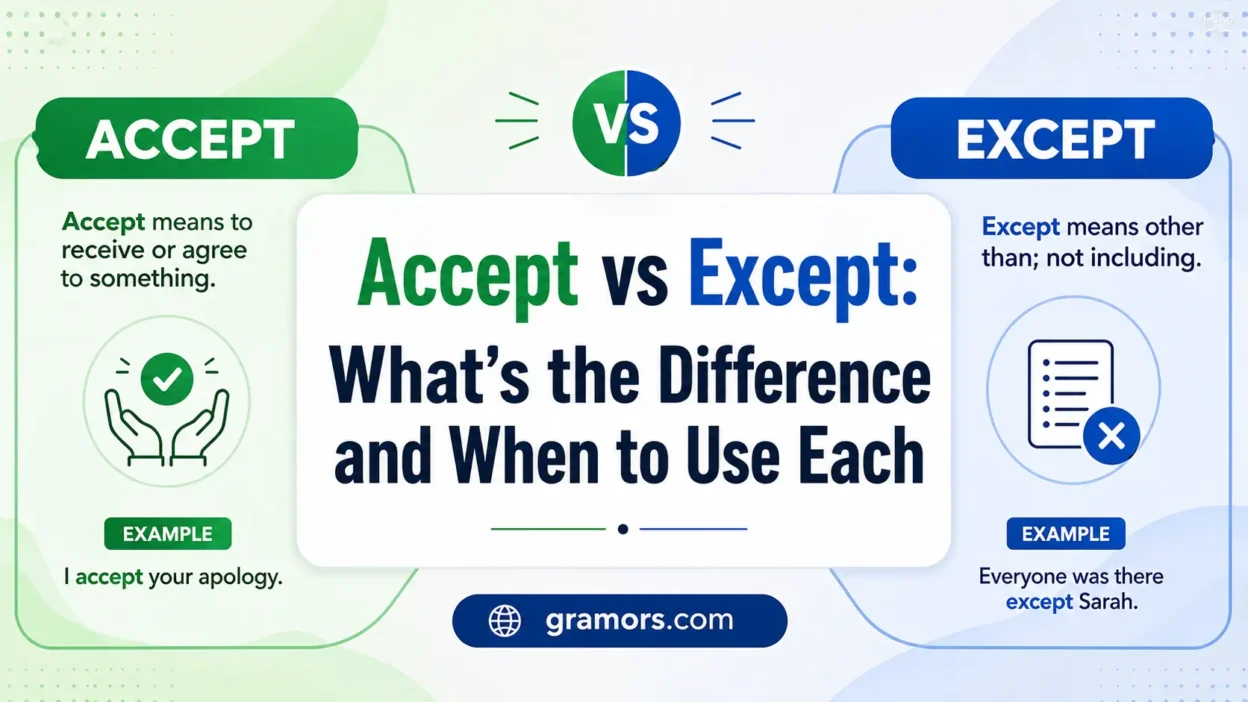
Many English learners mix up “accept” and “except” because the words sound almost the same in conversation. Their meanings, however, are very different.
“Accept” usually means to receive, agree to, or approve something. “Except” usually means to leave something out or exclude it.
Compare these examples:
- “I accept your apology.”
- “Everyone came except Mia.”
The confusion matters because switching the words changes the meaning of the sentence completely. This guide will make accept vs except easy to understand and use correctly.
Quick Answer
Use “accept” when you mean receive, agree to, approve, or recognize something.
Use “except” when you mean excluding, leaving out, or apart from something.
Examples:
- “She accepted the invitation.”
- “Everyone except Sam attended.”
A quick memory trick helps many people:
- “Except” starts with “ex,” like “exclude.”
- “Accept” is about taking something in, not leaving it out.
The words are not interchangeable, even though they sound very similar in many American accents.
Why People Confuse Them
The confusion mostly comes from pronunciation and spelling.
In fast speech, many Americans pronounce the two words almost identically. The small vowel difference often disappears in casual conversation.
Their spellings are also close:
- accept
- except
Both words appear often in emails, school writing, work documents, and conversations. That makes mistakes easy to repeat.
Learners also confuse them because the sentence structure may look similar at first glance.
Incorrect:
- “Everyone accept me.”
- “I except your apology.”
Correct:
- “Everyone except me.”
- “I accept your apology.”
Context usually reveals the correct choice more clearly than pronunciation does.
Key Differences At A Glance
| Context | Best Choice | Why |
|---|---|---|
| Receiving an offer | accept | Means agree to or receive |
| Approving an apology | accept | Shows willingness or agreement |
| Leaving one person out | except | Signals exclusion |
| Describing an exception | except | Means apart from |
| Taking responsibility | accept | Means admit or recognize |
| “Except for one issue” | except | Introduces something excluded |
Quick Comparison
- Accept: usually a verb connected to agreement or receiving
- Except: usually a preposition or conjunction connected to exclusion
- Accept responsibility = correct
- Everyone except Jake = correct
- Except can rarely appear as a formal verb
- The words are not normally interchangeable
Meaning and Usage Difference
“Accept” works as a verb in standard everyday English.
It can mean:
- receive something
- agree to something
- approve something
- recognize something as true or valid
Examples:
- “The school accepted her application.”
- “He accepted the job offer.”
- “She accepted responsibility for the mistake.”
“Except” usually introduces an exclusion.
It often works as a preposition:
- “I like all vegetables except broccoli.”
It can also work as a conjunction:
- “No one left except John.”
In formal or legal writing, “except” can rarely appear as a verb meaning exclude:
- “The contract excepts certain damages.”
That verb use exists, but it is uncommon in everyday American English.
Pronunciation can be tricky because many speakers say the words very similarly. Listening alone may not always help, so sentence meaning matters more.
Tone, Context, and Formality
Both words are standard English and appear in casual and formal writing.
“Accept” sounds natural in almost every setting:
- “Please accept my thanks.”
- “She accepted the terms.”
“Except” is also common in everyday speech:
- “Everyone went except Ryan.”
- “I eat everything except mushrooms.”
The rare verb form of “except” sounds more formal or legal:
- “Certain items are excepted from the policy.”
Most people will encounter “except” mainly as a word showing exclusion, not as a verb.
Professional writing often uses patterns like:
- “except for”
- “all except”
- “accepted by”
Which One Should You Use?
A simple question usually solves the problem:
Are you bringing something in or leaving something out?
Use “accept” for bringing in, agreeing, approving, or receiving:
- “Will you accept the award?”
- “They accepted the proposal.”
Use “except” for excluding something:
- “Everyone except the manager signed.”
- “The store is open every day except Sunday.”
Sentence structure also gives clues.
Words after “everyone,” “all,” or “everything” often use “except”:
- “Everyone except Ava arrived early.”
Invitations, apologies, offers, and responsibilities usually use “accept”:
- “She accepted the invitation.”
When One Choice Sounds Wrong
Sometimes the wrong word creates grammar problems immediately.
Incorrect:
- “I except your apology.”
Why it fails:
“Except” does not normally mean approve or receive.
Correct:
- “I accept your apology.”
Incorrect:
- “Everyone accept Jake.”
Why it fails:
The sentence needs a word showing exclusion, not agreement.
Correct:
- “Everyone except Jake.”
Incorrect:
- “She excepted the award proudly.”
Why it fails:
The sentence needs the idea of receiving or agreeing.
Correct:
- “She accepted the award proudly.”
Small spelling changes completely change the meaning.
Common Mistakes
One common mistake happens after words like “everyone” or “all.”
Wrong:
- “Everyone accept Mia.”
Correct:
- “Everyone except Mia.”
Another mistake appears with invitations or offers.
Wrong:
- “I except your invitation.”
Correct:
- “I accept your invitation.”
Some writers confuse “except” with “except for.”
Both can work, but the sentence structure changes slightly.
Examples:
- “Everyone except Ben came.”
- “The room was empty except for one chair.”
Spell-check programs may not catch these mistakes because both words are correctly spelled English words.
A quick fix:
- If the sentence means agreement or receiving, use “accept.”
- If the sentence means exclusion, use “except.”
Everyday Examples
- “The company accepted her resume yesterday.”
- “Everyone except Noah finished the project.”
- “Please accept this small gift.”
- “I drink every soda except root beer.”
- “She accepted the team captain position.”
- “All the lights worked except the kitchen light.”
- “He accepted the apology after the meeting.”
- “Nobody knew about the surprise except Lily.”
- “Our teacher accepted late homework this time.”
- “Every student except one passed the test.”
- “They accepted the new schedule without complaints.”
- “The restaurant is open daily except Monday.”
- “I accept that I made a mistake.”
- “Everyone except Chris joined the video call.”
Dictionary-Style Word Details
Verb
- Accept: Common verb meaning receive, agree to, approve, admit, or recognize.
- Except: Rare formal verb meaning exclude or leave out.
Noun
- Accept: Not commonly used as a noun in standard English.
- Except: Not commonly used as a noun in standard English.
Synonyms
- Accept: receive, approve, agree to
- Except: exclude, leave out, apart from
Example Sentences
- Accept: “She accepted the offer immediately.”
- Accept: “He accepted responsibility for the error.”
- Accept: “Please accept my apology.”
- Except: “Everyone except Ava arrived on time.”
- Except: “I like every season except winter.”
- Except: “No one spoke except the manager.”
Word History
- Accept: Comes from Latin roots connected to receiving or taking something willingly.
- Except: Comes from Latin roots connected to taking something out or excluding it.
Phrases Containing
- Accept:
- accept responsibility
- accept an offer
- accept defeat
- Except:
- except for
- present company excepted
- everyone except
FAQ
Are “accept” and “except” homophones?
They are near-homophones in many American accents because they sound very similar in fast speech.
Is “except” ever a verb?
Yes, but mainly in formal or legal writing. Most everyday uses are not verbs.
Can the words replace each other?
No. Swapping them usually creates a grammar or meaning mistake.
Which word means “excluding”?
“Except” means excluding or leaving something out.
Which word means “agree”?
“Accept” means agree to, approve, or receive something.
Conclusion
The difference between “accept” and “except” becomes much easier once you focus on meaning instead of sound.
“Accept” usually means receive, approve, or agree.
“Except” usually means exclude or leave something out.
Final comparison:
- “I accept your apology.”
- “Everyone came except Jordan.”
In accept vs except, context is the key. Once you identify whether the sentence is about inclusion or exclusion, the correct word becomes much clearer.