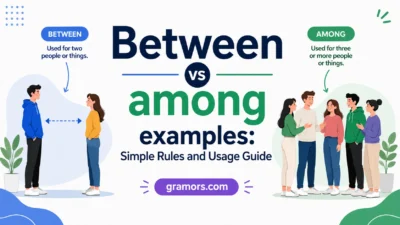
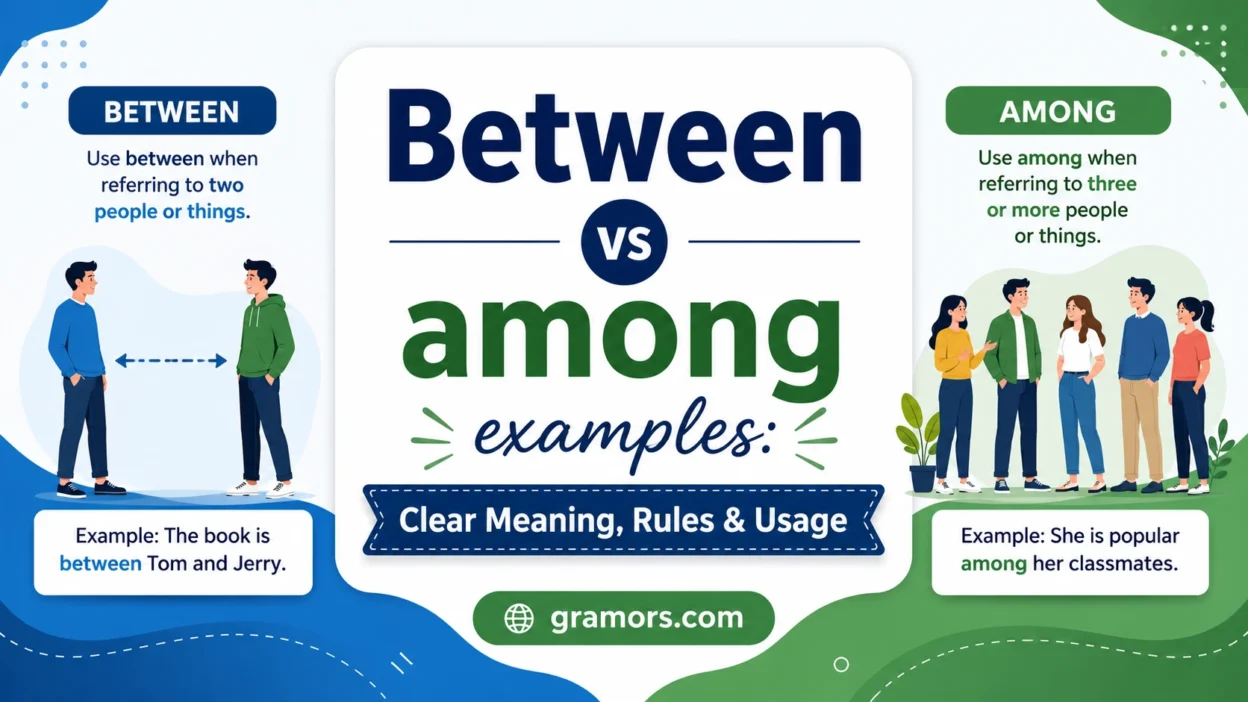
Many learners struggle with “between” and “among examples” because both words describe relationships involving more than one thing.
The old classroom rule says “between = two” and “among = more than two,” but modern English is more flexible than that.
Examples:
- between two friends
- between three departments
- among the crowd
Today, the real difference is about the type of relationship, not just the number of items.
2. Quick Answer
Use between when talking about distinct, separate relationships:
- between individuals
- between choices
- between clearly identified items
Example:
- The agreement was between five countries.
Use among when something is part of a group or collective:
- among people
- among objects in a group
- among a crowd
Example:
- The money was divided among the students.
Important note: “Between” can still correctly apply to more than two entities when each relationship is separate.
3. Why People Confuse Them
The confusion comes from school rules that simplify English into “two vs more than two,” which is not always accurate.
Both words describe relationships:
- between focuses on connections between separate items
- among focuses on a shared group environment
Examples of confusion:
- “between three people” (often taught as wrong, but commonly correct)
- “among two options” (sounds unnatural in most contexts)
Because spoken English is flexible, both words sometimes overlap in real usage.
4. Key Differences At A Glance
Context | Best Choice | Why
Separate relationships | between | focuses on individual connections
Group or collective setting | among | describes shared environment
Choices or comparisons | between | highlights distinct options
Crowds or masses | among | emphasizes inclusion in group
Distribution | among | implies sharing within group
| Feature | Between | Among |
|---|---|---|
| Focus | individual relationships | collective group |
| Usage style | comparison, choice, connection | inclusion, distribution, surroundings |
| Typical nouns | people, options, countries | crowd, group, team |
| Overlap cases | multiple parties | less common overlap |
5. Meaning and Usage Difference
Between is used when we see items as separate and distinct, even if there are more than two.
Examples:
- Choose between pizza, pasta, and salad.
- Negotiations between five countries began today.
Among is used when something is part of a larger group or distributed within it.
Examples:
- She felt comfortable among friends.
- The prize was shared among the students.
The key idea:
- between = individual connections
- among = collective environment
This is why “between three countries” is correct when discussing separate relationships between each country.
6. Tone, Context, and Formality
In formal writing like legal, academic, or diplomatic contexts, between is often used for structured agreements:
- Treaty between nations
- Agreement between companies
In social or descriptive contexts, among is more natural:
- Hidden among the trees
- Among the crowd at the concert
Both words are standard in modern English, and choice depends on meaning rather than strict formality rules.
7. Which One Should You Use?
Ask this simple question:
- Are you talking about separate relationships? → use between
- Are you talking about a group or environment? → use among
Examples:
- The decision between three job offers is difficult.
- He was standing among his classmates.
If you can clearly identify separate items, “between” is usually correct—even for more than two.
8. When One Choice Sounds Wrong
Some sentences sound unnatural because the relationship type is mismatched.
Awkward:
- Among the two options
Natural:
- Between the two options
Awkward:
- Between the crowd
Natural:
- Among the crowd
The meaning changes depending on whether we see items individually or as a group.
9. Common Mistakes
Mistake → Fix
- Among the two candidates → Between the two candidates
- Between the group of students → Among the students
- Among three choices → Between three choices (if distinct options)
- Between friends (group meaning) → Among friends
Key idea: match the word to whether items are separate or collective.
10. Everyday Examples
Workplace:
- The task was divided among team members.
- The choice between three vendors was difficult.
School:
- The prize was shared among students.
- The decision between courses is important.
Social:
- She was happy among friends.
- The secret passed between the two classmates.
Travel:
- The border agreement between countries was signed.
- He was lost among the tourists.
General:
- The debate between candidates was intense.
- Peace among nations is essential.
11. Dictionary-Style Word Details
Verb
• BETWEEN: Not commonly used as a verb.
• AMONG: Not commonly used as a verb.
• Applicability: Not commonly applicable for both.
Noun
• BETWEEN: Not commonly used as a noun in modern standard English.
• AMONG: Not commonly used as a noun.
• Applicability: Rare or not commonly applicable.
Synonyms
• BETWEEN: connecting, linking, in relation to
• AMONG: amid, surrounded by, within a group
• Applicability: Context-dependent rather than exact replacements.
Example Sentences
• BETWEEN:
- The discussion between the managers continued.
- Choose between the available options.
• AMONG:
- She stood among the guests at the party.
- The reward was divided among participants.
Word History
• BETWEEN: Old English roots linked to separation and placement “by two things,” later expanded to multiple distinct relationships.
• AMONG: Derived from Old English forms meaning “in a group” or “in company with others.”
• Applicability: Both evolved from spatial and relational meanings.
Phrases Containing
• BETWEEN:
- between you and me
- read between the lines
- caught between
• AMONG:
- among friends
- among other things
- counted among
12. FAQs
Can “between” be used for more than two things?
Yes. Modern English allows “between” for multiple items when referring to separate relationships.
Example:
- The deal is between five companies.
Is “among” always plural?
Not strictly. It usually refers to groups, but the group itself can be treated as a single collective unit.
Example:
- He was among the team.
Which sounds more formal: between or among?
Neither is more formal. The choice depends on meaning, not formality.
Why do grammar books disagree?
Because some follow traditional simplifications (“two vs more than two”), while modern usage recognizes relationship-based distinctions.
13. Conclusion
The difference in between vs among examples is not about numbers alone, but about relationships.
Use between for distinct connections and comparisons, and among for group or collective settings.
Example:
- between three options
- among friends
Modern English allows flexibility, but choosing based on meaning will always give the clearest result.