Many writers wonder whether they should use among or amongst. The good news is that the choice is usually simpler than it seems.
Both words are prepositions, and both have the same core meaning. They describe something that is surrounded by, included within, or associated with a group.
Examples:
- among friends
- amongst friends
The main difference is not meaning but style. Modern English strongly favors one form, while the other survives mostly as a stylistic alternative.
2. Quick Answer
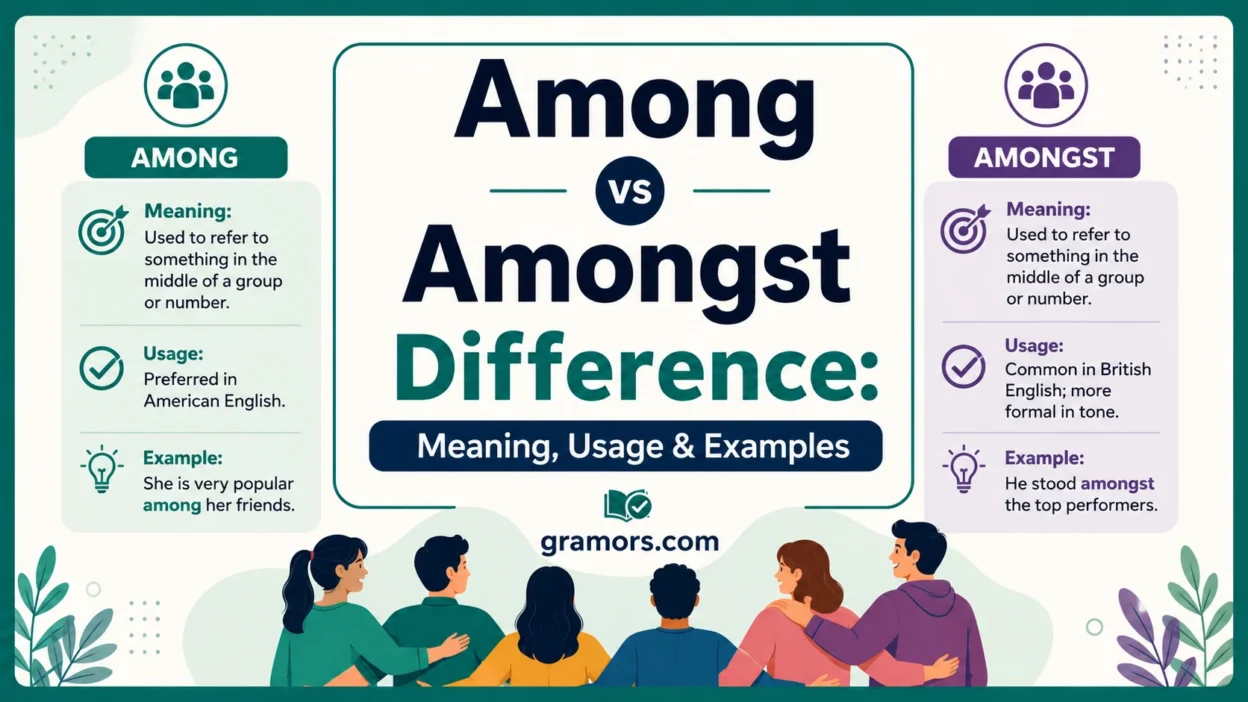
There is virtually no meaning difference between among and amongst.
Examples:
- She felt comfortable among friends.
- She felt comfortable amongst friends.
Both sentences mean the same thing.
In modern American English, among is the preferred choice in nearly all situations. Amongst is still correct, but it often sounds more formal, literary, traditional, or slightly old-fashioned.
3. Why People Confuse Them
Writers often confuse these words because they look nearly identical and share the same meaning.
Many learners assume there must be a grammar rule separating them. In reality, the distinction is mostly stylistic.
Common questions include:
- Is amongst more formal?
- Is amongst British English?
- Is among more correct?
- Can they be used interchangeably?
The confusion also comes from the history of English, where multiple word forms often survived side by side for centuries.
4. Key Differences At A Glance
| Feature | Among | Amongst |
|---|---|---|
| Meaning | Same meaning | Same meaning |
| Grammar Role | Preposition | Preposition |
| Formality | Neutral and modern | More formal or literary |
| Frequency | Very common | Less common |
| American English | Strongly preferred | Rare |
| British English | Common | Occasionally used |
| Correctness | Fully correct | Fully correct |
Quick Comparison
- Meaning: identical
- Grammar: identical
- Difference: mainly style and frequency
- Best modern default: among
- More traditional option: amongst
5. Meaning and Usage Difference
The meanings of among and amongst are effectively identical.
Both can describe:
Inclusion Within a Group
- She was among the winners.
- She was amongst the winners.
Position Within Something
- The cabin stood among the trees.
- The cabin stood amongst the trees.
Association With Others
- He felt relaxed among friends.
- He felt relaxed amongst friends.
In every example above, the meaning remains unchanged. The choice affects tone rather than grammar.
6. Tone, Context, and Formality
This is where the real difference appears.
Among
Among sounds neutral, modern, and natural.
Business example:
- The proposal was discussed among team members.
Academic example:
- The findings were shared among researchers.
Amongst
Amongst often creates a more formal or literary tone.
Literary example:
- The traveler wandered amongst the ancient ruins.
Traditional-style example:
- Peace was restored amongst the neighboring kingdoms.
The difference is a matter of style, not correctness.
7. Which One Should You Use?
For most writers, among is the safest choice.
Everyday Writing
- We discussed the issue among ourselves.
Professional Writing
- The report was distributed among department leaders.
Academic Writing
- The survey was conducted among college students.
Creative Writing
- The old castle stood quietly amongst the hills.
Practical guideline:
- Use among for everyday, business, and academic writing.
- Consider amongst when aiming for a formal, traditional, or literary effect.
8. When One Choice Sounds Wrong
Neither word is grammatically wrong, but style can make one sound less natural.
Natural in modern American English:
- The information was shared among employees.
Less natural:
- The information was shared amongst employees.
Natural in literary prose:
- The knight disappeared amongst the mist.
Less effective in highly literary writing:
- The knight disappeared among the mist.
The issue is usually style and audience expectations rather than correctness.
9. Common Mistakes
Mistake 1: Assuming They Have Different Meanings
Incorrect assumption:
- Among and amongst mean different things.
Correction:
- They have the same meaning.
Mistake 2: Thinking Amongst Is Wrong
Incorrect assumption:
- Amongst is incorrect English.
Correction:
- Amongst is fully correct English.
Mistake 3: Using Amongst Just to Sound Sophisticated
Less effective:
- The report was distributed amongst employees.
More natural:
- The report was distributed among employees.
Mistake 4: Treating the Choice as a Grammar Rule
Incorrect assumption:
- One form is grammatically required.
Correction:
- The choice is usually stylistic.
10. Everyday Examples
Conversation
- I found support among my friends.
- I found support amongst my friends.
Workplace
- The memo circulated among staff members.
- The memo circulated amongst staff members.
School Writing
- The results were shared among students.
- The results were shared amongst students.
Academic Writing
- The survey was conducted among participants.
- The survey was conducted amongst participants.
Literary Style
- The cottage stood among the trees.
- The cottage stood amongst the trees.
Casual Speech
- There was excitement among the crowd.
- There was excitement amongst the crowd.
Family Context
- The gifts were divided among the children.
- The gifts were divided amongst the children.
Community Context
- Trust grew among neighbors.
- Trust grew amongst neighbors.
Business Context
- Responsibilities were shared among departments.
- Responsibilities were shared amongst departments.
Travel Context
- The path wound among the hills.
- The path wound amongst the hills.
11. Dictionary-Style Word Details
Verb
Among
- Not commonly used as a verb.
Amongst
- Not commonly used as a verb.
Noun
Among
- Not commonly used as a noun.
Amongst
- Not commonly used as a noun.
Synonyms
Among
- amid
- amidst
- in the midst of
- surrounded by
Amongst
- amid
- amidst
- in the midst of
- surrounded by
Example Sentences
Among
- She was among the finalists.
- The idea spread among employees.
Amongst
- The traveler rested amongst the trees.
- The discussion continued amongst the guests.
Word History
Among
- Originates in Old English and is the older recorded form.
Amongst
- Developed later in Middle English through the addition of the historical “-st” ending.
Phrases Containing
Among
- among friends
- among ourselves
- among other things
Amongst
- amongst friends
- amongst ourselves
- amongst the crowd
12. FAQs
Is amongst old-fashioned?
Not exactly. It is still correct, but many readers view it as more formal, literary, or traditional than among.
Is amongst British English?
It appears somewhat more often in British-influenced writing, but among remains common in British English as well.
Is among more correct?
No. Both are correct. However, among is the preferred modern choice in most situations.
Are they interchangeable?
Yes. In most sentences, you can replace one with the other without changing meaning.
Which should students use?
Students should generally use among because it is more common in modern academic and everyday writing.
Which appears in formal writing?
Both can appear in formal writing, though amongst often creates a more traditional tone.
Which is preferred in the United States?
Among is strongly preferred in modern American English.
Can spellcheck flag amongst?
Sometimes. Certain writing tools favor among because it is more common, but amongst remains a correct word.
13. Conclusion
The among vs amongst difference is primarily about style, not meaning.
Both words are correct and interchangeable in most situations. However, among is the preferred choice in modern American English and most contemporary writing.
Example:
- She felt welcome among friends.
- She felt welcome amongst friends.
The meaning stays the same. The only real difference is the tone each word creates.