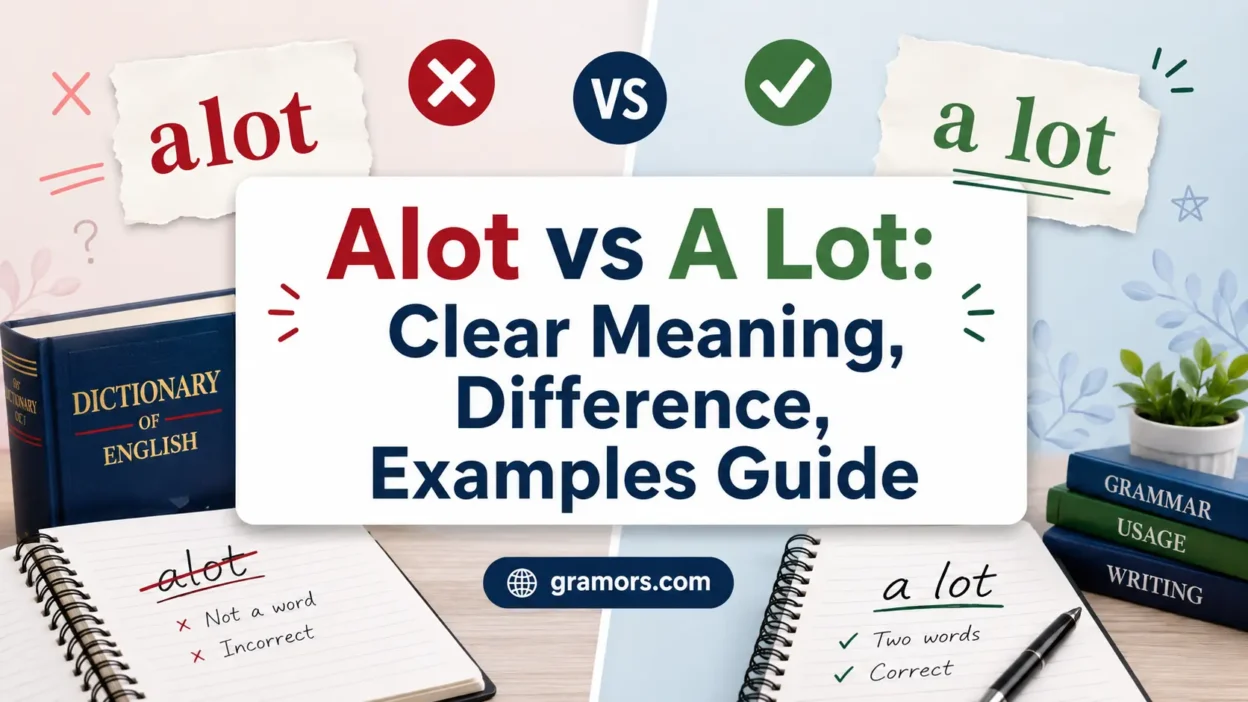
The confusion between alot vs a lot is very common. The two forms look almost identical, and the only visible difference is the space.
Still, that space matters.
A lot is the correct form in standard English. Alot is a nonstandard misspelling.
Correct: I have a lot of work today.
Incorrect: I have alot of work today.
This guide keeps the answer simple: use a lot when you mean many, much, very much, or often.
Quick Answer
A lot is correct.
Alot is not standard when you mean a lot. It should be corrected in schoolwork, emails, articles, applications, business writing, and any polished sentence.
Use a lot for quantity, degree, or frequency.
Correct: We learned a lot.
Correct: A lot of people joined.
Do not treat alot as an accepted spelling variant. It is a common nonstandard misspelling.
Why People Confuse Them
People confuse alot and a lot because the phrase is so common. In speech, we often hear it as one unit.
English also has many expressions that look like they could become one word over time. For example, readers may compare a lot with phrases like a little, a while, or a whole lot.
But a lot has not become standard as one word.
- Correct: I ate a little.
- Correct: I waited a while.
- Correct: I learned a whole lot.
- Correct: I learned a lot.
The safe rule is easy: keep the space.
Key Differences At A Glance
| Context | Best Choice | Why |
|---|---|---|
| Standard spelling | a lot | This is the accepted form. |
| Meaning “many” | a lot | Use it before plural nouns. |
| Meaning “much” | a lot | Use it for large amounts. |
| Meaning “very much” | a lot | Use it after verbs or before comparatives. |
| Meaning “often” | a lot | Use it for frequency. |
| Edited writing | a lot | Alot looks careless. |
Compact comparison:
- alot: nonstandard misspelling when you mean a lot
- a lot: correct phrase
- alot: should be fixed in standard writing
- a lot: can mean many, much, very much, or often
- alot: not a separate accepted meaning in this comparison
- a lot: works in casual and many formal sentences when used clearly
Meaning and Usage Difference
There is no real meaning difference between alot and a lot because alot is not the standard form.
The correct phrase a lot can express quantity, degree, or frequency.
For quantity, use a lot of before a noun.
Example: A lot of students passed.
For degree, use a lot to mean very much or by a large amount.
Example: This is a lot better.
For frequency, use a lot to mean often.
Example: He travels a lot.
The role of a lot changes by sentence. It can work like a quantity phrase, a degree phrase, or a frequency phrase. That is why it is better not to call it only one simple part of speech in every sentence.
Tone, Context, and Formality
A lot is natural in everyday English.
Casual: Thanks a lot.
Casual: I missed you a lot.
It can also appear in clear workplace or school writing, especially when the tone is plain and direct.
Example: We have a lot to discuss.
In more formal writing, a more exact word may sound better. Use many, much, a great deal, frequently, or a specific number when precision matters.
Casual: A lot of people responded.
More formal: Many participants responded.
Alot looks careless in edited writing. It can appear in casual typing, but that does not make it correct.
Which One Should You Use?
Use a lot every time you mean many, much, very much, or often.
- Correct: She has a lot of ideas.
- Correct: They practice a lot.
- Correct: This version is a lot clearer.
Do not use alot in standard writing.
Wrong: She has alot of ideas.
Correct: She has a lot of ideas.
Even in texting, alot is still nonstandard. Some people may understand it, but it can still look like a mistake.
When One Choice Sounds Wrong
Alot sounds wrong in schoolwork, business writing, emails, articles, job applications, and professional content.
Wrong: I learned alot from the meeting.
Better: I learned a lot from the meeting.
For a more formal tone, you can choose a stronger alternative.
More formal: I learned a great deal from the meeting.
A lot usually sounds natural, but it can be too vague when exact detail matters.
Vague: A lot of customers complained.
Clearer: More than 300 customers complained.
Do not replace a lot every time. In everyday writing, it is often perfectly fine.
Common Mistakes
Mistake: I spent alot of time on this.
Fix: I spent a lot of time on this.
Mistake: I like it alot.
Fix: I like it a lot.
Mistake: We need a lot money.
Fix: We need a lot of money.
Mistake: Alot of people came early.
Fix: A lot of people came early.
Mistake: She helped alot.
Fix: She helped a lot.
One side note: allot is a real verb meaning to assign or give out a share of something.
Example: The teacher will allot ten minutes for questions.
That word is separate from the main comparison. Do not use allot when you mean a lot.
Everyday Examples
I missed you a lot.
A lot of people ask this question.
This version is a lot clearer.
We have a lot to discuss.
She laughs a lot during that show.
A lot of students finished early.
Thanks a lot for your help.
He has a lot of experience with customer service.
The new plan saves a lot of time.
We talked a lot after the meeting.
Formal rewrite:
Casual: A lot of employees joined the training.
More formal: Many employees joined the training.
Dictionary-Style Word Details
Verb
alot: Not a standard verb.
a lot: Not a verb. It is a phrase used for quantity, degree, or frequency.
Do not confuse either form with allot, which is a real verb. That word means to assign or distribute something.
Noun
alot: Not a standard noun in this meaning.
a lot: Applies partly. It can work like a noun-like quantity expression in sentences such as That is a lot or a lot of time.
Example: That is a lot to remember.
Some references describe a lot by how it functions in a sentence, so avoid treating it as only one simple category in every use.
Synonyms
alot: No standard synonyms apply because it is not the accepted form.
a lot: Closest plain alternatives depend on meaning.
- For quantity, use many, much, numerous, or a large amount.
- For degree, use very much, greatly, or considerably.
- For frequency, use often, frequently, or regularly.
These alternatives are not perfect replacements in every sentence. Choose the one that fits the meaning.
Example Sentences
alot: Use only in wrong/correct examples.
Wrong: I have alot of homework.
Correct: I have a lot of homework.
a lot: Correct in standard writing.
- Correct: She smiles a lot.
- Correct: A lot of customers waited outside.
- Correct: This answer is a lot better.
Word History
alot: This form likely appears because writers run the common phrase together. Still, it is not standard when you mean a lot.
a lot: This phrase is formed from the article a plus lot. The space remains part of the standard spelling.
There is no need to guess that alot will become standard. For careful writing, use a lot.
Phrases Containing
alot: No standard phrases should be recommended.
a lot: Common phrases include a lot of, thanks a lot, a whole lot, quite a lot, a lot more, and a lot better.
Related informal phrase: lots of.
Example: Lots of people use that shortcut.
This is related in meaning, but it is not the same spelling issue.
FAQs
Is alot a word?
Alot is a common nonstandard misspelling of a lot.
Wrong: I learned alot.
Correct: I learned a lot.
Is a lot two words?
Yes. A lot is two words.
Correct: A lot of people arrived early.
Is a lot formal?
A lot can be acceptable in many clear sentences, but formal writing may prefer a more exact word.
Casual: A lot of people responded.
More formal: Many people responded.
Can a lot mean “often”?
Yes. A lot can mean often.
Correct: He travels a lot.
What should replace a lot in formal writing?
Use the replacement that matches your meaning.
- For quantity, use many or much.
- For degree, use greatly or considerably.
- For frequency, use often or frequently.
Example: Many participants responded.
Conclusion
The rule is simple: a lot is correct, and alot should be corrected in standard writing.
Use a lot when you mean many, much, very much, or often. Choose more formal alternatives when you need a sharper or more precise sentence.
For alot vs a lot, remember this tip: you can say a whole lot, so keep the space in a lot.