
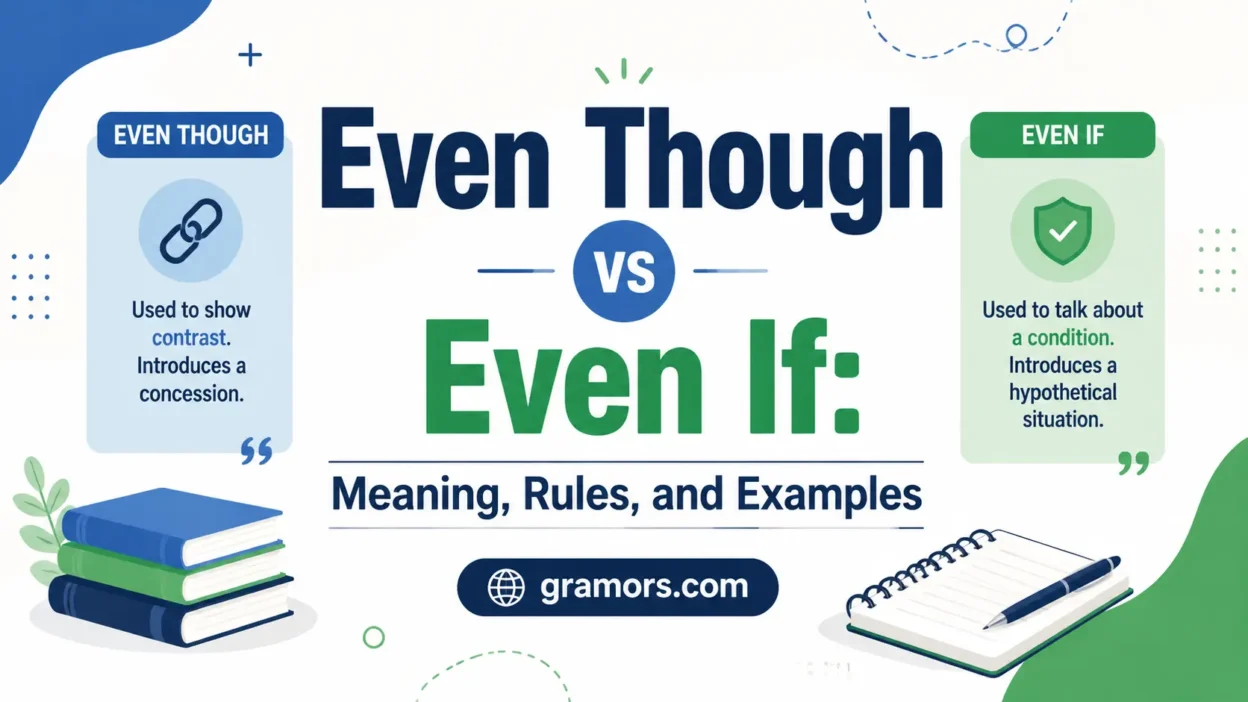
Many writers confuse even though vs even if because both phrases begin with even, both show contrast, and both can appear before a clause. Still, they do not create the same meaning.
Even though usually points to something true. Even if points to a possible, uncertain, or conditional situation.
Compare these sentences:
“Even though it is raining, we are going.”
“Even if it rains, we are going.”
The first sentence says the rain is real now. The second says rain is possible, but the plan will not change.
Quick Answer
Use even though for a real fact that contrasts with the main idea.
Example: “Even though I was tired, I finished the report.”
Use even if for a condition that may or may not happen but does not change the result.
Example: “Even if I get tired, I will finish the report.”
They are not always interchangeable. Changing the phrase can change the meaning from fact to possibility.
Why People Confuse Them
People confuse even though and even if because both phrases introduce dependent clauses. Both also show that one thing does not stop another result.
Examples:
“Even though the price is high, I bought it.”
“Even if the price is high, I’ll buy it.”
The first sentence treats the high price as a known fact. The second treats the high price as possible, uncertain, or not important to the decision.
The difference is not about American versus British English. It is also not mainly about formality. The real difference is meaning.
Key Differences At A Glance
| Context | Best Choice | Why |
|---|---|---|
| A known fact contrasts with the result | even though | It means “despite the fact that.” |
| A possible condition will not change the result | even if | It means “whether or not.” |
| The speaker knows the condition is true | even though | The contrast is based on reality. |
| The speaker is unsure or imagining a case | even if | The contrast is based on a condition. |
| The sentence looks backward at a real event | even though | It often fits known past or present facts. |
| The sentence looks ahead to a possible event | even if | It often fits future or uncertain cases. |
Meaning and Usage Difference
Even though means despite the fact that. It introduces a fact or accepted situation that contrasts with the main clause.
Examples:
“Even though he apologized, I’m still upset.”
“Even though the app crashed, I saved the file.”
“Even though traffic was bad, we arrived on time.”
In these sentences, the speaker treats the first idea as true.
Even if means whether or not. It introduces a condition that does not affect the result.
Examples:
“Even if he apologizes, I’ll still be upset.”
“Even if the app crashes, I’ll have a backup.”
“Even if traffic is bad, we’ll leave early.”
In these sentences, the condition may happen, may not happen, or may not matter. The result stays the same.
Extra comparison:
| Feature | even though | even if |
| Core meaning | despite the fact that | whether or not |
| Main use | real contrast | possible condition |
| Certainty level | known or accepted as true | possible, uncertain, or imagined |
| Example | “Even though she was nervous, she spoke clearly.” | “Even if she gets nervous, she will speak clearly.” |
Both phrases can act like subordinating conjunctions because they introduce dependent clauses.
Tone, Context, and Formality
Both even though and even if are standard in US English. You can use them in conversation, emails, school writing, and everyday explanations.
Even though often sounds like a stronger version of although. It is useful when you want to stress that a real fact did not stop something.
Example:
“Even though the meeting ran late, we finished the plan.”
Even if often sounds firmer or more decisive because it says the result will not change.
Example:
“Even if the meeting runs late, we’ll finish the plan.”
Neither phrase is automatically more formal in every sentence. The right choice depends on whether you mean a real fact or a possible condition.
Which One Should You Use?
Ask this first: Is the condition already true?
Use even though.
Examples:
“Even though I know the answer, I want to check.”
“Even though the instructions were clear, several people missed the deadline.”
“Even though she was sick yesterday, she came to work.”
Now ask: Is the condition possible, uncertain, imagined, or irrelevant to the result?
Use even if.
Examples:
“Even if I know the answer, I want to check.”
“Even if the instructions are clear, some people may still need help.”
“Even if I get sick, I’ll try to attend online.”
Changing the phrase can change the meaning. Even though presents the idea as true. Even if presents it as a condition.
When One Choice Sounds Wrong
Even though sounds wrong when the speaker does not know whether the condition is true.
Awkward: “Even though it rains tomorrow, we’ll go.”
Better: “Even if it rains tomorrow, we’ll go.”
Tomorrow’s rain is uncertain, so even if fits better.
Even if can sound wrong or change the meaning when the speaker wants to state a known fact.
Changed meaning: “Even if she is my sister, I won’t defend her.”
This means her being your sister may not matter, or the speaker is treating it like a condition.
Clear known fact: “Even though she is my sister, I won’t defend her.”
This means she really is your sister, but that fact does not change the result.
Do not judge only by tense. The real issue is certainty and meaning.
Common Mistakes
Mistake 1: using even though for an uncertain future condition.
Wrong: “Even though I win the lottery, I’ll keep working.”
Better: “Even if I win the lottery, I’ll keep working.”
Mistake 2: using even if when the fact is already known.
Changed meaning: “Even if she was sick yesterday, she came to work.”
Better if the sickness is known: “Even though she was sick yesterday, she came to work.”
Mistake 3: leaving out the clause after the phrase.
Wrong: “Even though, I finished it.”
Correct: “Even though I was tired, I finished it.”
Mistake 4: overusing both phrases when but is clearer.
Too heavy: “Even though the file was late, I still accepted it.”
Simpler: “The file was late, but I still accepted it.”
Use even though and even if when the contrast needs extra emphasis.
Everyday Examples
Work:
“Even though the client changed the deadline, we finished on time.”
“Even if the client changes the deadline, we’ll adjust the schedule.”
School:
“Even though the quiz was hard, Mia passed.”
“Mia will study tonight even if the quiz is easy.”
Weather:
“Even though it was snowing, the buses kept running.”
“We’ll drive carefully even if it starts snowing.”
Relationships:
“Even though I disagree, I respect your choice.”
“I’ll listen even if I disagree.”
Money:
“Even though the laptop was expensive, I bought it.”
“Even if the laptop is expensive, I may buy it.”
Travel:
“Even though our flight was delayed, we made the connection.”
“We’ll leave early even if our flight is delayed.”
Health:
“Even though I felt better, I stayed home.”
“Even if I feel better, I’ll rest today.”
Plans:
“Even though the restaurant was crowded, we got a table.”
“We’ll go there even if the restaurant is crowded.”
Dictionary-Style Word Details
Verb
• Even though: Not a verb. It introduces a dependent clause.
• Even if: Not a verb. It introduces a dependent clause.
Do not assign verb forms to either phrase.
Noun
• Even though: Not commonly used as a noun.
• Even if: Not commonly used as a noun.
Treat both as connecting phrases, not noun phrases.
Synonyms
• Even though: Closest plain alternatives include although, though, despite the fact that, and in spite of the fact that.
These are not perfect replacements in every sentence. Even though often adds stronger emphasis than though.
• Even if: Closest plain alternatives include whether or not, regardless of whether, no matter if, and supposing that.
These depend on sentence structure. Some replacements may sound more formal or less natural.
Example Sentences
• Even though:
“Even though the instructions were clear, several people missed the deadline.”
“She smiled even though she was nervous.”
“Even though the room was small, it felt comfortable.”
• Even if:
“Even if the instructions are clear, some people may still need help.”
“She will speak even if she gets nervous.”
“Even if the room is small, we can make it work.”
These examples show the key difference. Even though points to a fact. Even if points to a condition.
Word History
• Even though: The phrase combines even as an intensifier with though, a connector used for contrast.
• Even if: The phrase combines even as an intensifier with if, a connector used for conditions.
The history is less important than the modern meaning. In everyday writing, choose by asking whether the clause is a fact or a condition.
Phrases Containing
• Even though: Related phrases include although, though, even so, and despite the fact that.
• Even if: Related phrases include if, even when, whether or not, and no matter if.
These related phrases are not always interchangeable. Check whether your sentence needs a real contrast or a possible condition.
FAQs
Is “even though” the same as “even if”?
No. Even though points to a real fact. Even if points to a possible or conditional situation.
Example: “Even though it is raining” means it is raining. “Even if it rains” means rain is possible.
Can I use “even if” instead of “even though”?
Sometimes, but the meaning may change.
Example: “Even though she is late” treats her lateness as real. “Even if she is late” treats it as a condition.
Is “even though” formal?
No. Even though is standard in both casual and formal English.
Example: “Even though I was tired, I finished the work.”
Does “even if” always mean imaginary?
No. Even if can describe something possible, uncertain, or treated as not changing the result.
Example: “Even if the price is high, I’ll buy it.”
Can both phrases start a sentence?
Yes. Both can start a sentence.
Example: “Even though I was busy, I called back.”
Example: “Even if I’m busy, I’ll call back.”
Do I need a comma after them?
When the phrase starts the sentence, a comma usually comes after the dependent clause.
Example: “Even though it was late, we kept working.”
Example: “Even if it gets late, we’ll keep working.”
Conclusion
Use even though when the contrast is based on a real fact. Use even if when the result stays the same under a possible, uncertain, or imagined condition.
Final examples:
“Even though I disagree, I understand your point.”
“Even if I disagree, I’ll listen.”
For even though vs even if, remember this simple rule: fact takes even though; condition takes even if.


