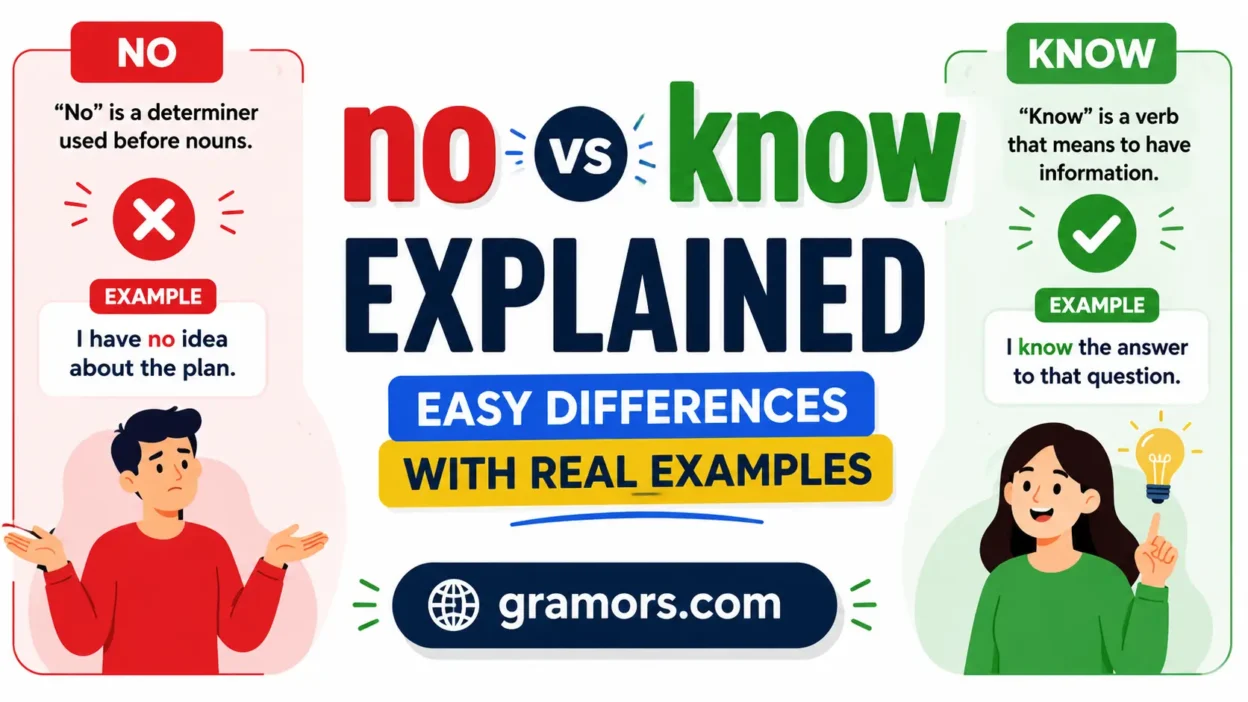
Many English learners confuse no vs know because the two words sound the same in normal speech. They are homophones, but they have completely different meanings and grammar roles.
“Know” relates to understanding, awareness, or familiarity. “No” expresses negation, refusal, absence, or zero quantity.
Examples:
- I know the answer.
- No, I do not.
The confusion is not just about spelling. These words function differently in sentences, so using the wrong one can completely change or break the meaning.
2. Quick Answer
“Know” is mainly a verb connected to knowledge or understanding.
“No” is mainly used to express negation, refusal, or absence.
Examples:
- Do you know her?
- There is no milk left.
They sound alike, but they are never interchangeable in standard English.
3. Why People Confuse Them
The biggest reason is pronunciation. In standard English, “no” and “know” are usually pronounced exactly the same.
The silent “k” in “know” also creates spelling problems, especially for learners and fast typists.
Common mistakes:
- no one → sometimes incorrectly written as “know one”
- I don’t know → incorrectly written as “I don’t no”
Autocorrect and fast texting can make these errors even more common.
4. Key Differences At A Glance
| Context | Best Choice | Why |
|---|---|---|
| Talking about understanding | know | functions as a verb |
| Expressing refusal or absence | no | functions as negation |
| Before a noun | no | determiner usage |
| After helper verbs | know | verb structure required |
Extra Comparison Block
- know → verb related to understanding or familiarity
- no → negation, refusal, or zero amount
- know usually follows subjects and helper verbs
- no commonly appears before nouns
- both are homophones but have different grammar roles
5. Meaning and Usage Difference
“Know” is a stative verb. It describes understanding, recognition, awareness, or familiarity.
Examples:
- I know where he lives.
- They know the rules.
- She knows my sister.
Because it is stative, “know” usually does not appear in continuous forms in standard English.
For example:
- ❌ I am knowing the answer.
- ✔️ I know the answer.
“No” expresses negation or absence.
Examples:
- No cars were parked outside.
- No problem.
- No students arrived.
It can function in different ways:
- determiner: no money
- interjection: No!
- noun: He gave a firm no.
6. Tone, Context, and Formality
Both words work in formal and informal English.
“Know” is neutral and common in everyday speech:
- I know what you mean.
“No” can sound direct or soft depending on wording.
Examples:
- No, thank you. (polite)
- No way! (strong emotional reaction)
- Unfortunately, no positions are available. (formal)
Tone depends more on phrasing than grammar.
7. Which One Should You Use?
Ask yourself two quick questions:
Does the sentence need a verb?
If yes, you probably need “know.”
Example:
- Do you know the answer?
Does the sentence express negation or absence?
If yes, you probably need “no.”
Example:
- No answer was given.
Grammar structure usually makes the correct choice obvious.
8. When One Choice Sounds Wrong
Some sentences fail grammatically when the wrong word is used.
Incorrect:
- I no the answer.
Correct:
- I know the answer.
Why it fails:
The sentence needs a verb, not a negative determiner.
Another example:
Incorrect:
- Know dogs allowed.
Correct:
- No dogs allowed.
Why it fails:
The phrase needs negation before the noun “dogs.”
9. Common Mistakes (and Quick Fixes)
- Mistake 1:
- ❌ know one
- ✔️ no one
- Mistake 2:
- ❌ I don’t no
- ✔️ I don’t know
- Mistake 3:
- ❌ know problem
- ✔️ no problem
- Mistake 4:
- ❌ No you the answer?
- ✔️ Know the answer? → incorrect structure
- ✔️ Do you know the answer? → correct structure
Quick fix:
- If the sentence needs action or understanding, use “know.”
- If the sentence shows absence or refusal, use “no.”
10. Everyday Examples
School:
- I know the homework rules.
- No phones during class.
Work:
- Do you know the client?
- No meetings today.
Texting:
- I don’t know yet.
- No worries.
Signs and notices:
- No entry.
- No parking.
Conversation:
- I know your brother.
- No, I have never met him.
11. Dictionary-Style Word Details
Verb
- no: not commonly used as a verb
- know: to understand, recognize, realize, or be familiar with something
Noun
- no: can mean a negative answer or refusal
- know: appears in expressions like “in the know”
Synonyms
- no: not, none, negative response
- know: understand, recognize, be aware of
Example Sentences
- no: “No excuses were accepted.”
- know: “I know the difference now.”
Word History
- no: comes from Old English roots related to negation
- know: comes from Old English roots connected to knowledge and recognition
Phrases Containing
- no: no way, no problem, no longer
- know: know better, know by heart, know the ropes
12. FAQ
Are “no” and “know” homophones?
Yes. They are usually pronounced the same in standard English.
Which word is more common?
Both are extremely common, but “no” appears very frequently in everyday conversation because it is used for negation.
Is “know” always a verb?
Mostly yes, though it can appear in fixed expressions like “in the know.”
Can “no” be a noun?
Yes. It can mean a refusal or negative answer.
Example:
- She gave a clear no.
Why is the “k” silent in “know”?
The silent “k” comes from older English pronunciation patterns that changed over time.
13. Conclusion
The difference between no vs know is simple once you focus on grammar and meaning. “Know” relates to understanding or familiarity, while “no” expresses negation or absence.
A final comparison makes it clear:
- I know the answer.
- No answer was given.
- Even though the words sound the same, their sentence roles are completely different.