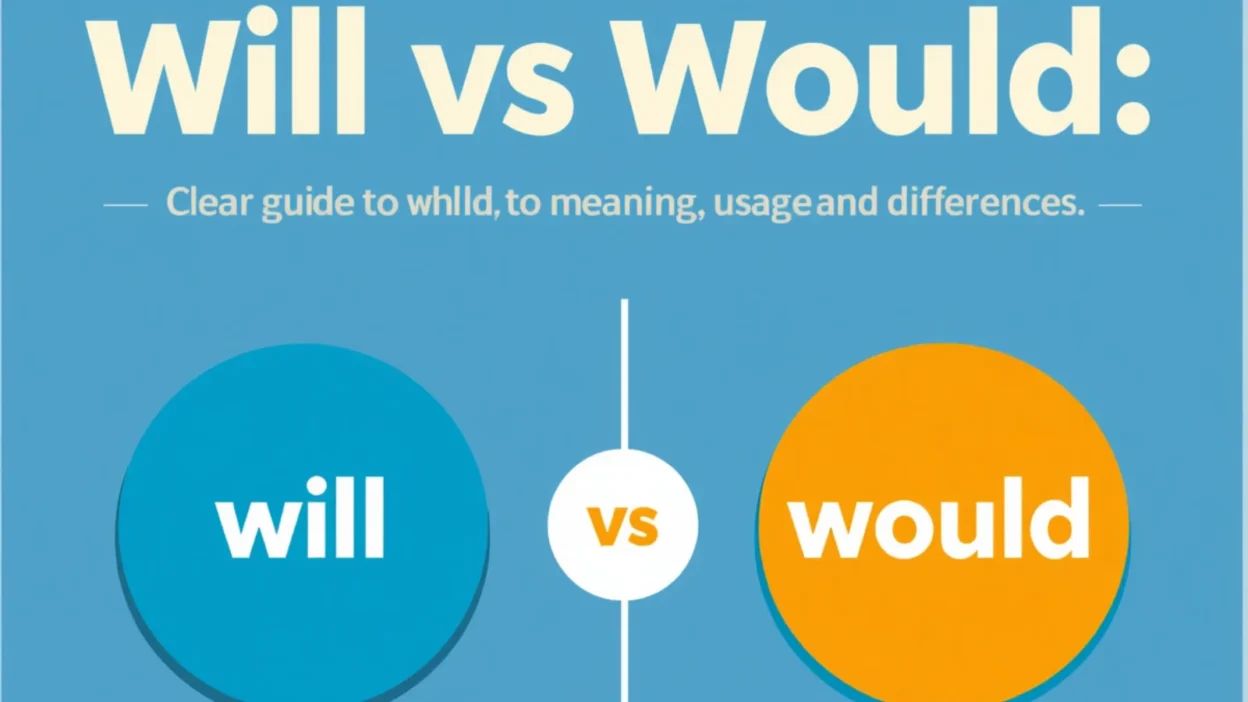
The difference between will vs would confuses many English learners because both words talk about actions, decisions, and possibilities.
At first, they look closely related. But in real usage, they behave very differently depending on time, certainty, and tone.
For example:
- I will go.
- I would go.
This guide breaks everything down so you can clearly understand when to use each one.
2. Quick Answer
- will = future certainty, decisions, promises
- would = hypothetical situations, politeness, or past/conditional meaning
They are not freely interchangeable.
Examples:
- I will call you tomorrow.
- I would call you if I had time.
Key idea: “will” is direct and certain, while “would” is softer and conditional.
3. Why People Confuse Them
Both will and would are modal verbs and come from the same verb family. That makes them structurally similar.
The confusion increases because schools often simplify “would” as just the past form of “will,” which is not fully accurate.
In real English, “would” is much broader and often has nothing to do with past time.
4. Key Differences At A Glance
| Context | Best Choice | Why |
|---|---|---|
| Future certainty | will | shows strong intention |
| Hypothetical situation | would | depends on condition |
| Polite request | would | sounds softer |
| Direct statement | will | more confident |
| Past-in-the-past | would | used in reported speech |
Quick Comparison
- will → certain, direct, planned
- would → conditional, polite, imagined
5. Meaning and Usage Difference
will is used for future actions, promises, and strong decisions.
- I will finish the work today.
- She will arrive at 6 PM.
It shows confidence or certainty.
would is used for imagined situations, polite speech, or past habits.
- I would travel if I had money.
- He said he would help.
It often removes certainty and adds conditions.
6. Tone, Context, and Formality
Tone is a big difference between these two.
will feels direct and strong:
- Will you open the door?
would feels softer and more polite:
- Would you open the door?
In everyday conversation, “would” is often used to make requests sound less demanding.
7. Which One Should You Use?
Use will when:
- You are sure about something
- You are making a decision or promise
Use would when:
- You are imagining a situation
- You want to sound polite
- You are talking about conditions
Examples:
- I will help you today.
- I would help you if I were free.
8. When One Choice Sounds Wrong
Some sentences sound unnatural when the wrong modal is used.
Wrong:
- I would go tomorrow (if you are certain)
Right:
- I will go tomorrow
Wrong:
- Will you mind helping me? (too direct in polite context)
Better:
- Would you mind helping me?
The issue is usually tone, not grammar structure.
9. Common Mistakes (and Quick Fixes)
- Mistake 1: Using “would” for definite plans
- Fix: Use will for certainty.
- Mistake 2: Using “will” in polite requests
- Fix: Use would for softer tone.
- Mistake 3: Treating “would” only as past tense
- Fix: Remember it also shows condition and politeness.
- Mistake 4: Wrong conditional structure
- Wrong: I would go tomorrow if I will have time
- Right: I would go tomorrow if I had time
10. Everyday Examples
- At home:
- I will clean my room.
- I would clean it if I had time.
- At school:
- The teacher will check homework.
- I would ask a question if I understood less.
- At work:
- We will finish the project today.
- We would finish faster with more staff.
Polite conversation:
- Will you help me?
- Would you help me, please?
11. Dictionary-Style Word Details
Verb
- will: modal verb expressing future certainty, intention, or promise
- would: modal verb expressing condition, politeness, or past-in-the-past action
Noun
- will: also used as a noun meaning a legal document (last will and testament)
- would: no common noun use
Synonyms
- will: going to, shall (closest alternatives)
- would: could, might, would like (context-dependent alternatives)
Example Sentences
- will: She will arrive soon.
- would: She would arrive if she could.
Word History
- will comes from Old English meaning desire or intention.
- would developed as a past form of “will,” later expanding into conditional and polite usage.
Phrases Containing
- will: will do, will be, will have
- would: would like, would rather, would have
FAQ
What is the main difference between will and would?
“Will” is mainly used for future certainty, decisions, and promises, while “would” is used for hypothetical situations, politeness, or conditional ideas.
Examples:
- I will call you tomorrow.
- I would call you if I had time.
Is would the past tense of will?
Historically, yes. But in modern English, “would” is also used for polite requests, imaginary situations, and conditional sentences.
Example:
- He said he would help later.
Which sounds more polite: will or would?
“Would” usually sounds softer and more polite.
Examples:
- Will you help me? → more direct
- Would you help me? → more polite
When should I use will?
Use “will” for:
- future plans
- promises
- decisions
- certainty
Examples:
- I will finish this tonight.
- She will arrive soon.
When should I use would?
Use “would” for:
- hypothetical situations
- polite requests
- imagined ideas
- conditional sentences
Examples:
- I would travel more if I had money.
- Would you like some coffee?
Can will and would be interchangeable?
Sometimes, but the meaning changes.
Examples:
- I will go tomorrow. → certain plan
- I would go tomorrow. → conditional or uncertain
They are not freely interchangeable.
Why is “I would go tomorrow” sometimes incorrect?
It sounds incomplete unless there is a condition or imagined situation.
Correct:
- I would go tomorrow if I were free.
If the action is certain, use “will” instead.
What grammar comes after will and would?
Use the base form of the verb.
Correct:
- will go
- would help
Incorrect:
- will goes
- would helped
Why do learners confuse will and would?
People confuse them because both are modal verbs from the same verb family, and both can talk about future-related ideas. The difference mainly comes from certainty, tone, and condition.
What is the easiest way to remember will vs would?
Use this quick memory trick:
- will = certain or direct
- would = conditional or polite
Examples:
- I will do it.
- I would do it if I could.
12. Conclusion
The difference between will vs would is about certainty, tone, and conditions. One expresses strong future intent, while the other softens meaning or creates hypothetical situations.
Once you focus on context instead of direct translation, choosing between them becomes much easier in everyday English.