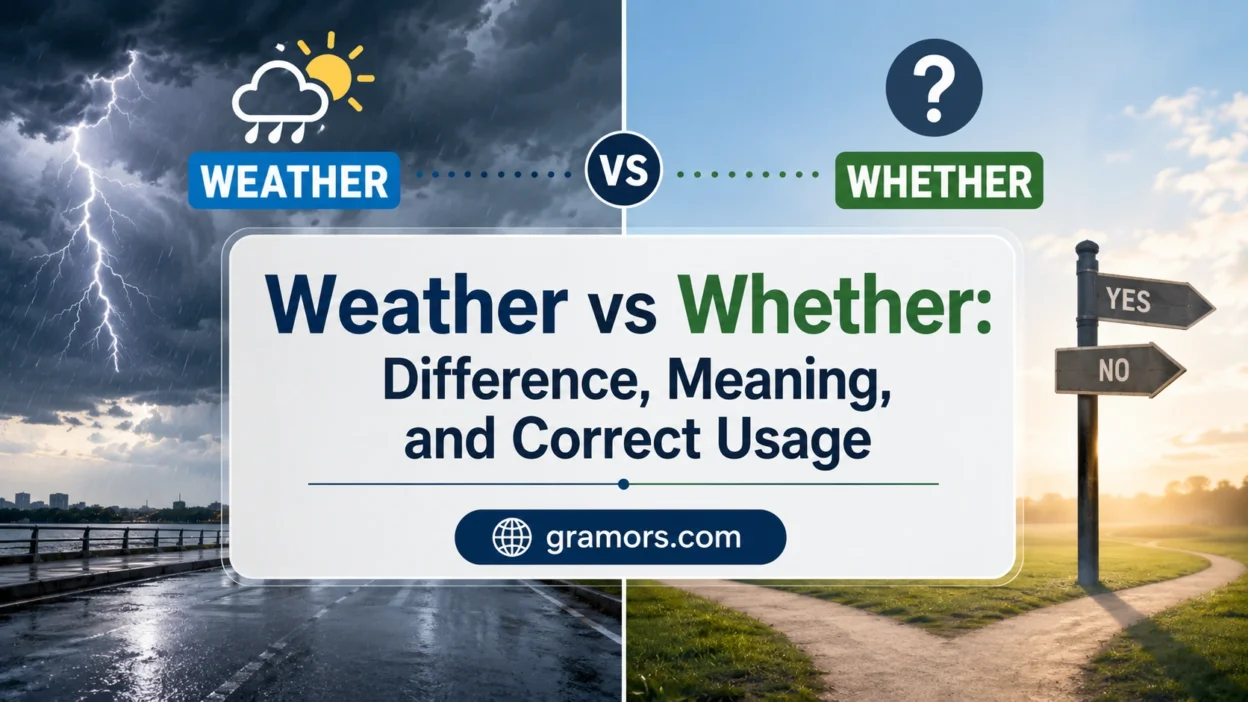
Many English learners and native speakers confuse “weather” and “whether” because the two words sound almost the same in everyday speech.
Even though their pronunciation is very similar, their meanings and grammar roles are completely different. “The weather is beautiful today” talks about atmospheric conditions, while “I don’t know whether he’s coming” introduces uncertainty or choice.
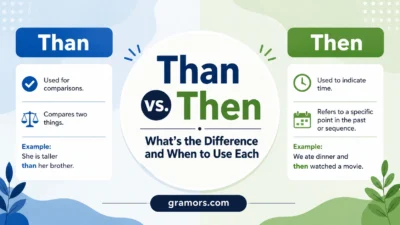
In a weather vs whether comparison, understanding the job each word performs in a sentence makes the difference much easier to remember.
Quick Answer
“Weather” usually refers to climate or atmospheric conditions like rain, heat, snow, or wind.
Examples:
- “We checked the weather forecast.”
- “The weather changed overnight.”
“Weather” can also be a verb meaning to survive or endure something difficult.
- “They weathered the financial crisis.”
“Whether” is a conjunction used to express uncertainty, alternatives, or indirect choices.
- “She wondered whether to stay.”
- “I don’t know whether he called.”
The words are not interchangeable in standard American English.
Why People Confuse Them
The biggest reason for confusion is pronunciation. In most American accents, “weather” and “whether” sound nearly identical.
The spelling pattern also adds to the problem. Both words begin with “wea/whe” and differ by only a few letters, so typing mistakes are common.
Autocorrect and fast texting can create errors like:
- incorrect: “I don’t know weather she’s ready.”
- correct: “I don’t know whether she’s ready.”
People may also hear both words spoken correctly but choose the wrong spelling when writing because the sound is so similar.
Key Differences At A Glance
| Context | Best Choice | Why |
|---|---|---|
| Talking about rain or temperature | weather | Refers to atmospheric conditions |
| Discussing uncertainty | whether | Introduces a choice or possibility |
| Describing survival during hardship | weather | Functions as a verb |
| Introducing alternatives | whether | Works as a conjunction |
| Referring to forecasts | weather | Related to climate |
| Starting an indirect yes/no question | whether | Connects clauses |
Quick Comparison Block
- Weather = climate, conditions, or enduring difficulty
- Whether = uncertainty, choice, or alternatives
- Weather can be a noun or verb
- Whether functions as a conjunction
Meaning and Usage Difference
“Weather” most commonly refers to atmospheric conditions.
Examples:
- “The weather turned cold overnight.”
- “Sunny weather is expected this weekend.”
It can also function as a verb meaning to survive or endure a difficult situation.
- “The company weathered the recession.”
- “They weathered the storm safely.”
“Whether,” however, is a conjunction. It introduces uncertainty, alternatives, or indirect questions.
Examples:
- “Whether we leave now depends on traffic.”
- “I can’t decide whether to order pizza or tacos.”
A useful distinction is sentence structure.
“Whether” connects ideas or choices:
- “She asked whether the meeting was canceled.”
“Weather” cannot introduce clauses in that way.
Incorrect:
- “Weather we stay home depends on the forecast.”
Correct:
- “Whether we stay home depends on the forecast.”
Pronunciation is another source of confusion because many speakers pronounce the two words almost identically in casual speech.
Tone, Context, and Formality
“Weather” appears naturally in everyday conversation, forecasts, news reports, and figurative writing.
Examples:
- “The weather looks terrible today.”
- “We can weather the challenges together.”
“Whether” commonly appears in both formal and neutral writing, especially in sentences involving choices or uncertainty.
- “Please confirm whether you received the package.”
You may also see structures like:
- “whether or not”
- “whether…or…”
Examples:
- “We need to decide whether or not to continue.”
- “Whether you agree or disagree, the deadline remains the same.”
Sometimes “if” can replace “whether,” but not always.
Natural:
- “I don’t know whether she’s coming.”
- “I don’t know if she’s coming.”
Less natural or incorrect in some formal structures:
- “The issue is whether we can afford it.”
- not: “The issue is if we can afford it.”
Which One Should You Use?
A simple clue can usually solve the problem quickly.
Use “weather” if the sentence involves:
- climate
- storms
- temperature
- forecasts
- enduring difficulty
Examples:
- “The weather app says it will rain.”
- “They weathered the crisis.”
Use “whether” if the sentence involves:
- uncertainty
- alternatives
- choices
- indirect yes/no questions
Examples:
- “I’m not sure whether she agreed.”
- “Whether we travel depends on the budget.”
A quick substitution trick also helps.
If you can replace the word with:
- “climate”
- “conditions”
- “survive”
then “weather” is probably correct.
If you can replace it with:
- “if”
- “whether or not”
- “which choice”
then “whether” is usually correct.
When One Choice Sounds Wrong
Some substitutions immediately break the sentence.
Incorrect:
- “I don’t know weather she called.”
Correct:
- “I don’t know whether she called.”
Why? Because the sentence introduces uncertainty.
Incorrect:
- “The whether is terrible today.”
Correct:
- “The weather is terrible today.”
Why? Because the sentence refers to atmospheric conditions.
Incorrect:
- “They whethered the crisis.”
Correct:
- “They weathered the crisis.”
Here, the sentence needs the verb form connected to endurance.
These mistakes are common in writing because the words sound so similar when spoken aloud.
Common Mistakes
Writers often make the same few errors repeatedly.
- Incorrect: “Check the whether forecast.”
Correct: “Check the weather forecast.” - Incorrect: “I’m unsure weather he replied.”
Correct: “I’m unsure whether he replied.” - Incorrect: “They survived because they whethered the storm.”
Correct: “They survived because they weathered the storm.” - Incorrect: “Weather or not we go depends on traffic.”
Correct: “Whether or not we go depends on traffic.”
Many of these are typing or proofreading mistakes rather than misunderstanding the meaning completely.
One helpful memory clue:
- “Weather” relates to the outside world and conditions.
- “Whether” relates to choices and uncertainty.
Everyday Examples
Travel:
- “The weather delayed our flight.”
- “We still haven’t decided whether to travel next month.”
School:
- “Students checked the weather before the field trip.”
- “The teacher asked whether everyone finished the assignment.”
Work:
- “The company weathered a difficult year.”
- “Management discussed whether to expand the office.”
Daily conversation:
- “The weather feels amazing today.”
- “I can’t tell whether he’s joking.”
Forecasts:
- “The weather forecast predicts snow.”
- “We’re unsure whether the game will be canceled.”
Decision-making:
- “Whether we leave early depends on traffic.”
- “The hikers weathered the heavy rain.”
Dictionary-Style Word Details
Verb
- Weather: Fully applies. As a verb, “weather” means to survive, endure, or come safely through something difficult.
- “They weathered the storm.”
- “The business weathered the downturn.”
- Whether: Not used as a verb in standard American English.
Noun
- Weather: Commonly used as a noun referring to atmospheric conditions.
- “The weather is humid today.”
- Whether: Not commonly used as a noun.
Synonyms
- Weather: Closest plain alternatives depend on context:
- “climate”
- “conditions”
- “forecast”
- Whether: Partial alternatives include:
- “if” in some sentence structures
These alternatives are not interchangeable in every situation.
Example Sentences
- Weather:
- “Cold weather moved into the region overnight.”
- “They weathered the financial crisis successfully.”
- Whether:
- “She asked whether dinner was ready.”
- “Whether we stay or leave is your decision.”
Word History
- Weather: Comes from older English roots connected to air, wind, and seasonal conditions.
- Whether: Comes from older English forms connected to choice or selecting between possibilities.
The historical details are less important than understanding their modern grammar roles.
Phrases Containing
- Weather:
- “weather forecast”
- “under the weather”
- “weather the storm”
- Whether:
- “whether or not”
- “whether…or…”
These phrases are fixed expressions and normally keep the same spelling.
Conclusion
The difference between “weather” and “whether” is straightforward once you focus on meaning and grammar role.
“Weather” relates to climate, conditions, or surviving difficulty:
- “The weather improved by noon.”
“Whether” introduces uncertainty or alternatives:
- “I don’t know whether we should leave now.”
Their similar pronunciation causes confusion, but context usually reveals the correct choice immediately. In weather vs whether usage, checking whether the sentence discusses conditions or uncertainty is the fastest way to choose correctly.