Many people mix up “loose” and “lose” because the words look similar and are easy to mistype in fast writing. Even though they differ by just one extra “o,” their meanings are completely different.
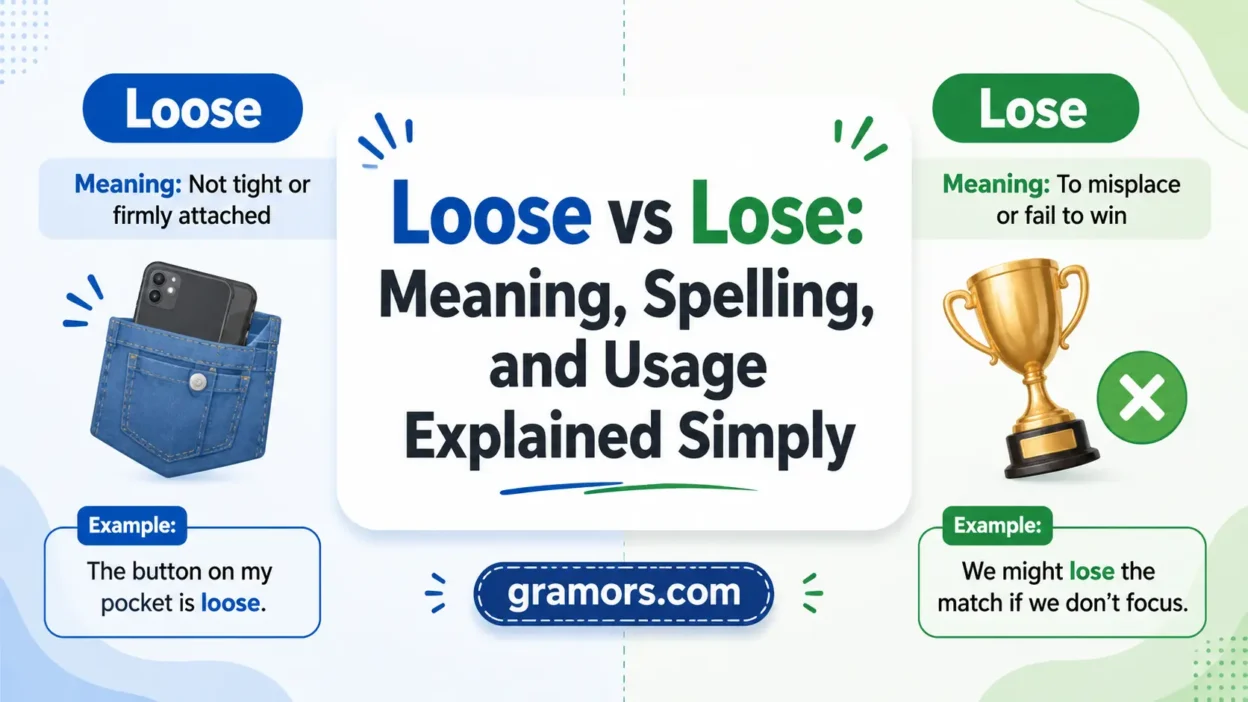
“Loose” usually describes something not tight or not firmly attached. “Lose” usually means to no longer have something, fail to keep something, or fail to win.
For example:
- “I don’t want to lose my keys.”
- “These shoes feel loose.”
The confusion is common in texting, school writing, and everyday communication, but using the correct word is important because the meaning changes completely.
Quick Answer
“Loose” describes something that is not tight, fixed, or firmly held.
“Lose” means to misplace something, fail to keep it, or not win.
One is mainly an adjective, and the other is mainly a verb.
Examples:
- “The bolt is loose.”
- “They might lose the game.”
A small spelling change completely changes the meaning.
Note: “loose” can rarely be used as a verb in older or formal contexts (like “loose the horses”), but this is uncommon today.
Why People Confuse Them
The confusion happens for a few simple reasons.
First, the spelling is very close. One extra “o” separates them:
- loose
- lose
Second, they can sound similar in fast speech, especially when unstressed in sentences.
Third, typing quickly often leads to errors, especially with common phrases like “lose weight,” where “loose” is a frequent mistake.
Common mistakes include:
- “I need to loose weight.”
- “Don’t loose the match.”
Correct versions:
- “I need to lose weight.”
- “Don’t lose the match.”
Fast reading also adds confusion because the eye can easily skip the second “o.”
Key Differences At A Glance
| Context | Best Choice | Why |
|---|---|---|
| Not tight clothing or objects | loose | Describes something slack or free |
| Losing a game or item | lose | Means failing or misplacing |
| Weight loss | lose | Correct verb for reduction |
| Loose screw or wire | loose | Not firmly attached |
| Emotional control | lose | Means failing to maintain control |
| Incorrect spelling “loose weight” | lose | “Lose” is the correct verb |
Quick Comparison
| Feature | loose | lose |
|---|---|---|
| Meaning | Not tight, free, relaxed | Fail to keep, misplace, not win |
| Part of speech | Adjective (mostly) | Verb (mostly) |
| Pronunciation | “loos” | “looz” |
| Common context | Clothing, objects, condition | Actions, outcomes, loss |
| Interchangeable? | No | No |
Meaning and Usage Difference
“Loose” mainly describes something that is not tightly fixed or controlled.
Examples:
- “A loose wire can be dangerous.”
- “Her hair was loose after the run.”
- “The dog got loose from the yard.”
It can also appear in figurative phrases:
- “That’s a loose interpretation of the rule.”
“Lose” describes an action where something is no longer kept, owned, or won.
Examples:
- “You might lose your phone.”
- “The team could lose the match.”
- “Don’t lose focus during the test.”
It is also used in emotional or abstract contexts:
- “Try not to lose your temper.”
- “He didn’t want to lose confidence.”
Rare note: “loose” can appear as a verb in older or literary language meaning “to release,” as in “They loosed the arrows,” but this is not common in everyday American English.
Tone, Context, and Formality
Both words are standard in everyday English, but they appear in different contexts.
“Loose” is often used in:
- physical descriptions
- clothing and objects
- technical or mechanical writing
- figurative language like “loose ends”
Examples:
- “The handle is loose.”
- “We need to fix loose connections.”
“Lose” appears in:
- sports and competition
- emotional or mental states
- daily life actions
- work and academic writing
Examples:
- “They might lose the contract.”
- “Don’t lose track of time.”
Neither word is more formal than the other. The difference depends on meaning, not style.
Which One Should You Use?
A simple way to choose is to ask what the sentence is talking about.
If it describes something not tight or not firmly attached, use “loose.”
If it describes losing, failing, or not having something anymore, use “lose.”
Examples:
- If it’s about fit → “loose”
- If it’s about loss → “lose”
Quick checks:
- “Am I talking about something slipping or not tight?” → loose
- “Am I talking about failing or losing something?” → lose
This works better than memorizing spelling alone.
When One Choice Sounds Wrong
Incorrect usage becomes obvious because the meaning breaks instantly.
Incorrect:
- “I need to loose weight.”
This is wrong because “loose” is not the correct verb for losing weight.
Correct:
- “I need to lose weight.”
Incorrect:
- “My pants might lose.”
This fails because pants cannot “lose” on their own.
Correct:
- “My pants feel loose.”
The wrong choice either changes the meaning or removes clarity completely.
Common Mistakes
Mistake:
- “Don’t loose the game.”
Fix:
- “Don’t lose the game.”
Mistake:
- “Loose weight quickly.”
Fix:
- “Lose weight quickly.”
Mistake:
- “A lose screw caused the issue.”
Fix:
- “A loose screw caused the issue.”
A helpful reminder:
- loose = not tight
- lose = to lose something
Spellcheck often misses context errors, so relying only on it can be risky.
Everyday Examples
- “The door handle is loose.”
- “Try not to lose your keys again.”
- “His jacket feels loose around the shoulders.”
- “They could lose the championship.”
- “The wire became loose after the move.”
- “She didn’t want to lose her place in line.”
- “Loose clothing is comfortable in summer.”
- “He might lose his phone on the trip.”
- “The bolt is loose and needs fixing.”
- “Don’t lose your temper during the meeting.”
- “The dog got loose in the park.”
- “We can’t afford to lose this opportunity.”
Dictionary-Style Word Details
Verb
- loose: rarely used as a verb in modern American English; can mean to release or set free (literary or formal usage)
- lose: to fail to keep, misplace, not win, or become deprived of something
Examples:
- “They loosed the horses into the field.”
- “You might lose your wallet.”
Noun
- loose: not commonly used as a noun in modern American English
- lose: not commonly used as a noun in standard usage
Synonyms
- loose: relaxed, slack, unsecured, free
- lose: misplace, forfeit, fail, surrender
Example Sentences
- loose: “The bolt is loose and needs tightening.”
- loose: “Her hair fell loose over her shoulders.”
- lose: “Don’t lose your phone again.”
- lose: “The team could lose the match.”
Word History
- loose: comes from Germanic roots meaning free or unbound
- lose: comes from ancient roots meaning to destroy, separate, or be deprived of something
Both words developed separately, even though their spelling became similar over time.
Phrases Containing
- loose: “loose ends,” “on the loose,” “loose change”
- lose: “lose control,” “lose track,” “lose face,” “lose touch”
FAQs
Why do people confuse loose and lose?
Because they are spelled almost the same and can sound similar in fast speech.
Which one means not tight?
“Loose” means not tight.
Example: “The shirt is loose.”
What does lose mean?
“Lose” means to no longer have something or fail to win.
Example: “Don’t lose your keys.”
Can “loose” be a verb?
Rarely. It can mean “to release,” but this is uncommon today.
Is it lose weight or loose weight?
Correct: “lose weight.”
Are they pronounced differently?
Yes. “Loose” sounds like “loos,” while “lose” sounds like “looz.”
Conclusion
The difference between loose vs lose is simple once you focus on meaning.
“Loose” describes something not tight or not firmly held. “Lose” describes failing, misplacing, or not keeping something.
Final contrast:
- “The shirt is loose.”
- “Don’t lose your shirt.”
When you focus on meaning instead of spelling alone, choosing the correct word becomes much easier.