People often get confused about meet vs met because both words describe the same action—coming into contact with someone. The problem is not the meaning, but the time.
You might hear sentences like “I meet him yesterday” or “I met him today,” and both feel close, but only one is correct depending on timing.
This guide makes the difference clear so you can use “meet” and “met” without mixing tenses in real conversation or writing.
2. Quick Answer
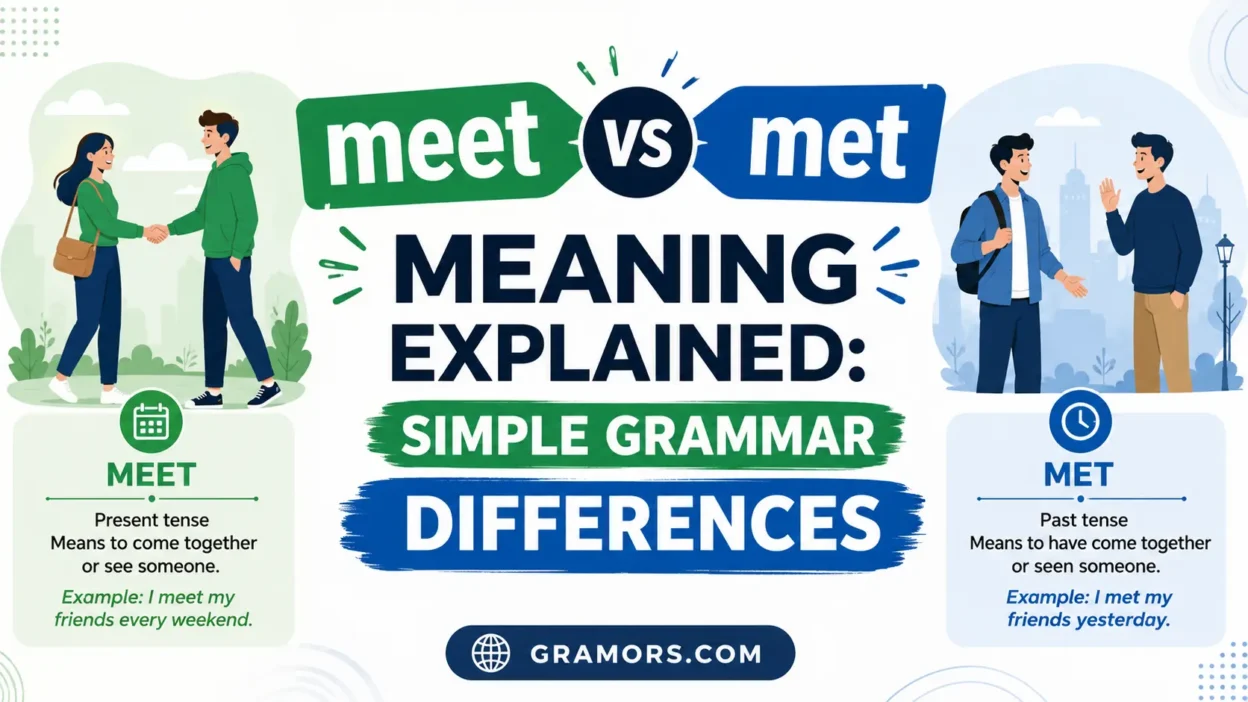
“Meet” is the base form of the verb. It is used for present, future, or regular actions.
“Met” is the past tense and past participle of “meet.” It is used for completed actions in the past.
They are not interchangeable.
Examples:
- We meet every Monday.
- We met last Monday.
The rule is simple: meet = now or routine, met = already happened.
3. Why People Confuse Them
The confusion happens because “meet” and “met” describe the same action but appear in different time frames.
Another reason is irregular verb structure. Instead of adding “-ed,” the word completely changes form.
People also mix tenses in fast speech or writing, especially when telling stories.
For example:
- ❌ I meet him yesterday
- ✔️ I met him yesterday
4. Key Differences At A Glance
Comparison Table
| Context | Best Choice | Why |
|---|---|---|
| Talking about daily routine | meet | describes repeated action |
| Talking about past event | met | shows completed action |
| Describing scheduled plans | meet | future or present context |
| Recounting finished interaction | met | past tense required |
Extra Comparison Block
- meet → present / future / repeated actions
- met → past completed actions
- Both refer to the same action but different time frames
- “meet” can stand alone in general statements
- “met” always connects to something already finished
5. Meaning and Usage Difference
“Meet” is the base verb form. It describes an action happening now, regularly, or in the future.
“Met” is the past and past participle form. It describes something that already happened.
Examples:
- I meet my teacher every week.
- I met my teacher last week.
Important note: “met” is also used in perfect tenses like “I have met him before.”
6. Tone, Context, and Formality
Both “meet” and “met” are neutral in tone. They work in casual speech, school writing, emails, and formal situations.
The difference is not tone but time accuracy.
In a business email:
- We meet clients every Friday.
- We met the client yesterday.
In conversation:
- I meet my friends after school.
- I met my friend at the station.
7. Which One Should You Use?
The easiest way to choose is to check the time reference.
Use meet when:
- talking about habits
- describing future plans
- stating general truth
Use met when:
- talking about finished actions
- describing past meetings
Examples:
- We meet the manager every month.
- We met the manager last month.
Never choose based on sound—always check time first.
8. When One Choice Sounds Wrong
Some sentences sound wrong because the verb does not match the time.
Wrong:
- I meet her yesterday.
- I met her tomorrow.
Correct:
- I met her yesterday.
- I will meet her tomorrow.
Another common mistake:
- Wrong: I meet you last week
- Correct: I met you last week
The key issue is always tense alignment.
9. Common Mistakes
- Mistake 1: Using “meet” in past time
- ❌ I meet him yesterday
- ✔️ I met him yesterday
- Mistake 2: Forgetting irregular form
- ❌ I meet him last year
- ✔️ I met him last year
- Mistake 3: Mixing tenses in one sentence
- ❌ We meet him and talked yesterday
- ✔️ We met him and talked yesterday
Quick fix rule: match the verb form to the timeline.
10. Everyday Examples
School:
- We meet our teacher every morning.
- We met our teacher on Monday.
Work:
- I meet my team weekly.
- I met my team yesterday.
Travel:
- I meet new people when I travel.
- I met new people in New York.
Social life:
- We meet friends on weekends.
- We met friends at the café.
11. Dictionary-Style Word Details
Verb
- meet: base form used for present, future, and habits
- met: past and past participle form used for completed actions
Noun
- meet: can mean a sports meeting or event (e.g., “track meet”)
- met: not used as a noun in this meaning
Synonyms
- meet: encounter, come across (context-based)
- met: encountered, saw (past context only)
Example Sentences
- meet: “I meet new students every year.”
- met: “I met new students last year.”
Word History
- meet: Old English origin meaning to come together
- met: developed as the irregular past form of “meet”
Phrases Containing
- meet: meet up, meet with, meet again
- met: have met, had met
12. Conclusion
The difference between meet vs met is only about time, not meaning. “Meet” is used for present or future actions, while “met” is used for completed past actions.
Once you connect each verb to its correct time frame, you avoid common mistakes and speak more naturally in English.