The confusion between say vs tell is common because both verbs involve reporting speech or sharing information. At first glance, they look similar, but they behave differently in English grammar.
The main difference is not just meaning—it is structure. One focuses on the words spoken, while the other focuses on the person receiving the information.
For example:
- “He said hello.”
- “He told me hello.” (less natural in standard usage)
Understanding this difference helps you avoid common mistakes in everyday English.
2. Quick Answer
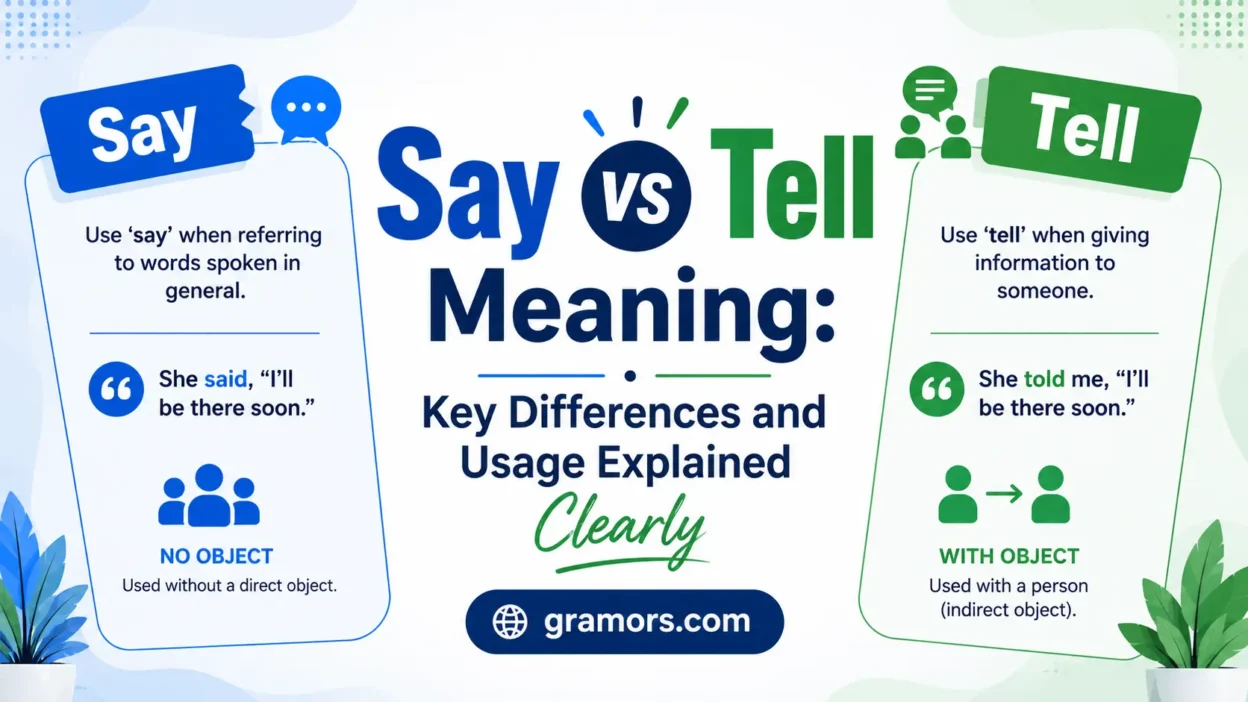
“Say” focuses on the words themselves.
“Tell” focuses on who receives the information.
They are not interchangeable because their grammar patterns are different.
Examples:
- “She said yes.”
- “She told me yes.”
Key rule:
- Say = words
- Tell = person + information
3. Why People Confuse Them
People confuse say and tell because both describe speech and often appear in similar situations.
The biggest issue is that learners try to translate directly from their native language, where this distinction may not exist.
Common error:
- “He say me something.” ❌
In real usage, confusion increases when reporting speech or giving instructions because both verbs can appear in similar contexts.
4. Key Differences At A Glance
| Context | Best Choice | Why |
|---|---|---|
| Focus on words spoken | Say | Emphasis is on what is said |
| Focus on listener | Tell | Requires a person receiving info |
| Direct speech | Say | Used for quoting exact words |
| Instruction/information | Tell | Used for giving guidance or facts |
Extra Comparison
| Feature | Say | Tell |
|---|---|---|
| Object needed | Not always | Always needs a person object |
| Focus | Words spoken | Information transfer |
5. Meaning and Usage Difference
Say is used when focusing on the actual words someone speaks.
Example: “She said she was tired.”
Tell is used when information is directed to someone.
Example: “She told me she was tired.”
Both can appear in similar meanings, but the structure changes:
- “He said he was busy.”
- “He told me he was busy.”
The key difference is whether the listener is directly mentioned.
6. Tone, Context, and Formality
Both verbs are neutral and used in everyday American English.
Typical patterns:
- “He said ‘wait here’.” (reporting speech)
- “He told me to wait.” (instruction or direction)
- “She said goodbye.” (simple statement)
- “He told us a story.” (information sharing)
The choice depends more on grammar structure than tone or formality.
7. Which One Should You Use?
Use this simple check:
- If you mention a person → use tell
- If you focus on words only → use say
Examples:
- “Tell me the truth.”
- “Say something funny.”
But remember: some fixed phrases break simple patterns.
8. When One Choice Sounds Wrong
Some sentences sound incorrect because they break grammar structure rules.
Wrong: “He say me the truth.”
Correct: “He told me the truth.”
Wrong: “She told that she was late.”
Correct: “She said that she was late.”
The problem is usually missing or misplaced objects.
9. Common Mistakes (and Quick Fixes)
Mistake → Correction:
- “He said me hello.” → “He said hello.” or “He said hello to me.”
- “She told that story.” → “She told me that story.”
- “Say me something.” → “Tell me something.”
Most errors come from forgetting that tell needs a person object.
10. Everyday Examples
- “She said she was busy.”
- “He told me the news.”
- “They said goodbye and left.”
- “She told us to wait outside.”
- “He said nothing.”
- “She told her friend everything.”
- “I said I would come.”
- “He told me to call back later.”
- “They said it was true.”
- “She told him the truth.”
- “He said ‘thank you.’”
- “She told the teacher the answer.”
- “He said he was tired.”
- “They told us the plan.”
- “She said hello to everyone.”
11. Dictionary-Style Word Details
Verb
- say: focuses on spoken words; may not require a direct object
- tell: always requires a person object and focuses on information delivery
Noun
- say: rare noun use (e.g., “have a say”)
- tell: very limited noun use in modern English; mainly functions as a verb
Synonyms
- say: speak, state, mention (closest alternatives)
- tell: inform, notify, instruct (context-based alternatives)
Note: these are not perfect replacements in all cases.
Example Sentences
- say: “He said nothing during the meeting.”
- tell: “She told me the truth about it.”
Word History
- say: originates from Old English, linked to expressing speech
- tell: also from Old English, originally meaning to recount or inform
These origins do not change modern usage rules.
Phrases Containing
- say: say hello, say again, say sorry
- tell: tell the truth, tell a story, tell someone
12. FAQ
Can I say “tell me” or “say me”?
“Tell me” is correct. “Say me” is incorrect in standard English.
Why do we say “tell a story” but not “say a story”?
Because “tell” focuses on delivering information, while “say” focuses on individual words.
Can say and tell be interchangeable?
No. Grammar structure prevents full interchangeability.
Is “say to someone” correct?
Yes, but “tell someone” is more natural.
13. Conclusion
The difference between say vs tell is mainly about structure and focus. “Say” highlights the words spoken, while “tell” focuses on the person receiving information.
Once you remember this simple rule, choosing the correct verb becomes much easier in everyday English.
Example:
- “She said she was fine.”
- “She told me she was fine.”