Many English speakers mix up “passed” and “past” because they sound almost the same. The confusion shows up in school papers, emails, text messages, and even professional writing.
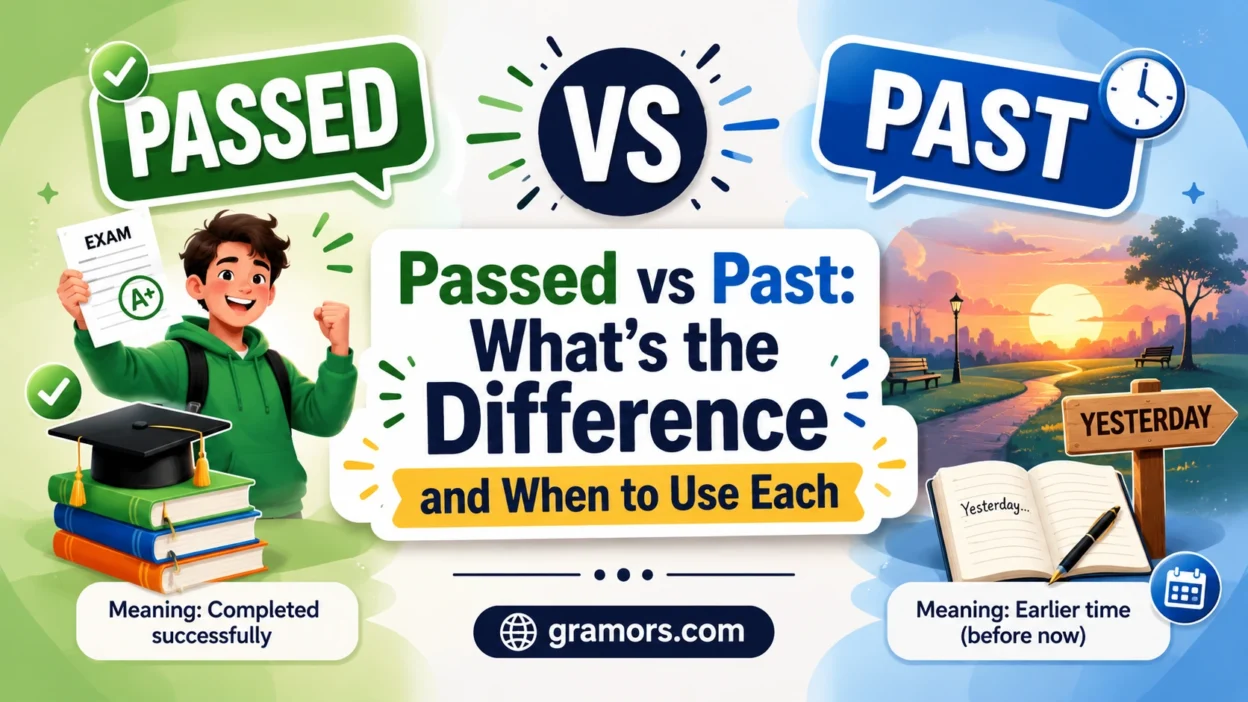
The difference matters because these words do different jobs in a sentence. “She passed the exam” means she completed an action. “The past still affects him” refers to an earlier time.
In a passed vs past comparison, the key is understanding grammar role, not just spelling. Once you know how each word functions, choosing the correct one becomes much easier.
Quick Answer
“Passed” is usually the past tense or past participle of the verb “pass.” It describes an action.
Examples:
- “He passed me on the highway.”
- “She passed the final exam.”
“Past” usually relates to time, position, or something earlier. It is commonly used as a noun, adjective, adverb, or preposition.
Examples:
- “He walked past me.”
- “It’s past midnight.”
The words are not interchangeable in standard American English.
Why People Confuse Them
The biggest reason for confusion is pronunciation. In most American accents, “passed” and “past” sound nearly identical.
The confusion also increases because both words often appear in movement-related sentences:
- “The car passed us.”
- “The car drove past us.”
Writers also struggle with phrases like:
- incorrect: “walked passed”
- correct: “walked past”
Another problem is proofreading. Since both spellings look familiar, mistakes can slip through unnoticed even when the sentence sounds right aloud.
Key Differences At A Glance
| Context | Best Choice | Why |
|---|---|---|
| Completing an action | passed | It is a verb form |
| Moving beyond something | past | It shows position or direction |
| Referring to earlier time | past | It relates to time |
| Finishing a test | passed | The action was completed |
| Talking about history | past | It functions as a noun or adjective |
| Going beyond midnight | past | It refers to time position |
Quick Comparison Block
- Passed = usually a verb connected to action
- Past = usually connected to time, position, or earlier events
- Passed can describe completion or movement
- Past is not normally used as a standard verb
Meaning and Usage Difference
“Passed” comes from the verb “pass.” It works as the past tense or past participle.
Examples:
- “She passed the ball.”
- “They passed the law.”
- “He passed by our house.”
In all of these examples, someone performed an action.
“Past,” on the other hand, has several grammar roles.
- As a preposition:
- “They ran past the house.”
- As an adjective:
- “Past mistakes still matter.”
- As a noun:
- “The past cannot be changed.”
- As an adverb:
- “He walked right past.”
A useful clue is sentence structure. If the word describes an action someone did, “passed” is usually correct. If it describes time, place, or direction, “past” is usually correct.
Compare these:
- “The runner passed me.”
- “The runner went past me.”
Both involve movement, but the grammar role changes.
“Passed” remains verbal. “Past” describes position or direction.
Tone, Context, and Formality
Both words are standard English. Neither is more formal than the other. Context determines the correct choice.
Some expressions are fixed and should not be changed:
- “passed away”
- “past due”
- “past performance”
For example:
- “Her grandfather passed away last year.”
- “The payment is past due.”
Using the wrong word in these phrases sounds grammatically incorrect rather than casual or formal.
In business writing, school assignments, and everyday conversation, the same distinction applies.
Which One Should You Use?
A quick test can help.
If the sentence needs an action verb, use “passed.”
Examples:
- “The car passed us.”
- “She passed the interview.”
If the sentence refers to time, location, or movement beyond something, use “past.”
Examples:
- “The car drove past us.”
- “It’s past noon.”
Another helpful trick is replacement.
If you can replace the word with:
- “completed”
- “moved by”
- “succeeded”
then “passed” probably fits.
If you can replace it with:
- “beyond”
- “earlier”
- “previous”
then “past” is probably correct.
Careful proofreading also helps because the mistake is often visual, not spoken.
When One Choice Sounds Wrong
Some mistakes immediately sound unnatural in written English.
Incorrect:
- “He past the test.”
Correct:
- “He passed the test.”
Why? Because the sentence needs a verb showing completed action.
Incorrect:
- “We walked passed the park.”
Correct:
- “We walked past the park.”
Why? Because the sentence describes movement beyond a location, not an action performed on the park.
Incorrect:
- “It’s passed midnight.”
Correct:
- “It’s past midnight.”
Here, the sentence refers to time.
These errors are common because the words sound so similar, but the grammar role changes the correct spelling.
Common Mistakes
Many mistakes happen in everyday writing.
- Incorrect: “walked passed the station”
Correct: “walked past the station” - Incorrect: “passed tense”
Correct: “past tense” - Incorrect: “The bill is passed due.”
Correct: “The bill is past due.” - Incorrect: “She past her driving test.”
Correct: “She passed her driving test.”
One easy memory cue is this:
- “Passed” usually involves something being done.
- “Past” usually points to time or position.
That guideline works in most standard situations without creating confusing grammar rules.
Everyday Examples
Here are realistic examples from daily American English.
School:
- “Jordan passed his math test.”
- “Past grades do not define your future.”
Driving:
- “A truck passed us on the interstate.”
- “We drove past the gas station.”
Work:
- “The manager passed the proposal to the team.”
- “Past experience helped her get the job.”
Conversation:
- “Time passed quickly during the trip.”
- “That happened in the past.”
Daily life:
- “It’s already past my bedtime.”
- “She passed the salt across the table.”
Storytelling:
- “The cyclist passed the runners near the bridge.”
- “They walked past the old theater downtown.”
Dictionary-Style Word Details
Verb
- Passed: Fully applies. “Passed” is the past tense and past participle of “pass.” It can be transitive or intransitive.
- “She passed the ball.”
- “Time passed slowly.”
- Past: Not commonly used as a standard verb in modern American English.
Noun
- Passed: Rarely used as a noun in standard everyday English.
- Past: Commonly used as a noun meaning earlier time or previous events.
- “He learned from the past.”
Synonyms
- Passed: Closest plain alternatives depend on context:
- “moved by”
- “completed”
- “succeeded”
- Past: Closest plain alternatives depend on context:
- “earlier”
- “previous”
- “beyond”
These are not always perfect substitutes because meaning changes by sentence.
Example Sentences
- Passed:
- “The teacher passed out the worksheets.”
- “She passed her road test on Friday.”
- Past:
- “We stayed up past midnight.”
- “He walked past the library.”
Word History
- Passed: Developed from the verb “pass,” which relates to movement, transfer, or completion.
- Past: Developed from meanings connected to going beyond something or referring to earlier time.
Detailed history is less important than understanding how the words function today.
Phrases Containing
- Passed:
- “passed away”
- “passed the test”
- “passed down”
- Past:
- “past midnight”
- “past experience”
- “the past”
These phrases keep their established meanings and usually cannot swap spellings.
Conclusion
The difference between “passed” and “past” becomes clearer once you focus on grammar role. “Passed” usually describes an action, while “past” usually relates to time, direction, or earlier events.
Compare these final examples:
- “She passed the store.”
- “She walked past the store.”
Both sentences involve movement, but the words serve different purposes.
In passed vs past usage, the safest approach is simple: check whether the sentence needs a verb or a time-and-position word. With a little proofreading, the correct choice becomes much easier.