People often mix up win vs beat because both words show success in games, sports, and competitions. At first glance, they feel the same. But in real English usage, they are not interchangeable.
The confusion usually comes from sentences like “We won the team” or “We beat the match,” which sound close but are actually incorrect. Once you understand how each word works, the choice becomes simple.
This guide breaks down exactly how “win” and “beat” are used so you can stop guessing and start using them correctly in real situations.
2. Quick Answer
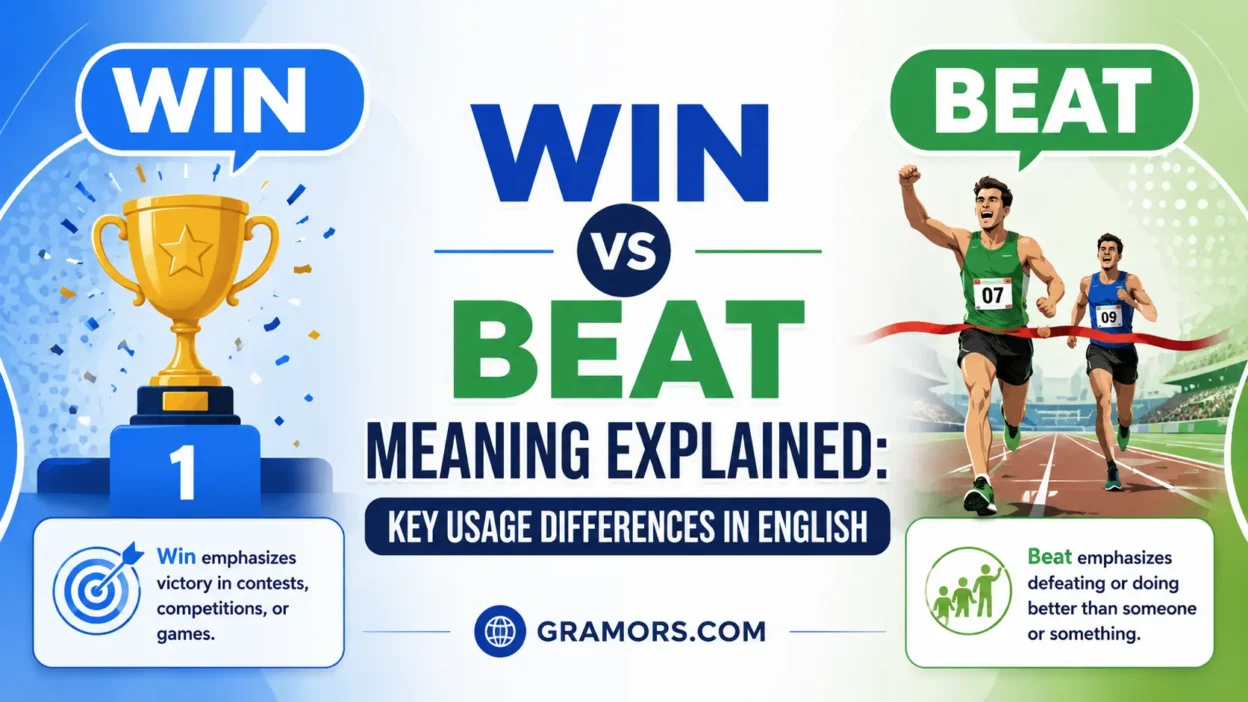
“Win” means achieving success or getting first place in something like a game, prize, or competition. It focuses on the result.
“Beat” means defeating a person or team. It focuses on the action against an opponent.
They are not interchangeable. You win something, but you beat someone.
Examples:
- You win a trophy or win a match.
- You beat a team or beat an opponent.
3. Why People Confuse Them
The confusion happens because both words appear in sports and competitions. People hear them used in similar situations and assume they mean the same thing.
Another reason is that both lead to victory. Whether you win or beat, the result feels like success.
The real issue is structure. One word focuses on the outcome, while the other focuses on the opponent.
4. Meaning and Usage Difference
“Win” is result-based. It describes success in a competition, game, or event. There doesn’t always need to be a named opponent.
“Beat” is opponent-based. It always involves defeating someone or something directly.
Comparison Table
| Context | Best Choice | Why |
|---|---|---|
| Getting first place in a contest | win | Focuses on final result |
| Defeating a team or person | beat | Focuses on opponent |
| Receiving a prize | win | No opponent needed |
| Sports match against another team | beat | Direct competition |
Example:
- You win a chess tournament.
- You beat your chess opponent.
5. Tone, Context, and Formality
Both words are neutral and widely used in everyday English. Neither is formal or informal.
However, “beat” can feel more direct because it points clearly at an opponent. It often appears in sports commentary or competitive talk.
“Win” feels broader and is used in many situations, not just sports.
6. Which One Should You Use?
Use “win” when talking about results, prizes, or achievements.
Use “beat” when talking about defeating a person, team, or rival.
Simple rule:
- If you can say “first place,” use win.
- If you can name an opponent, use beat.
Examples:
- We won the school competition.
- We beat the rival school team.
7. When One Choice Sounds Wrong
Some sentences sound unnatural because they mix the structure.
Incorrect:
- We win the team.
- We beat the trophy.
Correct:
- We beat the team.
- We win the trophy.
The key is object type:
- “Win” does not take a person as the object.
- “Beat” does not take prizes or trophies as the object.
8. Common Mistakes
A common mistake is using “win” with a person or team.
Wrong: I win you in chess.
Fix: I beat you in chess.
Another mistake is using “beat” with prizes or results.
Wrong: She beat the gold medal.
Fix: She won the gold medal.
Quick memory tip:
- win = thing or result
- beat = person or opponent
9. Everyday Examples
In real life, both words appear often in casual speech.
Sports:
- Our football team won the championship.
- Our football team beat the final opponent.
School:
- I won the spelling bee.
- I beat my classmate in the contest.
Games:
- He won the video game tournament.
- He beat every player in the tournament.
Emails or casual talk:
- We won the company challenge this year.
- We beat last year’s record team.
10. Dictionary-Style Word Details
Verb
- win: to achieve victory or success in a competition or event
- beat: to defeat someone in a contest, game, or struggle
Noun
- win: a victory or success (example: “It was a big win”)
- beat: not commonly used as a noun for this meaning
Synonyms
- win: succeed, achieve victory, come first
- beat: defeat, overcome, outplay
Example Sentences
- win: “They won the basketball championship.”
- beat: “They beat the top-ranked team.”
Word History
- win: Old English origin meaning to strive or gain success
- beat: Old English origin meaning to strike or defeat
Phrases Containing
- win: win over, win big, win a prize
- beat: beat down, beat someone at something, beat the odds
11. FAQ
Can “win” and “beat” mean the same thing?
No. They both relate to success, but they work differently in sentences.
Can you say “win someone”?
No. You cannot win a person. You beat a person.
Can you say “beat a prize”?
No. You win prizes, trophies, or awards.
Which is more common in sports?
Both are common. “Beat” is used for opponents, while “win” is used for matches or tournaments.
12. Conclusion
The difference between win vs beat is simple once you focus on structure. “Win” is about results and achievements, while “beat” is about defeating an opponent directly.
Use win for prizes and outcomes, and use beat for people or teams in competition. Once you follow this pattern, your English becomes clearer and more natural.