The confusion between look vs see happens because both words relate to vision. However, they do not describe the same kind of action.
The key difference is simple: one involves intention, and the other does not.
For example:
- “I see a bird in the tree.”
- “Look at the bird in the tree.”
Both are correct, but they describe different ways of using your eyes.
2. Quick Answer
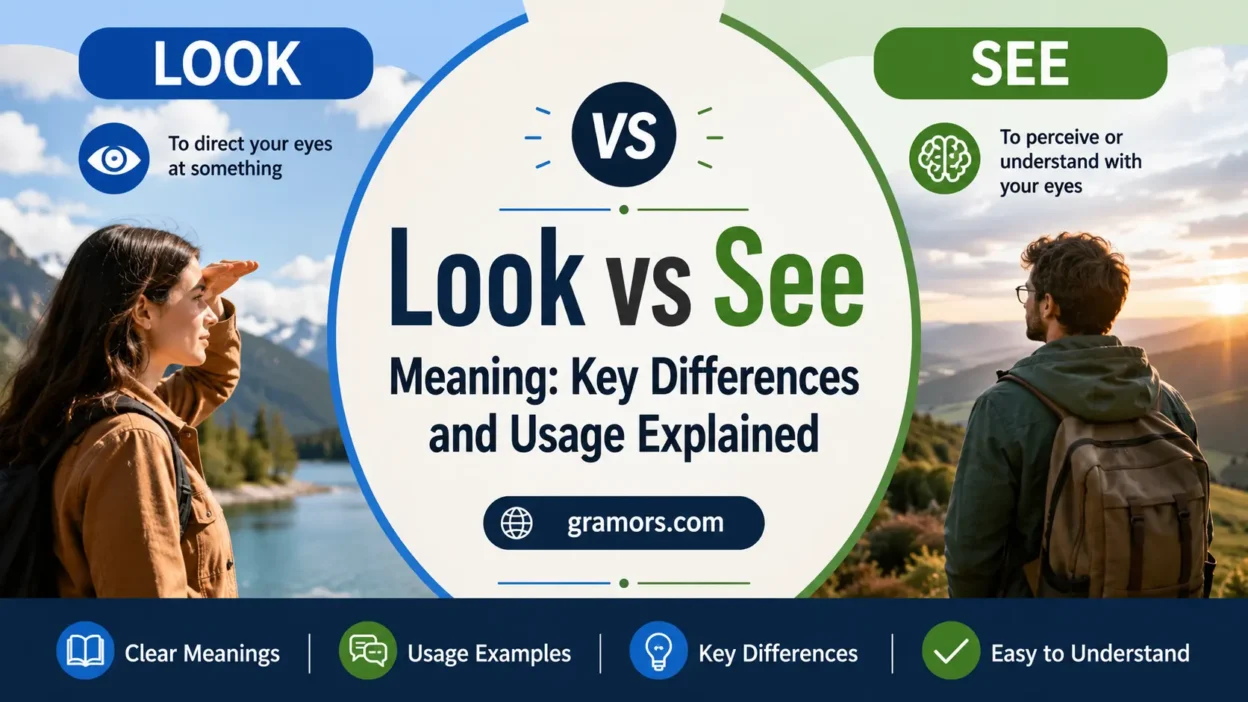
“See” means you notice something with your eyes without trying.
“Look” means you direct your eyes at something on purpose.
They are not always interchangeable because intention changes the meaning.
Examples:
- “I see the mountains.”
- “Look at the mountains.”
Important exception: “see” can also mean understanding, like “I see your point.”
3. Why People Confuse Them
People confuse look and see because both involve eyes and vision. In many situations, both can appear in similar sentences.
The confusion increases because in some languages, there is only one word for both actions.
Common mistake:
- “See at me.” ❌ (incorrect)
- “Look at me.” ✔
Since both relate to visual experience, learners often swap them accidentally.
4. Key Differences At A Glance
| Context | Best Choice | Why |
|---|---|---|
| Passive perception | See | Happens naturally without effort |
| Directed attention | Look | Requires intention |
| Noticing something | See | You become aware of it |
| Focusing eyes | Look | You actively aim your gaze |
Extra Comparison
| Feature | Look | See |
|---|---|---|
| Intent | Active | Passive |
| Control | You choose direction | Happens naturally |
5. Meaning and Usage Difference
See means something enters your vision without effort.
Example: “I see lights in the distance.”
Look means you actively direct your eyes toward something.
Example: “Look at the lights in the distance.”
“See” can also mean understanding:
- “I see what you mean.”
This shows that see is not only about eyesight, while look stays mainly about visual attention.
6. Tone, Context, and Formality
In everyday English, look is often used for commands or direction, while see is used for statements and understanding.
Examples:
- “Look here!” (attention command)
- “I see your point.” (understanding)
- “Look at this.” (direction)
- “I see a car coming.” (observation)
Tone matters because “look” can sound more direct when used as a command.
7. Which One Should You Use?
Use this simple rule:
- Use see when something happens naturally
- Use look when you control your eyes intentionally
Examples:
- “I see birds outside.”
- “Look at those birds.”
If you are not trying, use see. If you are focusing, use look.
8. When One Choice Sounds Wrong
Some sentences sound incorrect because they mix passive and active meanings.
Wrong: “See at me.”
Correct: “Look at me.”
Wrong: “I am seeing at the sky.”
Correct: “I am looking at the sky.”
Wrong: “Look I a bird.”
Correct: “I see a bird.”
The issue is usually missing structure or wrong intent.
9. Common Mistakes (and Quick Fixes)
Mistake → Correction:
- “See at the board.” → “Look at the board.”
- “I am seeing music.” → “I am listening to music / I hear music”
- “Look me.” → “Look at me”
Most mistakes happen because learners forget that look needs “at” + object.
10. Everyday Examples
- “I see a plane in the sky.”
- “Look at that plane!”
- “Do you see the clock?”
- “Look at the clock.”
- “I see people outside.”
- “Look outside the window.”
- “I see your car parked there.”
- “Look at your car!”
- “She sees the stars clearly.”
- “She is looking at the stars.”
- “I see what you mean.” (understanding)
- “Look at this photo.”
11. Dictionary-Style Word Details
Verb
- look: active direction of eyes toward something
- see: passive perception of sight or understanding
Noun
- look: refers to appearance or expression (“a look”)
- see: rarely used as a noun in standard English
Synonyms
- look: watch, glance (closest alternatives)
- see: notice, perceive (context-based alternatives)
Note: not all synonyms are interchangeable in all contexts.
Example Sentences
- look: “Look at the sky before it rains.”
- see: “I see dark clouds forming.”
Word History
- look: comes from Germanic roots meaning to observe or direct gaze
- see: comes from Old English roots meaning perception through sight
Phrases Containing
- look: look after, look into, look at
- see: see off, see through, see to
12. FAQ
Can you see without looking?
Yes. You can see something without focusing on it.
Is looking more active than seeing?
Yes. Looking requires intention.
Are look and see interchangeable?
No. Changing them changes meaning.
Can “see” mean understanding?
Yes. Example: “I see your point.”
13. Conclusion
The difference between look vs see is based on intention. “See” refers to passive perception or understanding, while “look” refers to active visual attention.
They are not interchangeable because one happens naturally and the other requires focus.
Example:
- “I see a bird.”
- “Look at the bird.”
Understanding this difference helps your English sound more natural and accurate.