Many English learners and native speakers hesitate when choosing between “less” and “fewer examples” because both words compare smaller amounts or quantities.
The difference usually depends on whether the noun can be counted individually or treated as a general amount.
Examples:
- less water
- fewer examples
- less traffic
In modern English, everyday speech sometimes bends the traditional rule, while formal writing usually follows it more closely.
2. Quick Answer
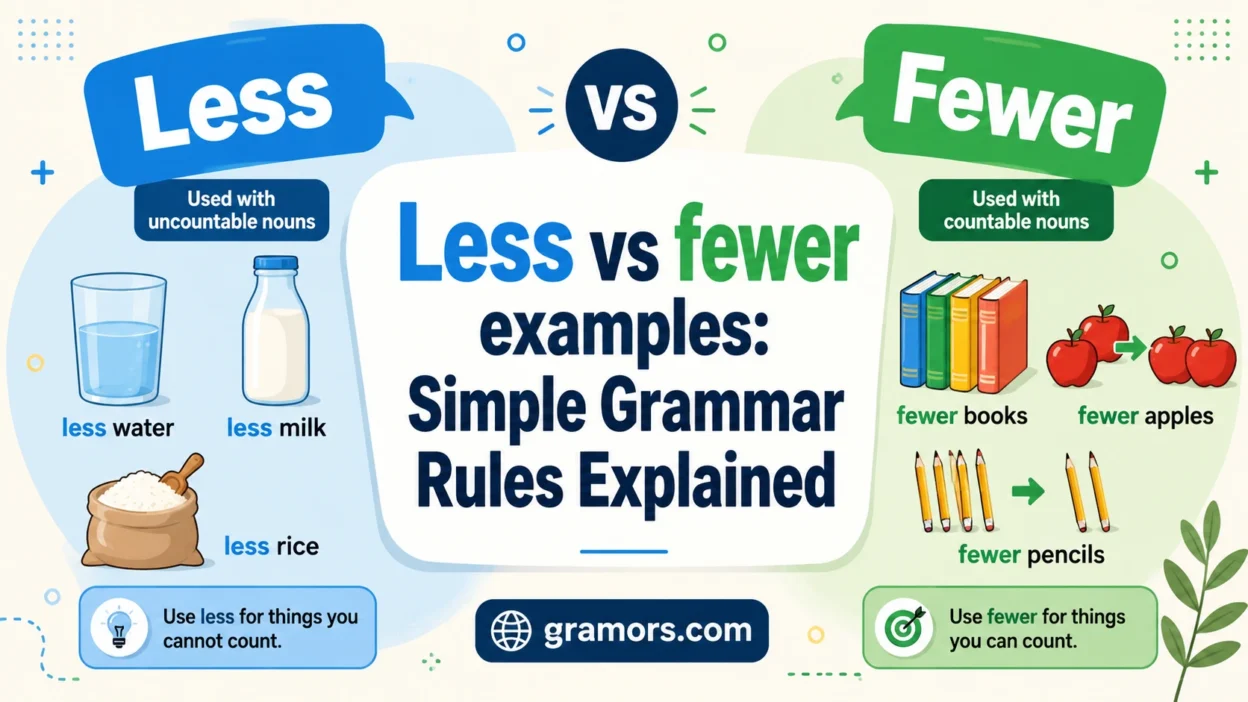
Use less with uncountable quantities:
- less sugar
- less stress
- less traffic
Use fewer with countable plural items:
- fewer books
- fewer mistakes
- fewer examples in the report
“Fewer examples” is the standard formal phrasing because examples can be counted individually.
Some accepted exceptions exist, especially with time, money, measurements, and common expressions.
3. Why People Confuse Them
People confuse “less” and “fewer” because both suggest a smaller quantity.
Spoken English often blends the two:
- less people
- less cars
You also see phrases like:
- 10 items or less
That wording is extremely common in stores, even though many formal editors would prefer:
- 10 items or fewer
English has historically used “less” with plural nouns in some situations, which explains why the overlap still feels natural to many speakers.
4. Key Differences At A Glance
Context | Best Choice | Why
Countable plural nouns | fewer | items can be counted individually
Uncountable quantities | less | treated as a general amount
Formal edited writing | fewer with count nouns | follows standard grammar preference
Measurements and time | less often accepted | treated as a quantity
Everyday conversation | overlap exists | spoken English is flexible
| Feature | Less | Fewer |
|---|---|---|
| Best with | uncountable nouns | countable plural nouns |
| Examples | less water | fewer bottles |
| Common exceptions | time, money, distance | fewer exceptions |
| Formal preference | less traffic | fewer cars |
5. Meaning and Usage Difference
Countable nouns can be counted individually:
- students
- emails
- chairs
- examples
These usually take fewer:
- fewer students
- fewer emails
- fewer examples
Uncountable nouns describe amounts or masses:
- coffee
- patience
- furniture
- information
These usually take less:
- less coffee
- less patience
- less information
Examples:
- We received fewer applications this year.
- I have less energy today.
The phrase “fewer examples” sounds standard because each example is a separate item that can be counted.
Still, not every plural noun automatically requires “fewer.” Measurements and quantities often use “less” naturally:
- less than 10 miles
- less than 20 dollars
6. Tone, Context, and Formality
Formal writing usually follows the traditional distinction carefully.
Examples:
- fewer than 10 employees
- fewer customer complaints
Conversational English is more flexible:
- less than 5 miles
- less than 10 minutes
Shopping signs also influence everyday usage:
- 10 items or less
Many speakers accept these expressions naturally, even though edited grammar guides may prefer “fewer.”
This difference reflects language habits, not carelessness.
7. Which One Should You Use?
A simple method:
- Ask whether the noun can be counted individually.
- If yes, use fewer.
- If no, use less.
Examples:
- fewer cookies
- fewer examples in essays
- less milk
- less traffic
For formal writing, checking countability is usually the safest editing strategy.
If the noun refers to time, money, distance, or measurements, “less” may still sound natural and accepted.
8. When One Choice Sounds Wrong
Some combinations sound unnatural in formal American English.
Awkward:
- less cars
- less mistakes
- fewer water
More natural:
- fewer cars
- fewer mistakes
- less water
Listeners often expect “fewer” with clearly countable plural nouns.
Still, spoken English may use relaxed forms casually:
- less people showed up today
That phrasing is common in conversation but less accepted in edited formal writing.
9. Common Mistakes
Mistake → Fix
- less people → fewer people
- less books → fewer books
- fewer sugar → less sugar
- fewer traffic jams → fewer traffic jams is acceptable because “traffic jams” are countable
Accepted exception:
- less than 20 dollars
- less than 10 minutes
These are usually treated as amounts rather than individual units.
10. Everyday Examples
Workplace:
- We had fewer meetings this week.
- The project required less effort than expected.
School writing:
- The teacher asked for fewer examples in the essay.
- This version contains less unnecessary detail.
Shopping:
- This cereal has less sugar.
- Fewer customers visited the store today.
Conversation:
- I have less free time now.
- We made fewer mistakes this time.
Travel:
- The drive took less than two hours.
- Fewer flights were available this weekend.
Health:
- She drinks less soda now.
- Fewer calories were listed on the new menu.
11. Dictionary-Style Word Details
Verb
• LESS: Not commonly used as a verb.
• FEWER EXAMPLES: Does not function as a verb.
• Applicability: Rarely applies to either term.
Noun
• LESS: Can function as a noun in limited structures such as “the less said, the better.”
• FEWER EXAMPLES: “Examples” is the noun, while “fewer” acts as a modifier.
• Applicability: Partly applicable to both.
Synonyms
• LESS: smaller amount, reduced quantity
• FEWER EXAMPLES: smaller number, not as many examples
• Applicability: Context-based but generally useful.
Example Sentences
• LESS:
- We spent less money this year.
- She has less patience today.
• FEWER EXAMPLES:
- The editor requested fewer examples.
- Fewer mistakes appeared in the final draft.
Word History
• LESS: Historical English often used “less” with plural nouns, especially in quantity expressions.
• FEWER EXAMPLES: Modern grammar traditions emphasized “fewer” more strongly for countable items.
• Applicability: Both reflect long-term English usage changes.
Phrases Containing
• LESS:
- less time
- less stress
- less effort
• FEWER EXAMPLES:
- fewer examples
- fewer complaints
- fewer errors
12. FAQ
Is “10 items or less” wrong?
In strict formal grammar, many editors prefer:
- 10 items or fewer
But “10 items or less” is extremely common in everyday English and store signage.
Can “less” ever be used with plural nouns?
Yes. It is commonly used with:
- time
- money
- distance
- measurements
Examples:
- less than 20 miles
- less than 30 minutes
Why does “fewer examples” sound more correct?
Because examples are countable items. You can count one example, two examples, or ten examples.
That makes “fewer examples” the standard formal choice.
Are “less” and “fewer” interchangeable in speech?
Sometimes. Casual conversation often relaxes the distinction:
- less people
- less cars
These forms are common in speech but less accepted in formal edited writing.
Is “less people” always wrong?
Not always in conversation, but it usually sounds incorrect in formal American English.
Formal preference:
- fewer people
13. Conclusion
The main difference in less vs fewer examples is simple: use fewer for countable items and less for uncountable quantities.
Examples:
- fewer examples
- less information
At the same time, English includes real exceptions involving time, money, distance, and everyday speech.
Instead of treating the rule as absolute, focus on clarity, natural wording, and the level of formality your writing needs.