Many writers mix up “complement” and “compliment” because the words sound almost the same in American English. Their spellings are also very close, which makes quick typing mistakes common in emails, captions, and everyday writing.
But these words do not mean the same thing.
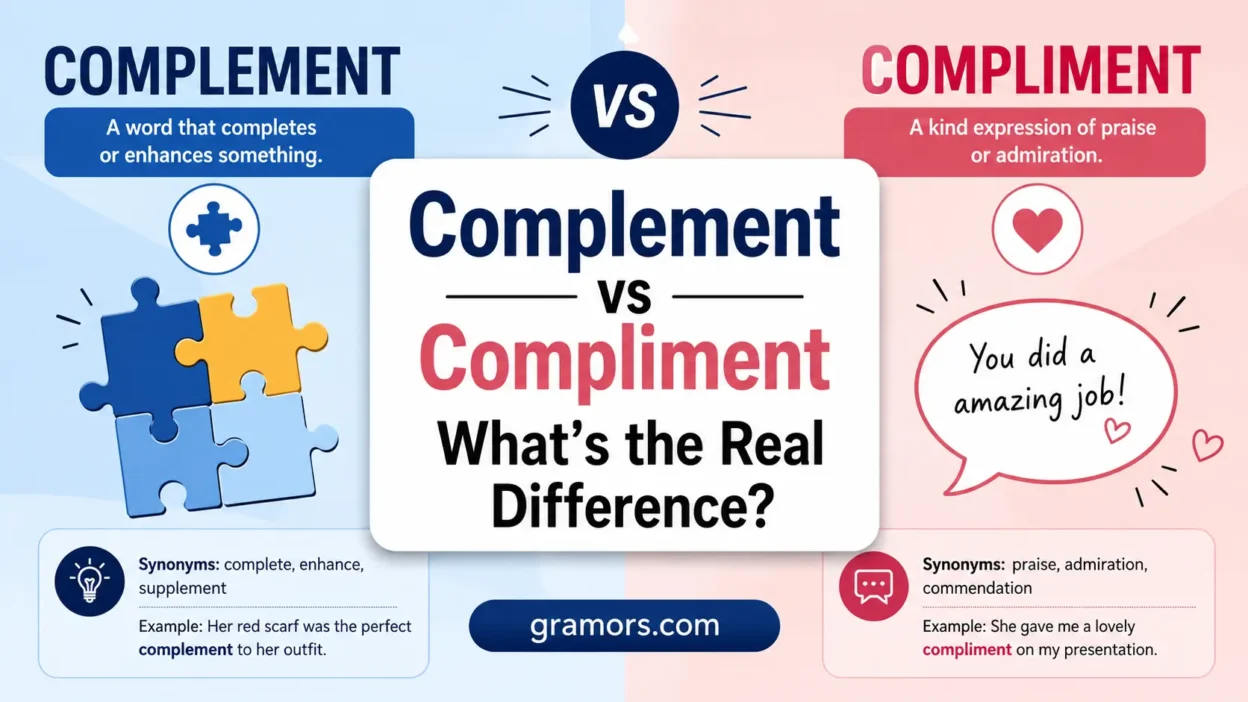
“Complement” relates to completing, improving, or matching well with something else. “Compliment” relates to praise or admiration.
For example:
- “Your shoes complement your outfit.”
- “Your shoes deserve a compliment.”
One sentence is about matching well. The other is about praise. That small spelling change completely changes the meaning.
If you often hesitate between complement vs compliment, this guide will make the difference clear and easy to remember.
Quick Answer
Use “complement” when something completes, improves, balances, or matches something else well.
Use “compliment” when someone gives praise or expresses admiration.
Both words can work as nouns and verbs.
Examples:
- Noun: “The scarf was the perfect complement to the jacket.”
- Noun: “She appreciated the compliment about her presentation.”
- Verb: “The lighting complements the room.”
- Verb: “He complimented her writing skills.”
These words are not interchangeable in standard American English.
Why People Confuse Them
The confusion mostly comes from pronunciation. In modern American English, “complement” and “compliment” sound nearly identical in everyday speech.
The spelling difference is also tiny:
- complement
- compliment
Only one letter changes, so typing errors happen constantly.
The confusion gets worse because both words often appear in positive situations. Someone may talk about a dress looking great or praise someone’s style, and both ideas feel connected emotionally.
Common mistakes include:
- “Your glasses really compliment your face.”
- “I want to complement you on your hard work.”
Autocorrect and fast social media writing also increase the problem. Many people recognize the correct sound but choose the wrong spelling.
Key Differences At A Glance
| Context | Best Choice | Why |
|---|---|---|
| A color matches another color well | complement | It means enhance or complete |
| Praising someone’s work | compliment | It means praise |
| A side dish improves the main meal | complement | It adds balance or enhancement |
| Telling someone they look great | compliment | It expresses admiration |
| Grammar terminology | complement | Technical grammar meaning |
| Friendly praise in conversation | compliment | Social approval or admiration |
Quick Comparison
| Feature | complement | compliment |
|---|---|---|
| Main meaning | Completes or enhances | Praises or admires |
| Emotional or functional | Mostly functional | Mostly emotional/social |
| Can be a verb | Yes | Yes |
| Common contexts | Design, grammar, food, balance | Conversation, feedback, politeness |
| Interchangeable? | No | No |
Meaning and Usage Difference
“Complement” means something completes, improves, balances, or works well with something else.
Examples:
- “The wine complements the pasta.”
- “Her calm personality complements the team.”
- “The blue walls complement the modern furniture.”
In grammar, a “complement” is also a technical term. It refers to a word or phrase that completes the meaning of another part of a sentence.
Example:
- “She became a doctor.”
In that sentence, “a doctor” functions as a complement because it completes the meaning.
“Compliment,” on the other hand, means praise, admiration, or a polite expression of approval.
Examples:
- “He complimented her presentation.”
- “That was a thoughtful compliment.”
- “The manager complimented the staff for finishing early.”
Both words can be nouns and verbs:
- complement (noun): something that improves another thing
- complement (verb): to improve or complete
- compliment (noun): an expression of praise
- compliment (verb): to praise someone
Although they sound similar, one word focuses on enhancement while the other focuses on admiration.
Tone, Context, and Formality
Neither word is automatically more formal than the other. The correct choice depends on context.
“Complement” commonly appears in:
- design discussions
- branding
- food descriptions
- grammar
- business writing
- product descriptions
Examples:
- “The new logo complements the brand identity.”
- “These flavors complement each other well.”
“Compliment” commonly appears in social interaction and communication.
Examples:
- “Thank you for the compliment.”
- “She complimented his attention to detail.”
In professional writing, the wrong choice can make a sentence sound confusing or careless.
Correct:
- “Your experience complements the rest of the team.”
Correct:
- “I want to compliment you on the excellent report.”
Even in casual speech, context determines which word sounds natural.
Which One Should You Use?
A fast way to choose the correct word is to ask what the sentence is actually describing.
If the meaning involves praise or admiration, use “compliment.”
Examples:
- “She complimented my haircut.”
- “That compliment made my day.”
If the meaning involves matching, improving, balancing, or completing something, use “complement.”
Examples:
- “The sauce complements the steak.”
- “His skills complement the project.”
A quick test can help:
- Does the sentence mean praise? → compliment
- Does the sentence mean complete, improve, or match? → complement
That approach works more reliably than most memory tricks.
When One Choice Sounds Wrong
Sometimes the wrong word creates a sentence that sounds awkward or changes the meaning entirely.
Incorrect:
- “The sauce complimented the pasta.”
This sounds wrong because sauces do not give praise. The intended meaning is that the sauce improves or matches the pasta.
Correct:
- “The sauce complemented the pasta.”
Another example:
- “She complemented my work.”
This could technically mean her work completed or balanced yours. But most writers actually mean praise.
More natural:
- “She complimented my work.”
Context matters because both words are grammatically valid, but only one usually fits the intended meaning.
Common Mistakes
Mistake:
- “Your jacket really compliments your shoes.”
Quick fix:
- “Your jacket really complements your shoes.”
Reason: the jacket matches the shoes well.
Mistake:
- “I want to complement you on your promotion.”
Quick fix:
- “I want to compliment you on your promotion.”
Reason: the sentence expresses praise.
Another common issue involves “complementary” and “complimentary.”
- complementary = matching or enhancing
- complimentary = free of charge or expressing praise
Examples:
- “The restaurant used complementary colors in its design.”
- “Guests received complimentary drinks.”
These two adjectives are often confused in advertising and hospitality writing.
Everyday Examples
- “The rug complements the living room furniture.”
- “He complimented her cooking.”
- “These apps complement each other well.”
- “She received a compliment after her speech.”
- “The bright lighting complements the open layout.”
- “My teacher complimented my essay.”
- “Fresh herbs complement grilled chicken.”
- “That tie complements your suit.”
- “The coach complimented the team for staying focused.”
- “The supporting data complements the report.”
- “She took the compliment seriously.”
- “The warm colors complement the restaurant’s branding.”
Dictionary-Style Word Details
Verb
- complement: to complete, improve, balance, or match well with something
- compliment: to praise or express admiration toward someone
Examples:
- “The soundtrack complements the movie.”
- “He complimented her professionalism.”
Noun
- complement: something that completes or enhances another thing
- compliment: a polite expression of praise or admiration
Examples:
- “The dessert was a perfect complement to dinner.”
- “She appreciated the compliment.”
Synonyms
- complement: closest plain alternatives include enhance, complete, balance, and match
- compliment: closest plain alternatives include praise, admiration, and flattering remark
These are related alternatives, not always exact replacements.
Example Sentences
- complement: “The chart complements the written report.”
- complement: “The green trim complements the house color.”
- complement: “The final phrase complements the sentence structure.”
- compliment: “My boss complimented my time management.”
- compliment: “She smiled after the compliment.”
- compliment: “He complimented the restaurant staff.”
Word History
- complement: comes from roots connected to completion and fulfillment
- compliment: developed from words connected to courtesy, respect, and polite expression
Although the spellings became similar over time, the meanings stayed separate.
Phrases Containing
- complement: “complementary colors,” “full complement,” “complement system”
- compliment: “pay a compliment,” “take it as a compliment,” “return the compliment”
These phrases remain common in modern American English.
Conclusion
The difference between complement vs compliment comes down to meaning.
“Complement” relates to completing, improving, balancing, or matching well. “Compliment” relates to praise and admiration.
A simple way to decide is to check the context:
- Does it mean enhance or complete? Use “complement.”
- Does it mean praise? Use “compliment.”
For example:
- “The curtains complement the room.”
- “She gave me a compliment about the room.”
Once you focus on the meaning instead of the spelling, choosing the correct word becomes much easier.