Many people confuse “advice” and “advise” because the words look similar and share closely related meanings. The difference, however, is actually simple once you understand how each word works in a sentence.
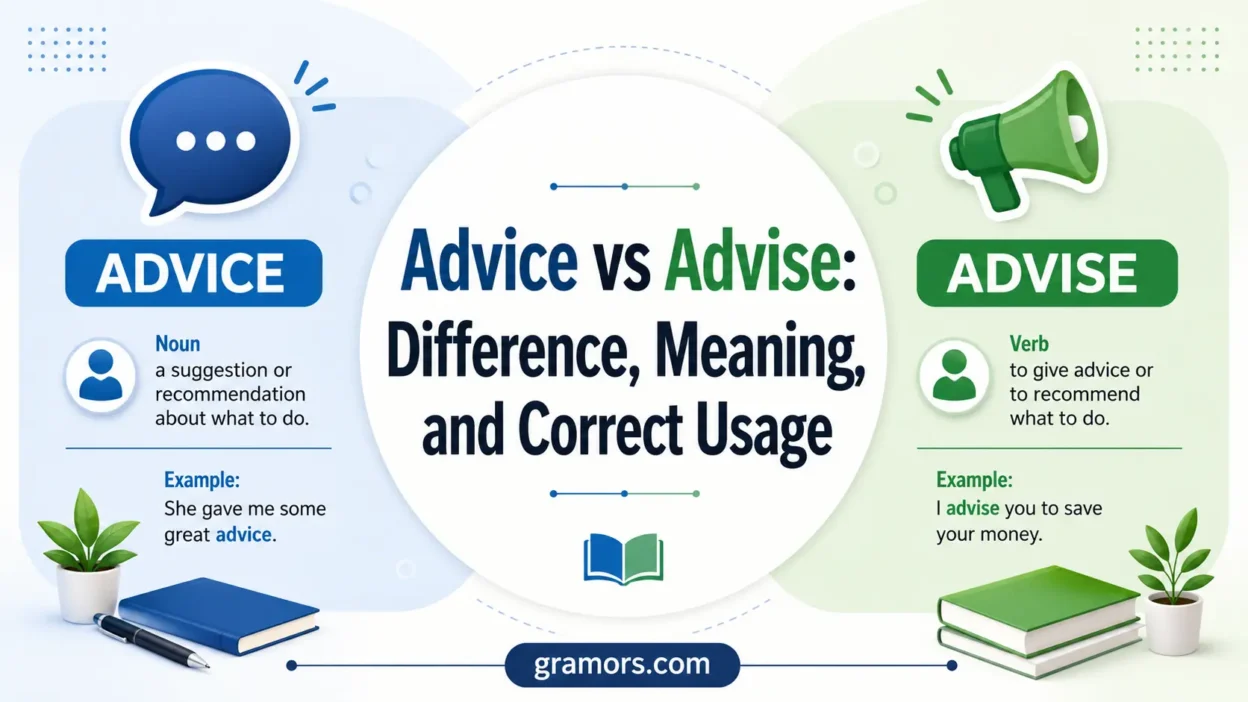
“Advice” is a thing. “Advise” is an action.
Compare these examples:
- “Can you give me advice?”
- “Can you advise me?”
Both words deal with guidance or recommendations, but they have different grammar roles. Mixing them up can create obvious writing mistakes, especially in emails, school assignments, and workplace communication.
Quick Answer
Use “advice” as a noun when talking about guidance or recommendations.
Use “advise” as a verb when talking about giving guidance.
Examples:
- “She gave good advice.”
- “She advised me to wait.”
A quick memory trick:
- Advice ends with “ice” and names the thing itself.
- Advise ends with “ise” and describes the action.
Pronunciation also changes:
- “Advice” ends with an /s/ sound.
- “Advise” ends with a /z/ sound.
Why People Confuse Them
The confusion usually comes from three things:
- similar spelling
- related meanings
- similar pronunciation
Many learners also type quickly and accidentally write:
- “Please advice”
instead of: - “Please advise”
Another common mistake is treating “advice” like a countable noun:
- “He gave me an advice.”
In standard modern English, that sentence sounds incorrect because “advice” is usually uncountable.
The pronunciation difference can also be subtle for learners:
- advice = soft “s” sound
- advise = buzzing “z” sound
Because the words are closely connected in meaning, people often assume they are interchangeable, but they are not.
Key Differences At A Glance
| Context | Best Choice | Why |
|---|---|---|
| Receiving guidance | advice | Refers to the guidance itself |
| Giving guidance | advise | Describes the action |
| Workplace email | advise | Used in phrases like “please advise” |
| Talking about recommendations | advice | Functions as a noun |
| Suggesting an action | advise | Functions as a verb |
| “Piece of advice” | advice | Uncountable noun structure |
Quick Comparison
- Advice = thing, guidance, recommendation
- Advise = action, giving guidance
- Advice = noun
- Advise = verb
- Advice ends with an /s/ sound
- Advise ends with a /z/ sound
Meaning and Usage Difference
“Advice” is a noun. It refers to guidance, suggestions, or recommendations.
Examples:
- “I need advice.”
- “Her advice helped me.”
- “She gave me a piece of advice.”
“Advice” is usually uncountable in standard English. That means these forms are normally incorrect:
- “an advice”
- “many advices”
Instead, English speakers usually say:
- “some advice”
- “a piece of advice”
- “a few pieces of advice”
“Advise” is a verb. It describes the act of giving guidance.
Examples:
- “The doctor advised him to rest.”
- “I advise you to double-check the report.”
- “She advised us not to drive in the storm.”
A common sentence pattern is:
- advise + person + to do something
Example:
- “They advised me to apply early.”
Pronunciation matters here:
- advice → /s/
- advise → /z/
That small sound difference helps many people remember which word they need.
Tone, Context, and Formality
Both words work in casual and professional English.
“Advice” sounds natural everywhere:
- “Thanks for your advice.”
- “My dad gave me good advice.”
“Advise” also appears in both everyday and professional communication:
- “I advise you to save your work often.”
- “Please advise on next steps.”
The phrase “please advise” is especially common in business emails and customer support messages. It sounds more formal than:
- “Please let me know.”
Still, “advise” itself is not always formal. People use it naturally in conversations every day.
Examples:
- “I’d advise against buying that laptop.”
- “What would you advise?”
Which One Should You Use?
A quick question usually solves the problem:
Are you talking about a thing or an action?
If it is the guidance itself, use “advice.”
- “Your advice was helpful.”
If it is the act of giving guidance, use “advise.”
- “I advise you to be careful.”
You can also use simple replacement tests.
If “suggestion” fits, use “advice.”
- “That suggestion helped me.”
- “That advice helped me.”
If “recommend” fits, use “advise.”
- “I recommend waiting.”
- “I advise waiting.”
This shortcut works in most everyday situations.
When One Choice Sounds Wrong
Some mistakes sound immediately unnatural in standard English.
Incorrect:
- “Please advice.”
Correct:
- “Please advise.”
Why?
Because the sentence needs a verb, not a noun.
Incorrect:
- “He gave me many advices.”
Correct:
- “He gave me a lot of advice.”
- “He gave me several pieces of advice.”
Why?
Because “advice” is generally uncountable.
Incorrect:
- “She advice me to wait.”
Correct:
- “She advised me to wait.”
Why?
The sentence needs the action word “advised.”
Common Mistakes
One very common workplace mistake is:
- “Please advice.”
Quick fix:
- Replace it with “please advise.”
Another frequent error:
- “Can you give me an advise?”
Quick fix:
- “Can you give me some advice?”
Learners also confuse pronunciation.
Wrong sound pattern:
- pronouncing both words exactly the same
Helpful reminder:
- advice = soft /s/
- advise = buzzing /z/
Another mistake happens with sentence structure.
Incorrect:
- “I advice you to leave early.”
Correct:
- “I advise you to leave early.”
Simple rule:
- advice = noun
- advise = verb
Everyday Examples
- “My teacher gave me useful advice.”
- “I advise you to back up your files.”
- “Thanks for the financial advice.”
- “The manager advised us to arrive early.”
- “Can you give me some advice about college?”
- “Doctors often advise patients to rest.”
- “Her advice saved me a lot of money.”
- “I strongly advise against skipping breakfast.”
- “That was excellent advice.”
- “The lawyer advised him to stay quiet.”
- “My brother always gives good advice.”
- “They advised us not to travel during the storm.”
- “I need advice about this job offer.”
- “Please advise if the meeting time changes.”
Dictionary-Style Word Details
Verb
- Advice: Not commonly used as a verb in standard English.
- Advise: Main verb form meaning recommend, guide, suggest, or counsel.
Noun
- Advice: Main noun form referring to guidance or recommendations. Usually uncountable.
- Advise: Not commonly used as a noun in standard English.
Synonyms
- Advice: guidance, recommendation, counsel, suggestion
- Advise: recommend, counsel, suggest, guide
Example Sentences
- Advice: “She gave me helpful advice.”
- Advice: “I need advice about my resume.”
- Advice: “That was good financial advice.”
- Advice: “His advice improved the project.”
- Advise: “I advise you to read the contract carefully.”
- Advise: “The doctor advised more exercise.”
- Advise: “She advised him against quitting.”
- Advise: “Please advise us about the schedule.”
Word History
- Advice: Developed through Old French and Middle English forms connected to opinions, guidance, and recommendations.
- Advise: Shares the same historical roots and developed as the related action form.
Phrases Containing
- Advice:
- piece of advice
- financial advice
- legal advice
- Advise:
- please advise
- strongly advise
- advise against
FAQ
Is “please advice” wrong?
Yes. The correct phrase is:
- “Please advise.”
The sentence needs a verb.
Can “advice” be plural?
Usually no in standard English. People normally say:
- “some advice”
- “pieces of advice”
instead of:
- “advices”
How are they pronounced?
- advice = ends with /s/
- advise = ends with /z/
Is “advise” formal?
Not always. It works in both everyday conversation and professional writing.
Are they interchangeable?
No. “Advice” is a noun, while “advise” is a verb.
Conclusion
The difference between “advice” and “advise” comes down to grammar and pronunciation.
- Advice = noun
- Advise = verb
Quick reminder:
- “She gave me advice.”
- “She advised me to wait.”
The pronunciation difference also helps:
- advice = /s/
- advise = /z/
Once you remember that “advice” is the guidance and “advise” is the action, choosing the correct word becomes much easier.