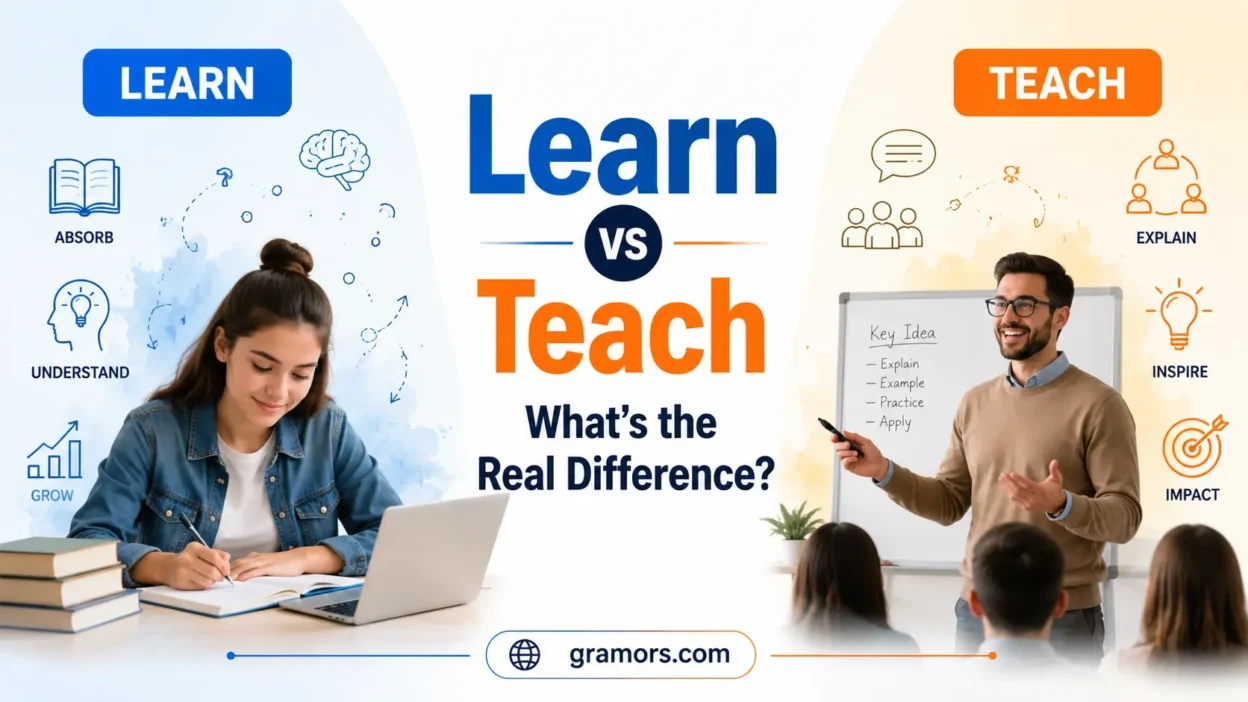
Many English learners confuse “learn” and “teach” because both words involve knowledge, skills, and education. The difference comes from direction and perspective.
When someone gains knowledge, they learn. When someone gives instruction or guidance, they teach.
For example:
- “I want to learn English.”
- “She teaches English.”
The two words are closely connected, but they are not interchangeable. Understanding who receives knowledge and who gives it makes the choice much easier in learn vs teach situations.
Quick Answer
“Learn” means to receive or gain knowledge, skill, or understanding.
- “Students learn new vocabulary every day.”
“Teach” means to give instruction or help someone understand something.
- “Teachers teach new vocabulary every day.”
A quick memory trick:
- learn = receive knowledge
- teach = give knowledge
Incorrect:
- “Can you learn me how to cook?”
Correct:
- “Can you teach me how to cook?”
People can also learn on their own, and teaching does not always happen in a classroom.
Why People Confuse Them
The confusion happens because both words describe the same general process: knowledge moving from one person to another.
For example:
- “My dad taught me how to drive.”
- “I learned how to drive from my dad.”
Same situation. Different viewpoint.
Some languages use one verb for both ideas, so learners may transfer that pattern into English.
There is also a historical reason for confusion. In some older regional dialects, “learn” was sometimes used to mean “teach.”
Example of nonstandard usage:
- “He learned me how to fish.”
Standard modern American English:
- “He taught me how to fish.”
Even native speakers may occasionally mix them up in casual conversation, especially when speaking quickly.
Key Differences At A Glance
| Context | Best Choice | Why |
|---|---|---|
| Receiving knowledge | learn | The subject gains information |
| Giving instruction | teach | The subject provides information |
| Self-study | learn | No instructor is required |
| Coaching someone | teach | The subject guides another person |
| “___ me Spanish” | teach | Someone gives instruction |
| “___ Spanish online” | learn | Someone gains the skill |
Quick Comparison
- learn → receive knowledge
- teach → provide knowledge
- learn often focuses on the student or learner
- teach focuses on the instructor, coach, parent, or guide
- both can happen in formal or informal situations
Meaning and Usage Difference
“Learn” means to gain knowledge, understanding, or skill.
Examples:
- “She learned basic coding online.”
- “I’m learning guitar.”
- “They learned about climate science in school.”
“Teach” means to instruct, train, guide, or help another person understand something.
Examples:
- “My uncle teaches guitar lessons.”
- “The trainer taught us new safety rules.”
- “She teaches math at a middle school.”
Both are verbs, but they focus on opposite roles in the same process.
Common sentence patterns:
- learn something
- learn how to do something
- learn from someone
Examples:
- “I learned French in college.”
- “We learned from experience.”
Common “teach” patterns:
- teach someone something
- teach someone how to do something
- teach at a school
Examples:
- “She taught me algebra.”
- “He teaches children how to swim.”
Past forms matter too:
- learn → learned or learnt
- teach → taught
In American English, “learned” is much more common than “learnt.”
“Teach” does not always require a classroom. Parents, coworkers, coaches, and friends can teach skills too.
Tone, Context, and Formality
Both “learn” and “teach” are neutral, everyday verbs in American English.
You can use them in:
- school settings
- work training
- parenting
- hobbies
- online courses
Examples:
- “I’m learning graphic design online.”
- “My manager taught me the new system.”
“Learn” often appears in self-study situations:
- “She learned photography through videos.”
“Teach” often highlights guidance or instruction:
- “He teaches new employees during orientation.”
In standard modern American English, “learn me” usually sounds incorrect or highly regional.
Formal:
- “The seminar taught employees new procedures.”
Casual:
- “You taught me a lot about cars.”
Neither word is naturally more formal than the other. The context matters more than the verb itself.
Which One Should You Use?
Ask one simple question:
Is the subject receiving knowledge or giving it?
If the subject receives knowledge, use “learn.”
- “I want to learn Italian.”
If the subject gives instruction, use “teach.”
- “My friend teaches Italian.”
Quick sentence test:
- “Who gains the knowledge?”
- “Who explains the knowledge?”
Fill-in-the-blank examples:
- “Our coach _____ us new drills.”
- Correct: taught
- “We _____ new drills at practice.”
- Correct: learned
Another helpful shortcut:
- learners learn
- instructors teach
When One Choice Sounds Wrong
Some combinations sound unnatural in standard American English.
Wrong:
- “Can you learn me math?”
Correct:
- “Can you teach me math?”
Wrong:
- “My teacher learned us grammar.”
Correct:
- “My teacher taught us grammar.”
Wrong:
- “I teach cooking from my grandmother.”
Correct:
- “I learned cooking from my grandmother.”
These mistakes usually happen when the direction of knowledge gets reversed.
Regional or older dialects may sometimes use “learn” to mean “teach,” but this is uncommon in modern US English and may sound incorrect in school or professional settings.
Common Mistakes
Mistake:
- “She learned me how to swim.”
Fix:
- “She taught me how to swim.”
Mistake:
- “I taught Spanish in college.”
Fix:
- “I learned Spanish in college.”
Mistake:
- “He is learning students online.”
Fix:
- “He is teaching students online.”
Mistake:
- “I learned from my teacher algebra.”
Fix:
- “I learned algebra from my teacher.”
Mistake:
- “The course taught me a lot.”
- Correct as written
Many learners incorrectly think “teach” must involve schools. It does not.
Everyday Examples
School:
- “The students learned about volcanoes.”
- “The teacher taught a lesson about volcanoes.”
Work:
- “I learned the new software last week.”
- “Our supervisor taught us the new software.”
Parenting:
- “Kids learn by watching adults.”
- “Parents teach children basic manners.”
Sports:
- “She learned how to serve in tennis.”
- “Her coach taught her how to serve.”
Hobbies:
- “I learned knitting from online videos.”
- “My grandmother taught me knitting.”
Cooking:
- “He learned to make tacos.”
- “His brother taught him the recipe.”
Technology:
- “They learned video editing at home.”
- “A friend taught them video editing.”
Travel:
- “I learned a few Japanese phrases before the trip.”
- “The guide taught us useful local expressions.”
Music:
- “She learned piano as a child.”
- “Her instructor taught piano lessons for years.”
Life experience:
- “I learned patience from that job.”
- “That experience taught me patience.”
Dictionary-Style Word Details
Verb
• learn:
A verb meaning to gain knowledge, skill, understanding, or experience.
Common patterns:
- learn something
- learn from someone
- learn how to do something
Examples:
- “I learned coding online.”
- “She learned from her mistakes.”
• teach:
A verb meaning to instruct, guide, train, or help someone understand something.
Common patterns:
- teach someone something
- teach someone how to do something
Examples:
- “He taught me chess.”
- “She teaches science.”
Noun
• learn:
Not commonly used as a noun in modern standard American English.
• teach:
Not commonly used as a noun in standard modern American English.
Synonyms
• learn:
Closest plain alternatives:
- study
- discover
- master
- understand
• teach:
Closest plain alternatives:
- instruct
- educate
- train
- coach
Exact synonym overlap is limited because the direction of knowledge changes.
Example Sentences
• learn:
- “I want to learn Korean.”
- “We learned a lot from the workshop.”
- “She learned the hard way.”
• teach:
- “My aunt teaches art classes.”
- “He taught me how to fix a bike.”
- “The program teaches basic coding skills.”
Word History
• learn:
Comes from older Germanic and Old English roots connected to gaining knowledge. Historically, some dialects also used “learn” to mean “teach.”
• teach:
Comes from Old English and has long referred to instruction, guidance, and training.
Both words have been connected to education and skill-building for centuries.
Phrases Containing
• learn:
- “learn the hard way”
- “live and learn”
• teach:
- “teach a lesson”
- “teach someone a skill”
FAQs
What is the main difference between “learn” and “teach”?
“Learn” means gaining knowledge or skill, while “teach” means giving instruction or helping someone understand something.
Examples:
- “I want to learn French.”
- “She teaches French.”
Is it “teach me” or “learn me”?
Standard American English uses “teach me.”
Correct:
- “Can you teach me how to drive?”
Incorrect:
- “Can you learn me how to drive?”
Can someone learn without a teacher?
Yes. People can learn through experience, practice, books, videos, or self-study.
Examples:
- “She learned photography online.”
- “I learned coding by practicing.”
Does “teach” only apply to schools?
No. Anyone can teach skills, ideas, or lessons.
Examples:
- “My dad taught me how to ride a bike.”
- “The coach taught us teamwork.”
Which word focuses on the student?
“Learn” focuses on the person receiving knowledge.
Example:
- “The students learned new vocabulary.”
Which word focuses on the instructor?
“Teach” focuses on the person giving instruction.
Example:
- “The teacher taught new vocabulary.”
What is the past tense of “learn”?
In American English, the most common past tense is “learned.”
Example:
- “I learned Spanish in school.”
“Learnt” is also correct but is more common in British English.
What is the past tense of “teach”?
The past tense of “teach” is “taught.”
Example:
- “She taught me how to swim.”
Why do learners confuse “learn” and “teach”?
Both words describe the same knowledge-sharing process from different viewpoints. Some languages also use one word for both meanings, which can create confusion in English.
Is this sentence correct: “He learned me math”?
No, that sounds incorrect in standard modern American English.
Correct:
- “He taught me math.”
Can a course “teach” you something?
Yes. “Teach” can refer to classes, books, experiences, software, or life situations.
Examples:
- “The course taught me useful skills.”
- “That experience taught me patience.”
How can I remember the difference easily?
Use this quick rule:
- learn = receive knowledge
- teach = give knowledge
Examples:
- “I learned guitar.”
- “My uncle taught me guitar.”
Can both words appear in the same situation?
Yes. They often describe the same event from different perspectives.
Examples:
- “My coach taught me how to serve.”
- “I learned how to serve from my coach.”
Is “learn” more formal than “teach”?
No. Both are common everyday verbs used in casual and professional English.
Examples:
- “I’m learning graphic design.”
- “She teaches graphic design.”
Conclusion
The difference between learn vs teach depends on direction.
Use “learn” when someone gains knowledge:
- “I learned Spanish online.”
Use “teach” when someone gives instruction:
- “My tutor taught me Spanish.”
The two words describe connected parts of the same process, but the perspective changes the correct choice. Once you focus on who receives knowledge and who provides it, the difference becomes much easier to remember.