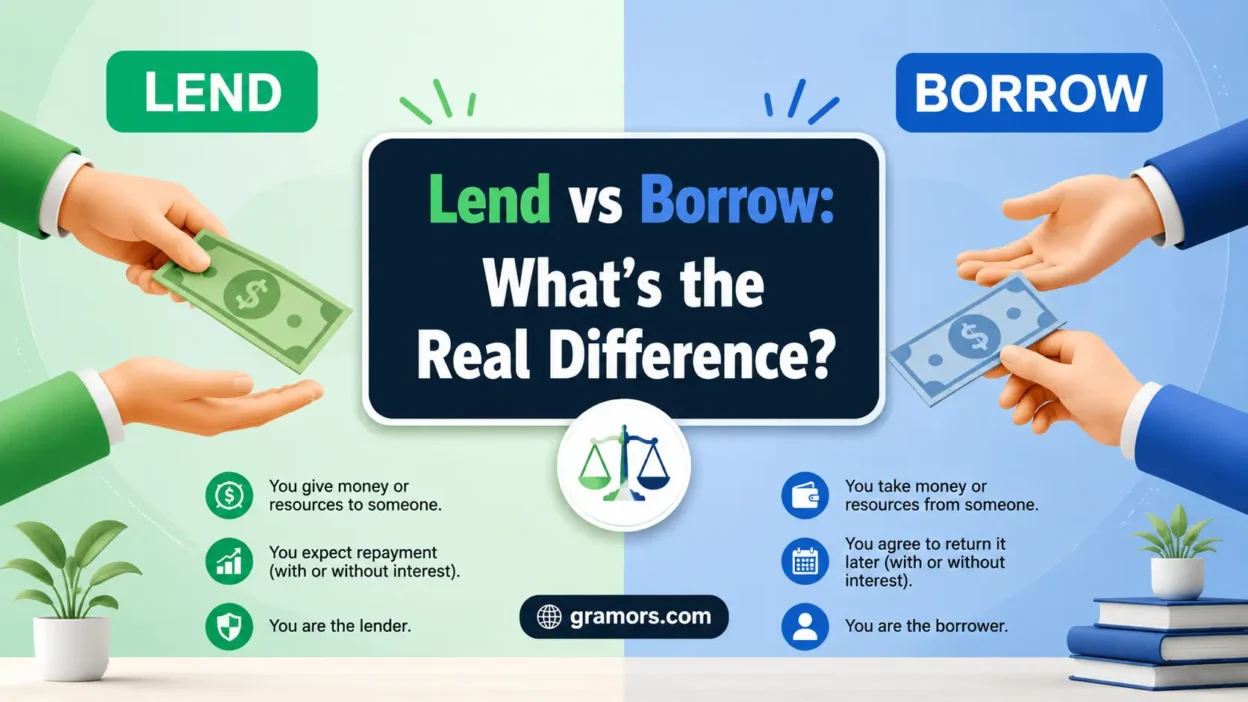
Many English learners mix up “lend” and “borrow” because both words describe the same temporary exchange. The difference is the speaker’s point of view.
In a typical situation, one person gives something temporarily, and another person receives it temporarily. That is where the confusion starts.
For example:
- “Can I borrow your book?”
- “Can you lend me your book?”
Both sentences describe the same situation, but the subject changes. This guide will make the difference between lend vs borrow simple and clear.
Quick Answer
“Lend” means to give something temporarily.
- “Can you lend me your charger?”
“Borrow” means to receive or take something temporarily.
- “Can I borrow your charger?”
The words are related, but they are not interchangeable. The subject of the sentence determines which one is correct.
Incorrect:
- “Can you borrow me your charger?”
Correct:
- “Can you lend me your charger?”
Why People Confuse Them
The confusion happens because both words describe one shared action from different viewpoints.
Imagine this situation:
- Jake lends his bike to Mia.
- Mia borrows Jake’s bike.
It is the same event. The only difference is who the sentence focuses on.
Many languages use one word for both ideas, so learners sometimes transfer that pattern into English. That is why sentences like “Can you borrow me a pen?” are common among learners, even though standard American English uses “lend” there.
The words also appear in similar situations:
- money
- books
- school supplies
- cars
- phones
Because the context is often identical, the direction of the action becomes easy to miss.
Key Differences At A Glance
| Context | Best Choice | Why |
|---|---|---|
| Giving your friend a jacket | lend | The subject gives the item |
| Taking a classmate’s notes | borrow | The subject receives the item |
| A bank providing money | lend | The bank gives money temporarily |
| A customer taking a loan | borrow | The customer receives money |
| “___ me your pen” | lend | The speaker asks someone to give |
| “___ your pen from you” | borrow | The speaker receives from someone |
Quick Comparison
| Feature | lend | borrow |
|---|---|---|
| Main meaning | Give temporarily | Receive temporarily |
| Common pattern | lend someone something | borrow something from someone |
| Focus | The giver | The receiver |
| Usually implies return | Yes | Yes |
Meaning and Usage Difference
“Lend” focuses on the person giving something for temporary use.
Examples:
- “I can lend you my laptop for the weekend.”
- “The library lends books for two weeks.”
Common sentence patterns:
- lend someone something
- lend something to someone
Examples:
- “She lent me her notes.”
- “She lent her notes to me.”
“Borrow” focuses on the person receiving something temporarily.
Examples:
- “I borrowed my brother’s headphones.”
- “Can we borrow chairs from the office?”
Common sentence pattern:
- borrow something from someone
Examples:
- “I borrowed a charger from Sam.”
- “They borrowed money from the bank.”
Both words usually imply the item will be returned. That is an important part of their meaning.
In school and workplace settings, the difference stays the same:
- “My coworker lent me a stapler.”
- “I borrowed a stapler from my coworker.”
With money:
- “The bank lends money.”
- “Customers borrow money.”
These words are closely connected, but they are not exact opposites in every possible context. For example, “lend support” is common, while “borrow support” is not.
Tone, Context, and Formality
Both “lend” and “borrow” are neutral everyday words in American English.
You can use them in:
- casual conversation
- emails
- workplace communication
- school writing
Examples:
- “Could you lend me your umbrella?”
- “I need to borrow your calculator.”
In financial contexts, “lend” often appears alongside “loan.”
Examples:
- “The bank lends money.”
- “The bank offers loans.”
In American English, “loan” can sometimes work as a verb:
- “Can you loan me twenty dollars?”
Still, “lend” remains very common and natural.
Polite requests usually use modal verbs:
- “Could I borrow your phone?”
- “Would you lend me your phone for a minute?”
Neither word is especially formal or informal.
Which One Should You Use?
A simple way to choose is to ask this question:
Who has the item right now?
If the subject gives the item, use “lend.”
- “Can you lend me your jacket?”
If the subject receives the item, use “borrow.”
- “Can I borrow your jacket?”
Another quick memory trick:
- lend = let someone use
- borrow = take for temporary use
Fill-in-the-blank examples:
- “My neighbor _____ me a ladder.”
- Correct: lent
- “I need to _____ a ladder from my neighbor.”
- Correct: borrow
Think about perspective. The action stays the same, but the sentence focus changes.
When One Choice Sounds Wrong
Some combinations sound unnatural or incorrect in standard American English.
Wrong:
- “Can you borrow me a pen?”
Correct:
- “Can you lend me a pen?”
Why? Because the subject is giving the pen, not receiving it.
Wrong:
- “I lent a book from my teacher.”
Correct:
- “I borrowed a book from my teacher.”
Wrong:
- “Can I lend your calculator?”
Correct:
- “Can I borrow your calculator?”
Another common issue is missing prepositions.
Wrong:
- “I borrowed him.”
Correct:
- “I borrowed money from him.”
Standard English normally uses:
- lend to
- borrow from
Some regional or dialectal speech patterns may differ, but the standard forms above are the safest choice in school, work, and professional writing.
Common Mistakes
Mistake:
- “Can you borrow me your notes?”
Fix:
- “Can you lend me your notes?”
Mistake:
- “I need to lend a phone from Jake.”
Fix:
- “I need to borrow a phone from Jake.”
Mistake:
- “She borrowed me twenty dollars.”
Fix:
- “She lent me twenty dollars.”
Mistake:
- “I borrowed him my charger.”
Fix:
- “I lent him my charger.”
Mistake:
- “The bank borrowed us money.”
Fix:
- “The bank lent us money.”
A quick check helps:
- giver = lend
- receiver = borrow
Everyday Examples
Home:
- “Can you lend me the remote?”
- “I borrowed the remote from my sister.”
School:
- “The teacher lent me a marker.”
- “I borrowed a marker from the teacher.”
Work:
- “Our manager lent us a conference room.”
- “We borrowed a conference room for the meeting.”
Money:
- “My dad lent me fifty dollars.”
- “I borrowed fifty dollars from my dad.”
Transportation:
- “Chris lent me his car for the afternoon.”
- “I borrowed Chris’s car for the afternoon.”
Travel:
- “Can you lend me your neck pillow?”
- “I forgot mine, so I borrowed one.”
Technology:
- “She lent me her tablet during class.”
- “I borrowed her tablet to finish my project.”
Neighbors:
- “Our neighbor lent us a garden hose.”
- “We borrowed a garden hose from our neighbor.”
Gym:
- “He lent me his locker key for a minute.”
- “I borrowed his locker key.”
Office:
- “Could you lend me your charger?”
- “I borrowed a charger from the front desk.”
Dictionary-Style Word Details
Verb
• lend:
A verb meaning to give something temporarily with the expectation that it will be returned.
Common patterns:
- lend someone something
- lend something to someone
Examples:
- “She lent me her headphones.”
- “He lent his bike to a friend.”
• borrow:
A verb meaning to take or receive something temporarily with the intention of returning it.
Common pattern:
- borrow something from someone
Examples:
- “I borrowed a laptop from work.”
- “They borrowed chairs from the church.”
Noun
• lend:
Not commonly used as a noun in modern standard American English.
• borrow:
Sometimes appears as a noun in specialized areas such as finance or computing, though this usage is less common in everyday conversation.
Synonyms
• lend:
Closest plain alternatives:
- loan
- provide temporarily
• borrow:
Closest plain alternatives:
- take temporarily
- use temporarily
Exact synonyms are limited because viewpoint changes the meaning.
Example Sentences
• lend:
- “Could you lend me your jacket?”
- “The library lends books for free.”
• borrow:
- “Can I borrow your jacket?”
- “I borrowed a cookbook from my aunt.”
Word History
• lend:
Comes from Old English and older Germanic language roots connected to allowing or granting temporary use.
• borrow:
Also comes from Germanic language roots and has historical connections to pledges, security, and temporary taking.
The exact historical development of both words stretches back many centuries.
Phrases Containing
• lend:
- “lend a hand”
- “lend support”
- “lend itself to”
• borrow:
- “borrow time”
- “borrow trouble”
- “borrowed words”
FAQs
What is the main difference between “lend” and “borrow”?
“Lend” means giving something temporarily, while “borrow” means receiving something temporarily.
Example:
- “Can you lend me your pen?”
- “Can I borrow your pen?”
Is it “borrow me” or “lend me”?
Standard American English uses “lend me,” not “borrow me.”
Correct:
- “Can you lend me your notes?”
Incorrect:
- “Can you borrow me your notes?”
Do both words imply returning the item?
Yes. Both “lend” and “borrow” usually mean the item will be returned later.
Example:
- “I borrowed his jacket.”
- “She lent me her jacket.”
Which word focuses on the giver?
“Lend” focuses on the giver.
Example:
- “My friend lent me a bike.”
The friend is giving the bike temporarily.
Which word focuses on the receiver?
“Borrow” focuses on the receiver.
Example:
- “I borrowed a bike from my friend.”
The speaker is receiving the bike.
Can “loan” replace “lend”?
Sometimes, yes — especially in American English.
Examples:
- “Can you lend me twenty dollars?”
- “Can you loan me twenty dollars?”
Both are common and natural.
What prepositions are commonly used?
“Lend” often uses to.
Example:
- “She lent money to her cousin.”
“Borrow” often uses from.
Example:
- “He borrowed money from his cousin.”
Is this sentence correct: “I borrowed him my book”?
No.
Correct:
- “I lent him my book.”
or
- “He borrowed my book.”
Why do learners confuse “lend” and “borrow”?
Many languages use one word for both ideas, so learners may translate directly into English. The confusion also happens because both words describe the same exchange from different viewpoints.
How can I remember the difference easily?
Use this simple rule:
- giver = lend
- receiver = borrow
Examples:
- “She lent me her phone.”
- “I borrowed her phone.”
Can banks “borrow” money to customers?
No. Banks usually lend money, while customers borrow money.
Correct:
- “The bank lends money.”
- “Customers borrow money from the bank.”
Is “lend” more formal than “borrow”?
No. Both are common everyday words used in casual and professional English.
Examples:
- “Could I borrow your charger?”
- “Could you lend me your charger?”
Conclusion
The difference between lend vs borrow comes down to perspective.
Use “lend” when someone gives something temporarily:
- “Can you lend me your notebook?”
Use “borrow” when someone receives something temporarily:
- “Can I borrow your notebook?”
Both words describe the same exchange, but from opposite directions. Once you focus on who gives and who receives, the correct choice becomes much easier.