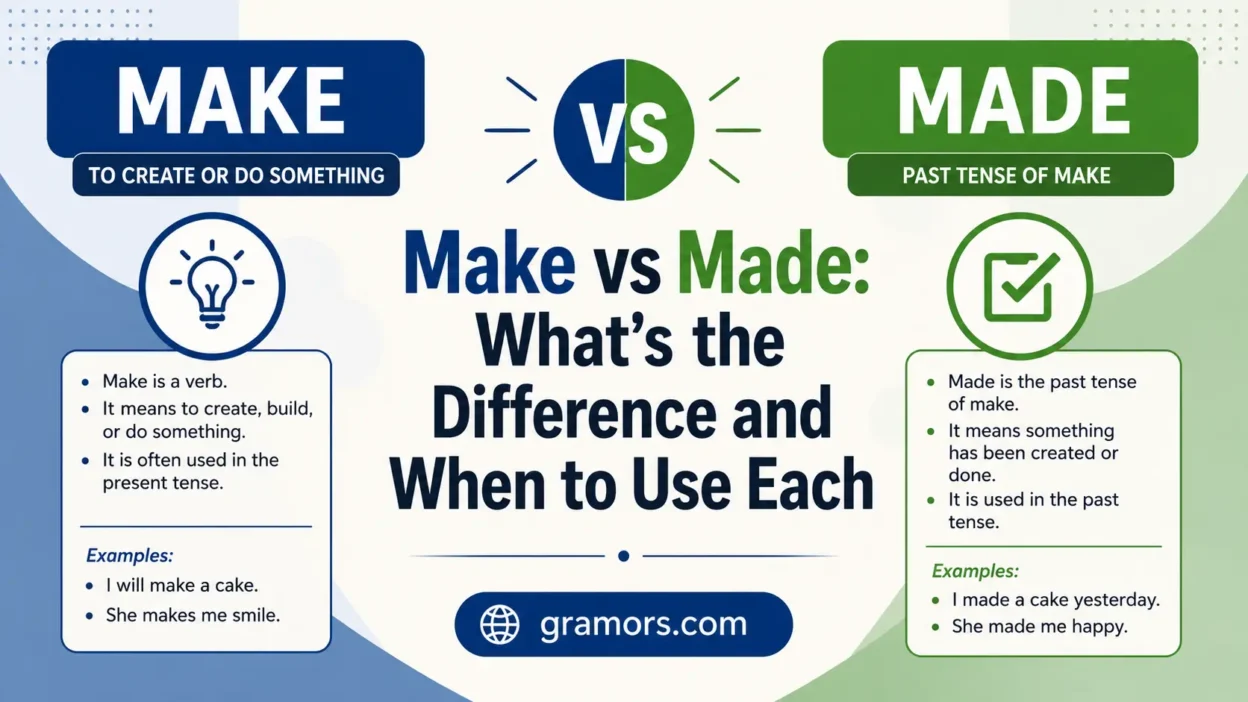
Many English learners mix up “make” and “made” because both words come from the same verb. The difference is not about meaning alone. It mostly comes down to grammar and sentence structure.
In simple terms, “make” is the base or present form, while “made” is used for past and completed actions. That sounds easy, but confusion often happens after helper verbs like “did,” “have,” or “can.”
For example:
- “I make coffee every morning.”
- “I made coffee this morning.”
This guide will make the difference between make vs made clear with real examples and quick rules you can actually use.
Quick Answer
“Make” is the base form of the verb. Use it for present actions, commands, infinitives, and after modal verbs.
Examples:
- “She will make dinner.”
- “Please make a copy.”
“Made” is the past tense and past participle form of “make.” Use it for completed past actions and perfect or passive structures.
Examples:
- “She made dinner.”
- “They have made progress.”
The two words are connected, but they are not interchangeable.
Why People Confuse Them
The biggest reason for confusion is that “make” is an irregular verb. Instead of adding “-ed” in a regular pattern, the verb changes form:
- make
- made
- made
Both words also keep the same core idea of creating, producing, causing, or preparing something. The grammar changes, but the basic meaning stays connected.
Helper verbs create even more confusion. Many learners incorrectly combine two past markers in one sentence.
Incorrect:
- “Did you made it?”
Correct:
- “Did you make it?”
After “did,” English uses the base verb, not the past form.
The same rule applies after modal verbs:
- “can make”
- “should make”
- not “can made” or “should made”
Key Differences At A Glance
| Context | Best Choice | Why |
|---|---|---|
| Present habits | make | Uses the base/present form |
| Commands | make | Commands use the base verb |
| After “can,” “will,” or “should” | make | Modal verbs take the base form |
| Finished past action | made | Shows a completed action |
| After “have,” “has,” or “had” | made | Perfect tenses use the past participle |
| Passive voice | made | Passive structures use the participle form |
Quick Comparison
- make = base form or present-tense form
- made = past tense and past participle
- make follows modal verbs and infinitives
- made appears in completed, passive, and perfect structures
Meaning and Usage Difference
The core meaning of both words is similar. They usually relate to creating, producing, building, causing, earning, or preparing something.
The real difference is grammatical use.
“Make” works as the base form and present-tense verb.
Examples:
- “We make our own bread.”
- “I want to make a change.”
- “Please make room.”
“Made” is used when the action is completed or connected to a perfect structure.
Examples:
- “We made our own bread.”
- “They have made improvements.”
- “She had made a mistake before the meeting.”
“Made” also appears in passive voice sentences.
Examples:
- “The bread was made fresh today.”
- “This phone is made in the USA.”
In some cases, “made” acts like an adjective.
Examples:
- “homemade cookies”
- “ready-made furniture”
That does not turn it into a separate word. It still comes from the verb “make.”
Tone, Context, and Formality
Neither word is naturally more formal than the other. Grammar determines the correct choice, not tone.
You can hear both in casual conversation, business meetings, emails, classrooms, and news writing.
Examples:
- “I made it!”
- “Let’s make a deal.”
- “We made a decision yesterday.”
In spoken American English, contractions often appear with “made.”
Examples:
- “I’ve made enough food already.”
- “She’d made plans before we called.”
The context changes the verb form, but not the level of formality.
Which One Should You Use?
Use “make” when the action is happening now, happens regularly, or follows certain helper verbs.
Use “made” when the action already happened or when the sentence uses a perfect or passive structure.
Here are the quickest rules:
- Present action → “make”
- Finished action → “made”
- After “did” → “make”
- After modal verbs → “make”
- After “have,” “has,” or “had” → “made”
Examples:
- “Can you make tea?”
- “They made dinner already.”
- “We have made changes.”
- “Did she make a reservation?”
A simple shortcut helps:
If another helper verb already carries the tense, the main verb usually returns to the base form.
When One Choice Sounds Wrong
Some combinations sound unnatural because the grammar structure is broken.
Incorrect:
- “She can made it.”
Correct:
- “She can make it.”
Why? Modal verbs like “can” require the base verb.
Incorrect:
- “Did you made lunch?”
Correct:
- “Did you make lunch?”
Why? “Did” already marks the sentence as past tense.
Incorrect:
- “They have make progress.”
Correct:
- “They have made progress.”
Why? Perfect tenses require the past participle.
Incorrect:
- “To made a list”
Correct:
- “To make a list”
Why? Infinitives use the base form after “to.”
Common Mistakes (and Quick Fixes)
One of the most common errors is using “made” after helper verbs.
Wrong:
- “Did you made it?”
Right:
- “Did you make it?”
Another mistake is using the base form after “have” or “has.”
Wrong:
- “We have make plans.”
Right:
- “We have made plans.”
Learners also mix up infinitives.
Wrong:
- “I want to made dinner.”
Right:
- “I want to make dinner.”
Quick memory tip:
- helper verb + base form → make
- have/has/had + participle → made
Everyday Examples
Here are some natural American English examples that show how both words work in daily life.
Work:
- “We make weekly reports for the sales team.”
- “The manager made a decision this morning.”
School:
- “I make notes during class.”
- “She made a great presentation yesterday.”
Cooking:
- “Can you make pancakes tonight?”
- “Dad made dinner after work.”
Travel:
- “Let’s make a hotel reservation.”
- “They made it to the airport on time.”
Conversation:
- “You make me laugh.”
- “We made friends at the concert.”
Common collocations include:
- make money
- make progress
- make a decision
- made a mistake
- made friends
- made dinner
Dictionary-Style Word Details
Verb
- make: Base form and present-tense form of the verb. It also appears after modal verbs and infinitives. The irregular pattern is make–made–made.
- made: Past tense and past participle form of “make.” It appears in completed actions, passive voice, and perfect tenses.
Noun
- make: Sometimes used as a noun, especially for brands or models, such as “car make.”
- made: Not commonly used as a noun in modern English.
Synonyms
- make: Closest plain alternatives include “create,” “produce,” and “build,” depending on context.
- made: Exact synonyms usually depend on the sentence structure because it is a past form. Context matters more than direct replacement.
Example Sentences
- make: “I make notes during class.”
- make: “They make furniture.”
- made: “She made lunch earlier.”
- made: “The movie was made in Canada.”
Word History
- make: Comes from Old English roots connected to creating, building, or causing something to happen.
- made: Developed as the irregular past and participle form of “make.”
Phrases Containing
- make: “make sense,” “make progress,” “make a decision”
- made: “made for each other,” “ready-made,” “homemade”
In some phrases, “made” functions more like an adjective than a standard verb form.
FAQ
Is “made” the past tense of “make”?
Yes. “Made” is both the past tense and past participle form of “make.”
- “She made coffee.”
- “They have made dinner.”
Can “made” be an adjective?
Yes. It appears adjectivally in phrases like “homemade soup” and “ready-made meals.”
Why is “did made” incorrect?
Because “did” already marks the sentence as past tense. The main verb must return to the base form.
Correct:
- “Did you make it?”
Is “have made” correct?
Yes. Perfect tenses use the past participle.
Example:
- “We have made progress.”
Can “make” and “made” replace each other?
Usually no. They belong to different grammatical structures.
- “I make lunch every day.”
- “I made lunch yesterday.”
Conclusion
The difference between “make” and “made” is mainly about grammar structure and time reference. “Make” works as the base or present form, while “made” is used for past and completed actions.
A simple comparison helps:
- “I make breakfast every morning.”
- “I made breakfast this morning.”
Once you understand the helper-verb patterns, make vs made becomes much easier to use correctly in everyday English.