Many English learners confuse come and came because both belong to the same irregular verb family and describe movement toward a place or person.
The real difference is grammar structure and time reference.
Compare these:
- “I come here every day.”
- “I came here yesterday.”
Only one fits present or base-form structures, while the other fits completed past actions.
This guide on come vs came explains exactly when to use each form and why mistakes like “did came” sound incorrect in standard English.
Quick Answer
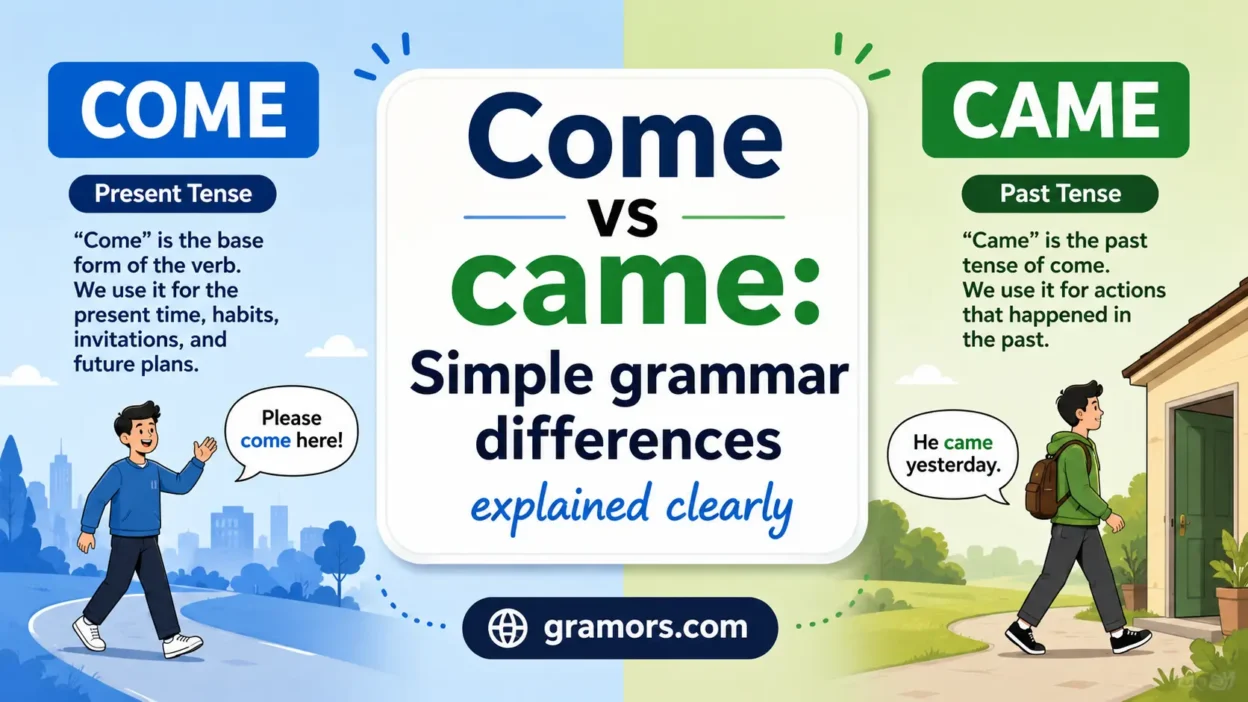
- come = base form or present-tense form
- came = simple past tense form
Examples:
- “Did you come?” ✔
- “She came late.” ✔
Important rule:
- Use come after helping verbs like did, will, can, have, and has.
- Never use came after helper verbs.
Examples:
- ✔ “Did he come?”
- ❌ “Did he came?”
Also, “come” is not only present tense. It can also appear in perfect tenses:
- “She has come already.”
Why People Confuse Them
The confusion happens because English irregular verbs do not follow simple “-ed” patterns.
Learners also hear both forms in fast speech and may not notice the grammar structure clearly.
Another issue is that come has several jobs:
- base form
- present-tense form
- past participle
Meanwhile, came only works as the simple past tense.
Common learner mistake:
- ❌ “Did he came?”
- ✔ “Did he come?”
The helper verb “did” already marks the sentence as past tense, so the main verb returns to the base form.
Key Differences At A Glance
| Context | Best Choice | Why |
|---|---|---|
| Present or habitual action | come | base/present form |
| Completed past action | came | simple past tense |
| After helper verbs | come | auxiliaries require base form |
| Perfect tense | come | used as past participle |
| Standalone past action | came | no helper verb needed |
Feature Comparison
| Feature | come | came |
|---|---|---|
| Grammar role | Base form/present/past participle | Simple past tense |
| Used after helper verbs | Yes | No |
| Time reference | Present, general, or perfect structures | Finished past action |
| Example | “Will you come?” | “She came early.” |
Meaning and Usage Difference
“Come” mainly works as the base form of the verb.
It appears in:
- present tense
- imperatives
- infinitives
- perfect tenses
- sentences with helper verbs
Examples:
- “Please come inside.”
- “They usually come early.”
- “She has come already.”
- “Will you come tomorrow?”
“Came” is only the simple past tense form.
Examples:
- “He came home late.”
- “They came last night.”
Key difference:
- come works in several grammar structures
- came only describes a completed past action without helper verbs
Tone, Context, and Formality
Both forms are neutral and standard in American English.
The difference is grammar, not formality.
Examples in conversation:
- “Come here for a second.”
- “She came by earlier.”
In writing:
- “Please come to the office at 2 PM.”
- “The guests came before noon.”
Spoken English often shortens helper structures:
- “Did you come?”
- “Have they come yet?”
But the grammar rule stays the same.
Which One Should You Use?
Use come when:
- the sentence is present tense
- a helper verb appears
- you are using an imperative
- the sentence uses a perfect tense
Use came when:
- the action happened in the past
- no helper verb controls the main verb
Examples:
- “Will you come tomorrow?”
- “He came last week.”
Quick test:
If the sentence contains did, has, have, had, can, or will, use come, not came.
When One Choice Sounds Wrong
Some structures immediately sound incorrect to native speakers.
Examples:
- ❌ “She did came.”
- ✔ “She did come.”
- ❌ “Yesterday I come home.”
- ✔ “Yesterday I came home.”
- ❌ “He has came already.”
- ✔ “He has come already.”
Why these fail:
Helper verbs already carry tense information, so the main verb must stay in the base or participle form.
Common Mistakes (and Quick Fixes)
- ❌ “Did you came?”
✔ “Did you come?” - ❌ “She has came.”
✔ “She has come.” - ❌ “Yesterday they come late.”
✔ “Yesterday they came late.” - ❌ “He will came tomorrow.”
✔ “He will come tomorrow.”
Quick memory tip:
- Helper verb present → use come
- No helper verb + past action → use came
Everyday Examples
Casual conversation:
- “Come with us.”
- “They came early.”
School:
- “Did you come to class?”
- “She came prepared.”
Work:
- “Please come to the meeting.”
- “The manager came late.”
Travel:
- “Will you come to New York?”
- “We came back yesterday.”
Family conversation:
- “Come eat dinner.”
- “Grandpa came over today.”
Questions:
- “Why didn’t you come?”
- “Who came first?”
Social situations:
- “You should come with us.”
- “They came to the party.”
Dictionary-Style Word Details
Verb
- come: base form of the verb used in present tense, imperatives, infinitives, and perfect constructions
- came: simple past tense form of “come” used for completed past actions
Noun
- come: limited noun usage appears in a few informal expressions and idioms
- came: not commonly used as a noun in standard English
Synonyms
- come: arrive, approach, reach (depending on context)
- came: arrived, approached, reached (past-tense equivalents)
Example Sentences
- come: “Please come early.”
- come: “Have they come yet?”
- came: “She came home late.”
Word History
- come comes from Old English verb forms related to movement and arrival.
- came developed as the irregular past-tense form within the historical English verb system.
Phrases Containing
- come: come back, come in, come along, come true
- came: came across, came by, came up
FAQ
Is “came” the past tense of “come”?
Yes. “Came” is the simple past form.
Why is “did come” correct?
Because “did” already marks the sentence as past tense.
Can “come” refer to the past?
Yes. It works as the past participle in perfect tenses:
- “They have come already.”
Is “come” irregular?
Yes. Its forms are:
- come → came → come
Which form follows “has”?
Use come:
- “She has come home.”
Conclusion
The difference between come vs came mainly depends on grammar structure and time reference.
- come = base form, present form, and past participle
- came = simple past tense
Examples:
- “They come here often.”
- “They came here yesterday.”
Focus on helper verbs and time clues, and choosing the correct form becomes much easier.