Writers and speakers often confuse anytime and any time because they sound identical and differ by only a space. Understanding the difference is essential for clear writing in emails, essays, and casual communication. For example: “You can call me anytime” versus “Do you have any time tomorrow to meet?” This guide clarifies their meaning, usage, and common pitfalls.
Quick Answer
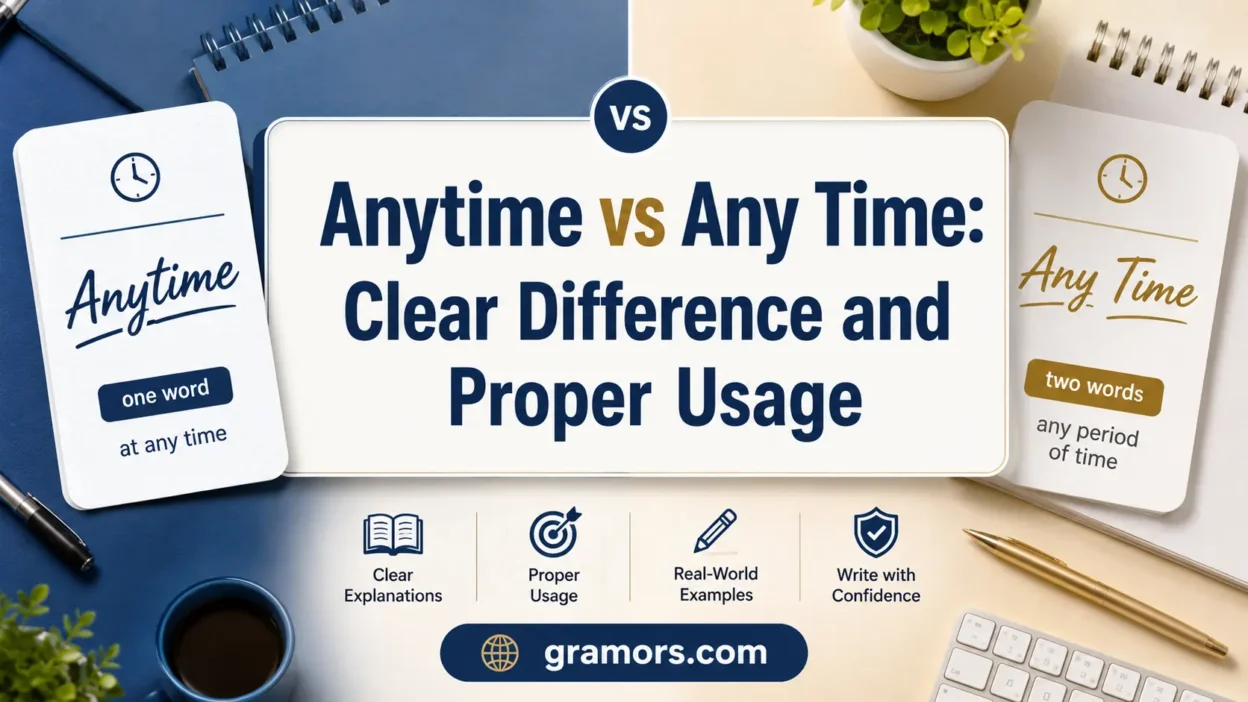
- anytime – an adverb meaning “whenever” or “at any moment.”
- Example: “You can come over anytime.”
- any time – a noun phrase meaning “any amount of time.”
- Example: “Do you have any time this afternoon?”
- They are not interchangeable: one expresses a general moment (adverb), the other a measurable period (noun).
Why People Confuse Them
- Pronunciation: Both are spoken the same.
- Visual similarity: Only one space separates them.
- History of compounding: English trends toward combining words into single forms (anytime) while the open form (any time) remains standard as a noun phrase.
- Speech vs writing habits: People may write what they hear, creating errors like “at anytime” instead of “at any time.”
Key Differences At A Glance
| Context | Best Choice | Why |
|---|---|---|
| Expressing “whenever” | anytime | Acts as an adverb for flexibility in timing. |
| Referring to a measurable period | any time | Functions as a noun phrase indicating duration. |
| After prepositions (at, for) | any time | Correct syntax: “at any time,” not “at anytime.” |
| Casual response | anytime | Friendly and informal usage: “Thanks!” → “Anytime.” |
Quick Usage Tip
- Substitute “whenever” for anytime; if it fits, the adverb form is correct.
- Substitute “a period of time” for any time; if it fits, the noun form is correct.
Meaning and Usage Difference
- anytime (adverb): Expresses flexibility or an open invitation.
- Example: “Call me anytime if you need help.”
- any time (noun phrase): Specifies an amount of time or duration.
- Example: “I don’t have any time for a long meeting today.”
- Preposition note: Always use any time after prepositions like at, for, or in.
- Correct: “You can stop by at any time.”
- Incorrect: “You can stop by at anytime.”
Tone, Context, and Formality
- anytime: Informal but acceptable in friendly emails, text messages, or spoken conversation.
- any time: Neutral tone; standard in formal writing, business correspondence, or academic contexts.
- Both are widely understood in US English; tone differences are subtle.
Which One Should You Use?
- Use anytime when you want to say “whenever” casually.
- Example: “Feel free to reach out anytime.”
- Use any time when referring to a duration, quantity, or when it follows a preposition.
- Example: “Do you have any time next week for a call?”
When One Choice Sounds Wrong
- “I’ll see you at anytime tomorrow.” → Wrong, must be any time
- “You can contact me any time you want.” → Technically correct, but anytime sounds more natural in casual US speech.
- Reason: Prepositions require the noun form; adverb form may sound informal or awkward after prepositions.
Common Mistakes
- Mistake: “Call me at anytime if you need help.”
- Fix: “Call me at any time if you need help.”
- Mistake: “Do you have anytime to talk?”
- Fix: “Do you have any time to talk?”
- Mistake: “Thanks for helping! Any time.” (used formally)
- Fix: Acceptable in casual conversation; use any time in formal writing.
Everyday Examples
- You can come over anytime this week.
- I don’t have any time to finish this report.
- Call me anytime you feel stressed.
- The manager will meet with you at any time this afternoon.
- I’ll answer your emails anytime.
- She doesn’t have any time to waste on distractions.
- Feel free to ask questions anytime in class.
- Are you free at any time next Monday?
- We can start the project anytime after lunch.
- He never seems to have any time for small talk.
Dictionary-Style Word Details
Verb
- Neither anytime nor any time functions as a verb.
Noun
- anytime: Not a noun.
- any time: Proper noun phrase indicating measurable time.
Synonyms
- anytime: whenever, at any moment
- any time: period, stretch, duration
Example Sentences
- anytime: “You can text me anytime.”
- any time: “I don’t have any time left before the meeting.”
Word History
- anytime: Emerged from the natural trend to form adverbs from noun phrases in modern English.
- any time: Traditional English noun phrase; “any” + “time” has been used this way for centuries.
Phrases Containing
- anytime: anytime soon, anytime now
- any time: at any time, for any time, in any time
FAQs
1. Can I always use anytime instead of any time?
- No. Use anytime only as an adverb; after prepositions or when specifying duration, use any time.
2. Is anytime informal?
- Slightly informal; suitable for casual emails, texts, and speech.
3. Can I write “at anytime”?
- Incorrect in standard US English. Always write at any time.
4. Does any time always require a number or amount?
- Not always, but it typically refers to an amount of time or duration.
5. Can anytime and any time be used in questions?
- Yes, but the choice depends on meaning:
- “Do you have any time tomorrow?” → duration
- “Can I call you anytime?” → whenever
6. Are there idiomatic expressions with either form?
- anytime: “anytime soon,” “anytime now”
- any time: “at any time,” “for any time”
Conclusion
In summary, anytime is an adverb meaning “whenever,” while any time is a noun phrase meaning “any amount of time.” Correct usage depends on whether you’re describing flexibility in action or a measurable period. With practice, these distinctions become second nature in US English writing and speech. Remember: “Call me anytime” versus “Do you have any time tomorrow?” — small space, big difference.