
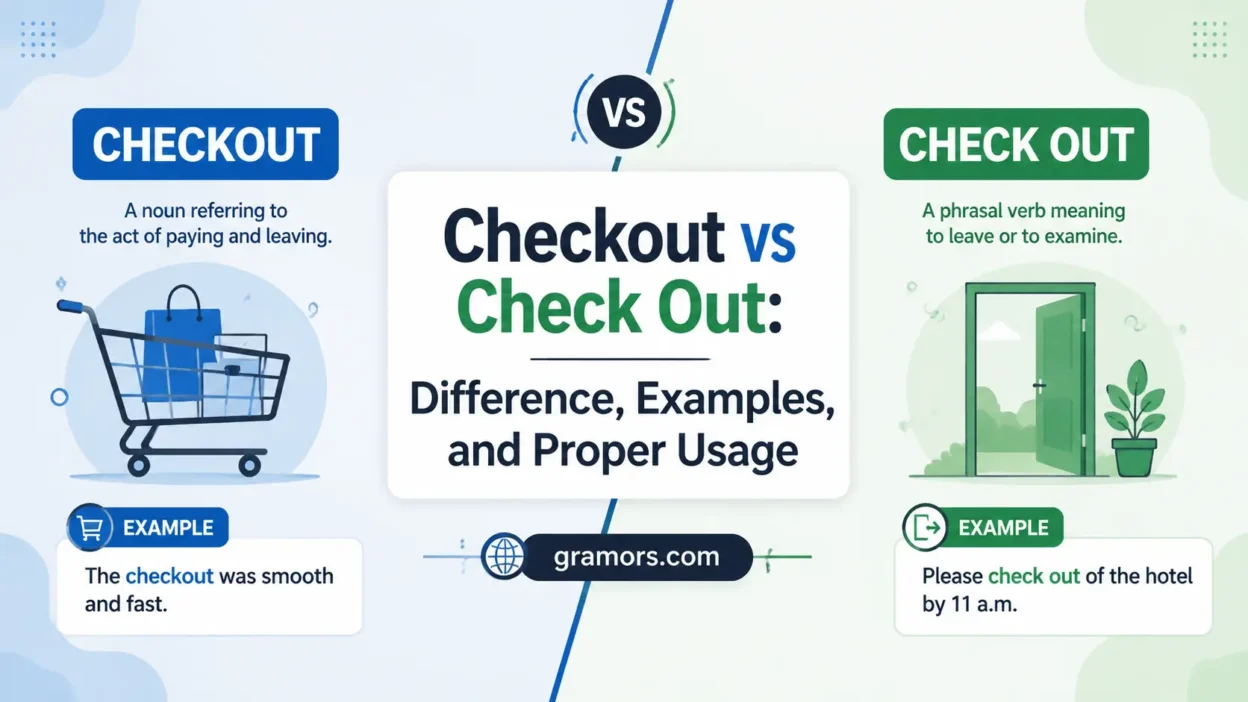
Many writers confuse checkout and check out because they sound alike but serve different grammatical functions.
- Checkout is a noun or adjective, referring to a place, process, or time.
- Check out is a verb phrase, describing an action.
Examples:
- Noun: “Please go to the checkout.”
- Verb: “We need to check out the new library books.”
Getting this distinction right helps in retail, hospitality, e-commerce, and everyday writing.
Quick Answer
- Checkout = noun/adjective; names a thing or process.
- Check out = verb phrase; describes action.
Examples:
- “The checkout line was long.”
- “Let’s check out the museum this weekend.”
This is about grammar, not just spelling.
Why People Confuse Them
Confusion arises because:
- They sound the same.
- Checkout looks like a verb but functions as a noun.
- Digital labels, buttons, and casual speech often mix the forms.
Example: “Click checkout to pay” (noun) vs “Check out this feature” (verb).
Focus on function to avoid errors, not just pronunciation.
Key Differences At A Glance
| Term | Part of Speech | Core Function | Example |
|---|---|---|---|
| checkout | Noun/Adjective | Place, process, or time | “The checkout is open.” |
| check out | Verb phrase | Action: examine, pay, leave | “Please check out the book.” |
Quick tip: replace checkout with “payment point” or check out with “examine” to test correctness.
Meaning and Usage Difference
- Checkout identifies a system, location, or process.
- Example: “The online checkout was smooth.”
- Check out describes performing the action of examining, leaving, or paying.
- Example: “We will check out of the hotel by 11 a.m.”
Extended uses:
- Examine: “Check out the new app.”
- Try: “Check out this restaurant.”
Tone, Context, and Formality
- Checkout appears in written instructions, e-commerce, and formal contexts.
- Check out is common in conversation, informal emails, and instructions.
Examples:
- Email: “Please proceed to the checkout page.”
- Conversation: “Let’s check out the new café.”
Both are standard US English; tone varies with context.
Which One Should You Use?
Step 1: Identify function.
- Noun/adjective → checkout
- Action → check out
Step 2: Test substitution.
- “Payment point” fits? → checkout ✅
- “Examine/inspect” fits? → check out ✅
Examples:
- “Complete the checkout before leaving.”
- “We should check out the exhibit.”
Step 3: Watch hyphenation.
- Some style guides allow check‑out as a noun; checkout is more common.
When One Choice Sounds Wrong
Incorrect: “I will checkout the new features now.” ❌
Correct: “I will check out the new features now.” ✅
Incorrect: “Go to the check out to pay.” ❌
Correct: “Go to the checkout to pay.” ✅
Errors usually occur when noun/verb roles are swapped.
Common Mistakes
| Mistake | Correction |
| “I checkout my email.” | “I check out my email.” |
| “The check out line is long.” | “The checkout line is long.” |
| “Click check out to complete purchase.” | “Click checkout to complete purchase.” |
Avoid hyphen confusion and confirm sentence role first.
Everyday Examples
- “The checkout counter is busy this morning.”
- “We need to check out the new library books.”
- “Complete your online checkout carefully.”
- “Don’t forget to check out the latest updates.”
- “The hotel checkout time is 11 a.m.”
- “Please check out the museum exhibit.”
- “The checkout process was fast and easy.”
- “Let’s check out that restaurant tonight.”
Dictionary-Style Word Details
Verb
- check out: phrasal verb meaning to examine, leave, pay, or verify.
- checkout: not used as a verb.
Noun
- checkout: location or process for payment or verification.
- check out: not a noun.
Synonyms
- checkout: register, payment point, counter.
- check out: examine, inspect, verify.
Example Sentences
- checkout: “The checkout line moved quickly.”
- check out: “We need to check out the new library section.”
Word History
- checkout: evolved from verb phrase check out into a compound noun for processes.
- check out: phrasal verb has long history in English, literal “look at, verify, leave.”
Phrases Containing
- checkout: checkout line, checkout page, backup checkout.
- check out: check out of hotel, check out a book, check out the software.
FAQs
Is “checkout” ever a verb?
No. Use check out for actions.
Can “check out” be hyphenated?
Rarely as a noun in older texts (check‑out), but modern usage favors checkout.
When do I use “checkout” vs “check out”?
Noun/adjective → checkout; action → check out.
Is “check out” informal?
No. It is correct in standard US English for verb phrases.
What if a UI button says “Checkout”?
Acceptable as noun for payment; action buttons may vary by interface.
Conclusion
Checkout names a place or process; check out describes the action.
Final examples:
- Noun: “Complete the checkout before leaving the store.”
- Verb: “Please check out the new exhibit at the museum.”
Always check grammatical function first to ensure clarity and professional writing.