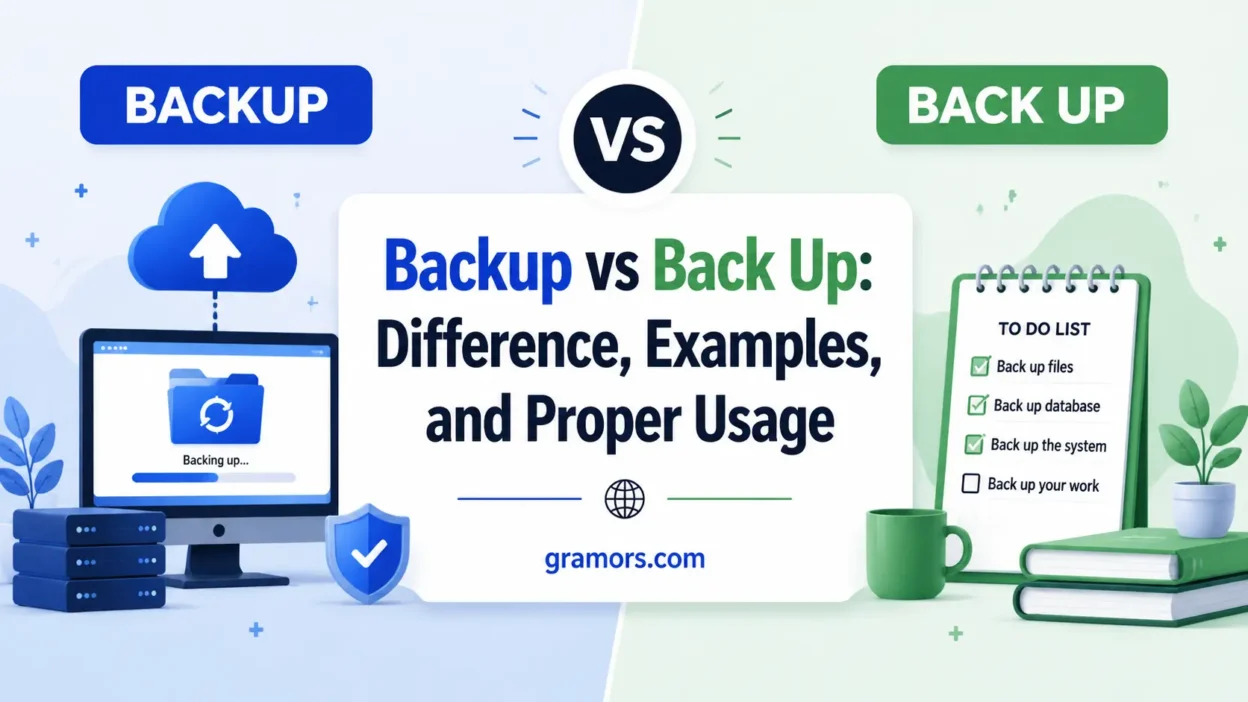
Confusion between backup and back up is common in writing and conversation. Both terms involve similar words but have distinct grammatical roles and meanings.
Examples:
- Noun: “I need a backup copy of the file.”
- Verb: “Please back up your files before updating.”
Using the wrong form can create ambiguity, especially in technical instructions, business communications, or casual writing.
Quick Answer
- Backup = noun or adjective. Refers to a copy, reserve, or plan.
- Back up = verb phrase. Describes the action of creating a copy or moving backward.
Examples:
- Noun: “The backup plan is ready.”
- Adjective: “Make a backup folder.”
- Verb: “Remember to back up your documents.”
The distinction is about grammatical function, not pronunciation.
Why People Confuse Them
Confusion arises because:
- They sound the same in speech.
- Both involve the words back + up.
- Phrasal verbs often overlap with compound nouns in formation.
Example: Saying “I will backup my files” aloud sounds correct, but written usage requires back up for the verb.
Focus on function, not just sound, to avoid errors.
Key Differences At A Glance
| Term | Part of Speech | Core Sense | Example |
|---|---|---|---|
| backup | Noun / Adjective | Reserve, copy, contingency | “We have a backup plan.” |
| back up | Verb phrase | Create a copy; move backward | “Please back up your data.” |
Remember: backup rarely functions as a verb in modern US English.
Meaning and Usage Difference
- Backup: Names a reserve, duplicate, or system prepared for emergencies.
- Example: “A backup of the database is essential.”
- Back up: Action of creating a copy, returning to a previous position, or supporting someone.
- Example: “Always back up your files daily.”
Literal vs figurative uses:
- Literal: “Back up the truck.”
- Figurative: “I’ll back up your story in the meeting.”
Tone, Context, and Formality
- Backup: Common in technical writing, business plans, or instructions.
- Back up: Appears in action instructions, informal conversation, or user guidance.
Examples:
- Business: “Ensure backup servers are operational.”
- Casual: “Don’t forget to back up your game progress.”
Both are standard US English. Tone varies with context, not grammar.
Which One Should You Use?
Step 1: Determine function.
- Naming a thing or plan? → backup
- Describing an action? → back up
Step 2: Substitute to check meaning.
- “Reserve” fits? → backup ✅
- “Copy” or “move backward” fits? → back up ✅
Examples:
- “Create a backup folder for your work.”
- “Please back up the presentation before the meeting.”
Step 3: Check adjectives.
- “Backup folder” is acceptable; “back up folder” is incorrect.
When One Choice Sounds Wrong
Incorrect: “I will backup my files now.” ❌
Correct: “I will back up my files now.” ✅
Incorrect: “The files need to back up before the update.” ❌ (noun intended)
Correct: “The backup files are ready before the update.” ✅
Hyphenated forms (back‑up) are occasionally seen but less common in US technical writing.
Common Mistakes
| Mistake | Correction |
| “I backup my computer.” | “I back up my computer.” |
| “We need to backup plan.” | “We need a backup plan.” |
| “Backed up the files yesterday” | Correct verb usage: “Backed up the files yesterday.” |
Avoid overcomplicating; focus on verb vs noun distinction.
Everyday Examples
- Tech: “The server backup ran overnight.”
- Office: “Please back up your spreadsheets.”
- Conversation: “I always back up my phone photos.”
- School: “The backup printer is in the supply room.”
- Events: “Set up a backup plan for outdoor activities.”
- Instruction: “Back up your accounts regularly.”
Variety shows clarity across contexts.
Dictionary-Style Word Details
Verb
- back up: Phrasal verb, action of copying, moving backward, or supporting.
- backup: Not a verb.
Noun
- backup: Refers to duplicate, reserve, or contingency.
- back up: Not a noun.
Synonyms
- backup: reserve, duplicate, contingency.
- back up: copy, reverse, support, reinforce.
Example Sentences
- backup: “Our backup systems prevent data loss.”
- back up: “Don’t forget to back up your work tonight.”
Word History
- backup: Emerged from compound formation of back + up as noun/adjective.
- back up: Phrasal verb evolved from literal movement to figurative digital action.
Phrases Containing
- backup: backup plan, backup copy, backup system.
- back up: back up files, back up your argument, back up the truck.
FAQs
Is “backup” ever a verb?
Rarely. Modern usage prefers back up for actions.
Can “back‑up” be hyphenated?
Yes, mostly as a noun; less common in standard US English.
Do I say “back up your data” or “backup your data”?
Verb → back up. Noun → backup.
Can “backup” be used informally for action?
Some people use it colloquially, but formal writing requires back up for verbs.
Is “back up” interchangeable with “backup” in all contexts?
No. Grammar role decides usage: verb = back up; noun/adjective = backup.
Conclusion
Backup names a thing: a copy, reserve, or system.
Back up describes the action of making that copy or preparing the arrangement.
Final examples:
- Noun: “Ensure the backup is current.”
- Verb: “Always back up your work before leaving.”
Check function first—your writing will be clear, accurate, and professional.