The confusion between altogether vs all together is common because the two forms sound the same. But they do not mean the same thing.
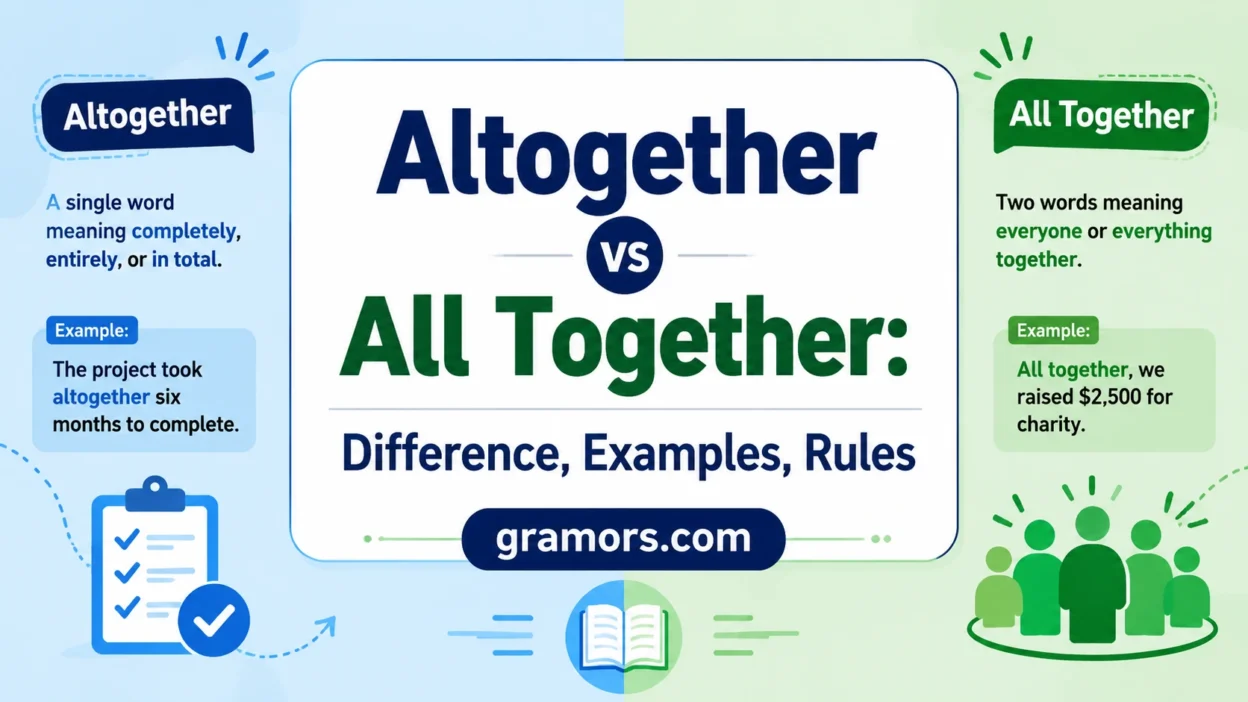
Altogether is one word.
It was altogether different.
All together is two words.
We were all together.
The first sentence means completely different. The second means everyone was together as a group. They are not interchangeable.
Quick Answer
Use altogether when you mean completely, in total, or on the whole.
The plan was altogether new.
Altogether, the repairs cost $900.
Use all together when you mean as a group or in one place.
The kids sang all together.
We put the files all together in one folder.
Why People Confuse Them
People confuse these forms because they are homophones. In speech, the meaning usually comes from context.
For example, if someone says, “They were all together different,” the listener may not know whether the speaker means:
They were all together, different from the others.
They were altogether different from the others.
The spelling matters because it shows the intended meaning. Still, pronunciation is not the rule. Meaning is.
Key Differences At A Glance
| Context | Best Choice | Why |
|---|---|---|
| Meaning “completely” | altogether | It modifies the whole idea. |
| Meaning “in total” | altogether | It gives a full amount. |
| Meaning “on the whole” | altogether | It sums up a judgment. |
| Meaning “as a group” | all together | It shows people or things together. |
| Meaning “in one place” | all together | It shows grouping or location. |
| Replacement test | depends | Use “completely” for altogether; use “as a group” for all together. |
Compact comparison:
- Altogether = completely, entirely, in total, or on the whole.
- All together = as a group or in one place.
- Altogether is one adverb.
- All together is a two-word phrase.
- Altogether different means completely different.
- All together now means everyone together now.
Meaning and Usage Difference
Altogether is an adverb. It can mean completely.
The story was altogether false.
That is an altogether different issue.
It can also mean in total.
Altogether, we raised $2,400.
There were 15 people altogether.
It can mean on the whole.
Altogether, the event went well.
The proposal is altogether reasonable.
All together is a phrase. It means together as a group or in one place.
The students stood all together.
Keep the receipts all together.
The family traveled all together.
You can also split the words when the sentence needs it.
They all came together after dinner.
The pieces all fit together.
That is another clue: all together is not a fixed one-word adverb. It can work as separate words in a sentence.
Tone, Context, and Formality
Both forms are standard in English.
Altogether can sound slightly more formal when it means on the whole.
Altogether, the study supports the claim.
Altogether, the proposal is strong.
It also works in everyday writing.
That movie was altogether too long.
All together is neutral. It fits family, school, work, and casual writing.
Let’s sit all together.
Please keep the forms all together.
Do not turn style into a grammar rule. The right choice depends on meaning.
Which One Should You Use?
Use a replacement test.
If completely works, use altogether.
The plan was altogether new.
The plan was completely new.
If in total works, use altogether.
Altogether, the bill came to $120.
In total, the bill came to $120.
If on the whole works, use altogether.
Altogether, it was a good trip.
On the whole, it was a good trip.
If as a group or in one place works, use all together.
The team arrived all together.
The team arrived as a group.
Sometimes a sentence may need rewriting for clarity.
Unclear: The students were altogether ready.
Clearer: The students were completely ready.
Clearer: The students were all together and ready.
When One Choice Sounds Wrong
Wrong: We sat altogether in one room.
Right: We sat all together in one room.
Why: The sentence means as a group in one place.
Wrong: The task was all together impossible.
Right: The task was altogether impossible.
Why: The sentence means completely impossible.
Wrong: There were 30 guests all together.
Better: There were 30 guests altogether.
Why: The sentence gives a total number.
Wrong: The family was altogether for dinner.
Right: The family was all together for dinner.
Why: The sentence means the family was in the same place.
Common Mistakes
Mistake: Using all together for a total.
Wrong: The tickets cost $80 all together.
Right: The tickets cost $80 altogether.
Mistake: Using altogether for group location.
Wrong: We were altogether at the table.
Right: We were all together at the table.
Mistake: Using all together for “completely.”
Wrong: That is all together wrong.
Right: That is altogether wrong.
Mistake: Using altogether for object grouping.
Wrong: Put the papers altogether.
Right: Put the papers all together.
Mistake: Misusing a sentence opener.
Wrong: All together, the meeting was useful.
Right: Altogether, the meeting was useful.
Mistake: Confusing group action with a summary.
Wrong: Altogether now, sing the chorus.
Right: All together now, sing the chorus.
Everyday Examples
Work:
Altogether, the project took six weeks.
The team sat all together for the training.
School:
The answer is altogether correct.
The students lined up all together.
Family:
Altogether, the trip was worth it.
We were all together for Thanksgiving.
Travel:
The hotel cost $600 altogether.
Our group boarded the bus all together.
Money:
Altogether, I spent less than $50.
Keep all the receipts all together.
Events:
Altogether, the concert was a success.
The singers came on stage all together.
Dictionary-Style Word Details
Verb
• altogether: Not commonly a verb. It does not name an action.
• all together: Not a verb as a full phrase, though together can appear with verbs.
Example:
They worked together.
Noun
• altogether: Rarely, the altogether can be used informally to mean nudity. This is not the normal use in this comparison.
• all together: Not commonly a noun.
For ordinary writing, neither form is mainly used as a noun.
Synonyms
• altogether: Context-based alternatives include completely, entirely, totally, in total, and on the whole.
• all together: Context-based alternatives include as a group, together, collectively, and in one place.
Choose the synonym that matches the sentence.
Example Sentences
• altogether: The project was altogether successful.
• altogether: Altogether, we collected 40 donations.
• all together: The team arrived all together.
• all together: Please keep the supplies all together.
Word History
• altogether: It was formed from all and together, but it now works as a fixed one-word adverb.
• all together: This remains a transparent two-word phrase.
The modern distinction is more useful than the history: one word for completely or in total, two words for as a group.
Phrases Containing
• altogether: in the altogether, altogether different, altogether too.
• all together: all together now, put it all together, get everyone all together.
These phrases show the contrast clearly.
FAQs
Is it altogether or all together?
Use altogether for completely, in total, or on the whole. Use all together for as a group or in one place.
Altogether, we saved $300.
We sat all together.
Is altogether one word?
Yes, when it means completely, in total, or on the whole.
That is altogether different.
Is all together two words?
Yes, when it means as a group or in one place.
The kids played all together.
Are altogether and all together interchangeable?
No. They sound the same, but they mean different things.
The trip was altogether fun.
The group traveled all together.
What are synonyms for altogether?
Possible choices include completely, entirely, in total, and on the whole.
The plan was altogether new.
The plan was completely new.
What are synonyms for all together?
Possible choices include as a group, collectively, and in one place.
The team arrived all together.
The team arrived as a group.
Conclusion
The rule for altogether vs all together is simple.
Altogether means completely, in total, or on the whole. All together means as a group or in one place.
The bill was $80 altogether.
We ate dinner all together.