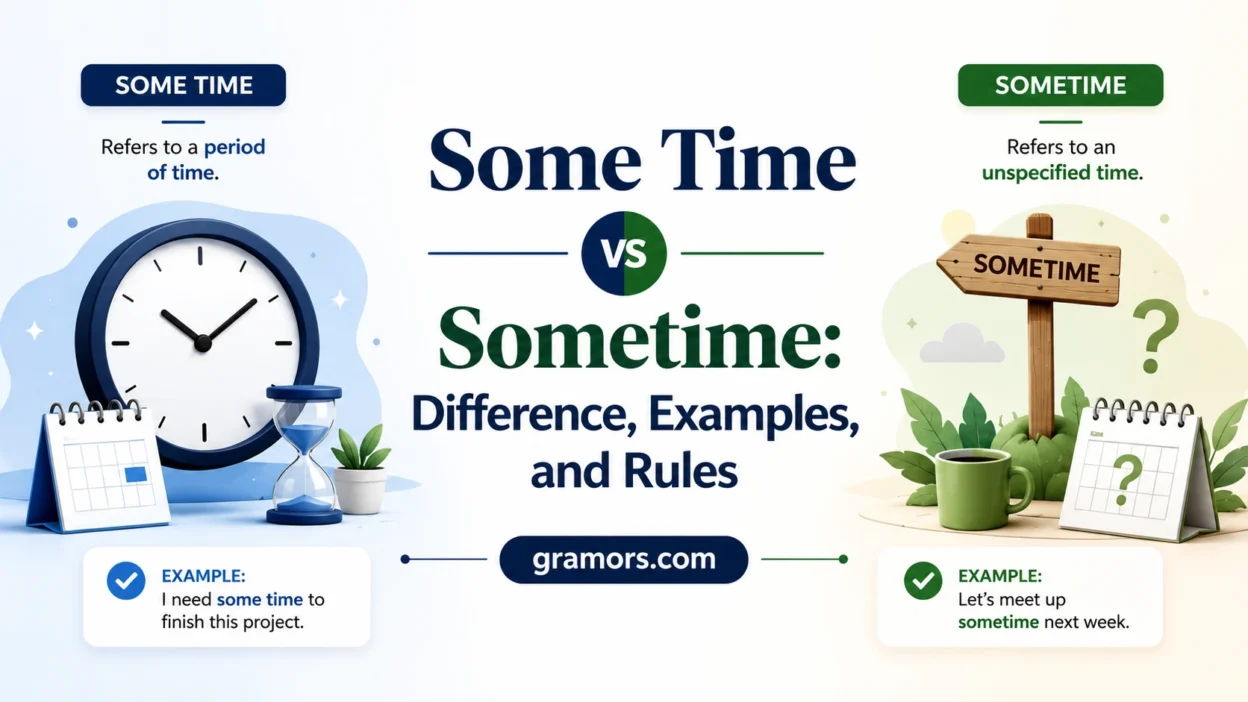
The confusion between some time vs sometime is common because the forms look almost the same. The space changes the grammar and the meaning.
Some time means a period of time.
Give me some time.
Sometime means at an unspecified point in time.
Call me sometime.
Both forms are correct, but they are not interchangeable.
Quick Answer
Use some time when you mean a period of time or a while.
I need some time.
We spent some time together.
Use sometime when you mean at an unspecified point in time.
Let’s meet sometime.
I’ll call sometime next week.
The quick rule is simple: some time is about duration. Sometime is about an indefinite moment.
Why People Confuse Them
People confuse these forms because the spelling is nearly identical. They also share the same root word and both relate to time.
Compare:
We talked some time later.
We talked sometime later.
The first sentence can suggest a length of time passed before the talk. The second means the talk happened at an unspecified later point.
The difference is not only the space. The space signals a different meaning.
Key Differences At A Glance
| Context | Best Choice | Why |
|---|---|---|
| Meaning “a period of time” | some time | It refers to duration. |
| Meaning “at some point” | sometime | It refers to an unspecified moment. |
| After verbs like “need” or “spend” | some time | The sentence needs a time amount. |
| With phrases like “next week” or “soon” | sometime | It points to an unclear time within a period. |
| Answering “How long?” | some time | It gives or suggests duration. |
| Answering “When?” | sometime | It points to timing. |
Compact comparison:
- Some time = a period of time.
- Sometime = at an unspecified point in time.
- Some time answers how long?
- Sometime answers when?
- Some time is a noun phrase.
- Sometime is usually an adverb.
Meaning and Usage Difference
Some time means a period, amount, or span of time. It often appears after verbs such as need, take, spend, save, or give.
I need some time to decide.
Take some time to rest.
We spent some time together.
Give me some time before I answer.
In these sentences, some time works like a while or a period of time.
Sometime means at an unspecified point in time. It often appears with future or past time phrases.
Visit sometime.
Call sometime next week.
I saw him sometime last summer.
The package should arrive sometime soon.
In these sentences, sometime tells when, but not exactly when.
There is also a less common adjective use of sometime, meaning former.
The sometime mayor spoke at the event.
That use is real, but it is not the main rule for everyday writing.
Tone, Context, and Formality
Both some time and sometime are standard in English. The choice is about meaning, not formality.
Casual conversation:
Give me some time.
Come over sometime.
Professional writing:
Please allow some time for review.
Let’s schedule a call sometime next week.
School writing:
The project took some time to complete.
The event happened sometime in June.
Neither form is more correct by tone alone. Context decides the choice.
Which One Should You Use?
Ask what question the phrase answers.
If it answers how long?, use some time.
I need some time.
She spent some time studying.
The repair may take some time.
If it answers when?, use sometime.
Let’s talk sometime.
Email me sometime tomorrow.
They moved sometime last year.
Use this memory trick:
Some time = some amount of time.
Sometime = some point in time.
The test works best when you read the whole sentence, not just the phrase.
When One Choice Sounds Wrong
The wrong form can confuse the reader.
Wrong: I need sometime to think.
Correct: I need some time to think.
Why: The sentence means a period of time.
Wrong: Let’s meet some time next week.
Usually better: Let’s meet sometime next week.
Why: The sentence means at an unspecified point next week.
Wrong: We spent sometime together.
Correct: We spent some time together.
Why: Spent needs a duration.
Wrong: Call me some time.
Usually better: Call me sometime.
Why: The meaning is an unspecified future time, not a length of time.
Common Mistakes
Mistake: Missing the space for duration.
Wrong: Give me sometime.
Right: Give me some time.
Mistake: Using two words for an indefinite point.
Wrong: I’ll visit some time soon.
Right: I’ll visit sometime soon.
Mistake: Using sometime after spend.
Wrong: We spent sometime at the park.
Right: We spent some time at the park.
Mistake: Using sometime after take.
Wrong: This will take sometime.
Right: This will take some time.
Mistake: Misreading duration as a date.
Wrong: I need sometime next week to finish.
Right: I need some time next week to finish.
The last sentence means the person needs a block of time during the week, not an unknown date.
Everyday Examples
Work:
Please allow some time for the update.
Let’s meet sometime tomorrow.
School:
I need some time to study.
The test will happen sometime next month.
Family:
Give your brother some time to cool off.
We should visit Grandma sometime soon.
Travel:
The drive will take some time.
We arrived sometime after midnight.
Messages:
Can you give me some time?
Text me sometime.
Plans:
We spent some time planning the trip.
We should go hiking sometime.
Health:
Recovery may take some time.
The clinic will call sometime today.
Each example follows the same rule. Some time means duration. Sometime means an unspecified moment.
Dictionary-Style Word Details
Verb
• some time: Not commonly used as a verb.
• sometime: Not commonly used as a verb.
Neither form names an action.
Noun
• some time: Functions as a noun phrase referring to a period of time.
• sometime: Not commonly a noun.
Examples:
I need some time.
We spent some time together.
Synonyms
• some time: Closest alternatives include a period of time, a while, and a span of time.
• sometime: Closest alternatives include someday, one day, and sooner or later, depending on context.
These are useful alternatives, but the best choice depends on the sentence.
Example Sentences
• some time: I need some time to decide.
• some time: We spent some time together.
• sometime: Let’s meet sometime.
• sometime: I saw him sometime last summer.
Word History
• some time: This developed as a noun phrase combining some and time.
• sometime: This is an established adverb meaning an indefinite point in time. It also has a rare adjective use meaning former.
For everyday writing, the key difference is duration versus timing.
Phrases Containing
• some time: take some time, spend some time, for some time.
• sometime: sometime next week, sometime soon, sometime last year.
These phrases are useful patterns. Take some time uses two words. Sometime next week usually uses one word.
FAQs
Is it “sometime next week” or “some time next week”?
Use sometime next week when you mean at an unspecified point next week.
Let’s meet sometime next week.
Use some time next week only when you mean a block or amount of time during next week.
I need some time next week to finish the report.
Is it “give me sometime” or “give me some time”?
Use some time.
Give me some time to think.
Can sometime mean former?
Yes, but that adjective use is less common.
The sometime coach returned for the ceremony.
Are some time and sometime interchangeable?
No. Some time means a period of time. Sometime means at an unspecified point in time.
I need some time.
Call me sometime.
How do I remember the difference?
Ask the question.
How long? Use some time.
When? Use sometime.
Conclusion
The rule for some time vs sometime is simple.
Some time means a period of time. Sometime means at an unspecified point in time.
Remember it this way: some time is a length of time, while sometime is a time you have not named yet.
I need some time.
Call me sometime.