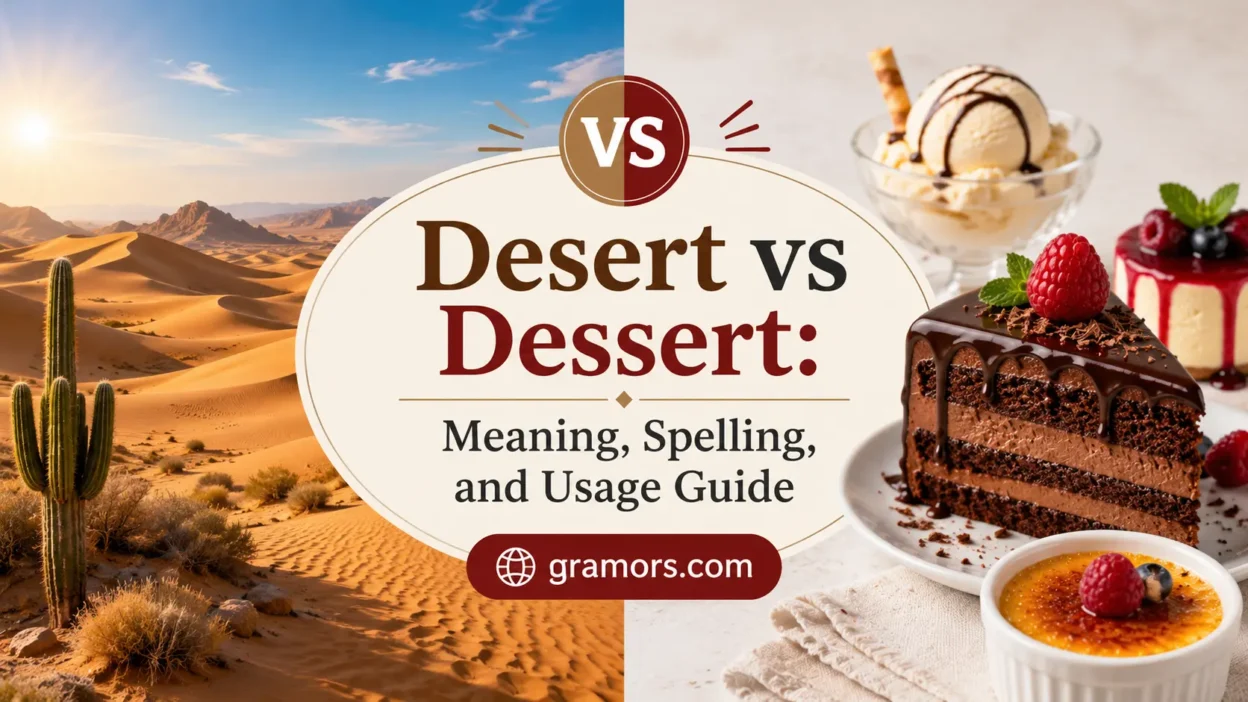
Many people confuse “desert” and “dessert” because the words look very similar and can sound alike in some situations. A single extra “s” changes the meaning completely.
“Dessert” refers to sweet food served after a meal. “Desert” usually refers to a dry region, but it can also mean abandoning someone or something.
For example:
- “We ate dessert after dinner.”
- “Camels survive in the desert.”
The distinction matters in school writing, professional communication, menus, travel writing, and everyday conversation. Using the wrong spelling can quickly change the meaning of a sentence.
Quick Answer
Use “desert” when talking about:
- a dry landscape
- abandoning a person, group, or responsibility
Use “dessert” when talking about sweet food after a meal.
Examples:
- “Chocolate cake is my favorite dessert.”
- “The hikers crossed the desert.”
A quick spelling reminder helps many writers:
- dessert = two s’s
- desert = one s when referring to dry land
Also remember that “desert” can work as both a noun and a verb.
Why People Confuse Them
The confusion comes from three main issues:
- very similar spelling
- overlapping pronunciation in some forms
- fast typing mistakes
Many people also learn these words early in school, where spelling confusion is common.
For example, these mistakes appear often:
Incorrect:
- “I ordered desert after dinner.”
Correct:
- “I ordered dessert after dinner.”
Another source of confusion is pronunciation.
- The noun “desert” is commonly pronounced like “DEH-zert.”
- The verb “desert” is often pronounced closer to “dih-ZERT.”
- “Dessert” is usually pronounced “dih-ZERT.”
Because the verb “desert” and the noun “dessert” sound very similar in American English, writers often mix them up.
Autocorrect and rushed texting also increase spelling errors.
Key Differences At A Glance
| Context | Best Choice | Why |
|---|---|---|
| Sweet food after a meal | dessert | Refers to cakes, pie, ice cream, and sweets |
| Dry sandy landscape | desert | Refers to an arid region |
| Leaving someone behind | desert | Verb meaning abandon |
| Restaurant menu item | dessert | Food-related meaning |
| Military abandonment | desert | Legal or official verb use |
| Travel writing about climate | desert | Geographic meaning |
Quick Comparison
| Feature | desert | dessert |
|---|---|---|
| Main meanings | Dry region; abandon | Sweet course after a meal |
| Part of speech | Noun and verb | Mainly noun |
| Common pronunciation | “DEH-zert” or “dih-ZERT” | “dih-ZERT” |
| Spelling clue | Usually one s | Always two s’s |
| Common contexts | Geography, military, travel | Restaurants, meals, celebrations |
| Interchangeable? | No | No |
Meaning and Usage Difference
“Desert” has two major meanings.
As a noun, it refers to a dry region with little rainfall.
Example:
- “The desert gets cold at night.”
As a verb, it means to abandon someone, leave a duty, or walk away from responsibility.
Examples:
- “The soldier deserted his post.”
- “They deserted the project halfway through.”
The pronunciation changes depending on meaning:
- noun “desert” → “DEH-zert”
- verb “desert” → “dih-ZERT”
“Dessert,” however, almost always functions as a noun. It refers to sweet food served after the main meal.
Examples:
- “We ordered dessert.”
- “Apple pie is a classic dessert.”
Unlike “desert,” “dessert” does not commonly function as a verb in standard American English.
Tone, Context, and Formality
Both words are standard English and appear in both formal and informal writing.
“Desert” often appears in:
- travel writing
- geography
- science
- history
- military or legal contexts
Examples:
- “The documentary explored desert climates.”
- “Several troops deserted during the conflict.”
“Dessert” appears most often in:
- restaurant menus
- casual conversation
- food writing
- celebrations and events
Examples:
- “Would you like to see the dessert menu?”
- “Dessert will be served after dinner.”
The choice depends entirely on context, not formality.
Which One Should You Use?
A quick context check usually solves the problem.
If the sentence involves food after a meal, use “dessert.”
Examples:
- “Cheesecake is my favorite dessert.”
- “We skipped dessert tonight.”
If the sentence involves dry land or abandonment, use “desert.”
Examples:
- “They drove across the desert.”
- “He deserted the team.”
One reliable spelling reminder is this:
- dessert has two s’s because many people want a second serving
That memory trick works well because it connects directly to the food meaning without changing the actual definition.
When One Choice Sounds Wrong
Using the wrong word can make a sentence confusing or unintentionally funny.
Incorrect:
- “I ate desert after dinner.”
This sounds wrong because “desert” refers to dry land or abandonment, not food.
Correct:
- “I ate dessert after dinner.”
Another example:
- “The dessert was extremely hot and dry.”
This sentence accidentally sounds like someone is describing cake as a barren landscape.
More natural:
- “The desert was extremely hot and dry.”
Verb confusion also happens.
Incorrect:
- “The soldiers desserted their positions.”
Correct:
- “The soldiers deserted their positions.”
The meaning fails when the spelling does not match the context.
Common Mistakes
Mistake:
- “Do you want desert after dinner?”
Quick fix:
- “Do you want dessert after dinner?”
Reason: the sentence refers to food.
Mistake:
- “The travelers crossed the dessert.”
Quick fix:
- “The travelers crossed the desert.”
Reason: the sentence refers to geography.
Mistake:
- “He desserted the group.”
Quick fix:
- “He deserted the group.”
Reason: the verb means abandon.
Another common issue involves pronunciation-based spelling mistakes. Writers often spell words the way they hear them, especially when “dessert” and the verb “desert” sound similar.
Everyday Examples
- “We shared chocolate mousse for dessert.”
- “The desert air felt extremely dry.”
- “She made homemade dessert for the party.”
- “Several workers deserted the company during the crisis.”
- “The kids were excited about dessert.”
- “The documentary focused on desert wildlife.”
- “He deserted his responsibilities.”
- “Ice cream is a popular summer dessert.”
- “They camped near the edge of the desert.”
- “The restaurant added a new dessert menu.”
- “Nobody wanted to desert the team before the tournament.”
- “Brownies were served for dessert.”
Dictionary-Style Word Details
Verb
- desert: means to abandon, leave behind, or walk away from duty or responsibility; commonly pronounced “dih-ZERT” as a verb
- dessert: not commonly used as a verb in standard American English
Examples:
- “The captain warned them not to desert the mission.”
- “Several players deserted the league.”
Noun
- desert: a dry region with little rainfall
- dessert: a sweet dish served after the main meal
Examples:
- “The Sahara is a famous desert.”
- “We had pie for dessert.”
Synonyms
- desert: closest alternatives include wasteland, arid region, abandon, and leave
- dessert: closest plain alternatives include sweet course and after-dinner treat
These alternatives may not fit every sentence exactly.
Example Sentences
- desert: “The desert became colder after sunset.”
- desert: “She refused to desert her friends.”
- dessert: “The restaurant serves excellent dessert.”
- dessert: “We ordered dessert after the steak.”
Word History
- desert: developed from Latin and French roots connected to abandonment and wasteland
- dessert: comes from a French word connected to clearing the table after a meal
Although the spellings are close today, the words developed along different paths.
Phrases Containing
- desert: “desert island,” “just deserts,” “desert climate”
- dessert: “dessert menu,” “dessert tray,” “dessert wine”
The phrase “just deserts” is unrelated to sweet food. In that expression, “deserts” refers to what someone deserves.
FAQs
Which spelling means sweet food after a meal?
“Dessert” with two s’s refers to sweet food.
Example:
- “We had ice cream for dessert.”
Can “desert” mean abandon?
Yes. As a verb, “desert” means to leave or abandon.
Example:
- “He deserted the project.”
Are “desert” and “dessert” pronounced the same?
Not always.
- noun “desert” usually sounds different
- verb “desert” sounds very close to “dessert”
That pronunciation overlap causes confusion.
Is “dessert” ever a verb?
In normal American English, “dessert” is primarily used as a noun.
What is a simple way to remember the difference?
Many writers remember that “dessert” has two s’s because people often want a second serving of sweets.
Are these words interchangeable?
No. Their meanings are completely different.
Conclusion
The difference between desert vs dessert is simple once you focus on context.
“Desert” refers to dry land or abandoning someone. “Dessert” refers to sweet food served after a meal.
A quick final comparison makes the distinction clear:
- “They crossed the desert.”
- “They ate dessert afterward.”
The spelling difference is small, but the meanings are completely separate. Once you connect each word to its context, choosing the correct spelling becomes much easier.