Many English learners and native speakers confuse “stationary” and “stationery” because the words sound almost identical in American English.
However, they have completely different meanings and different grammar roles.
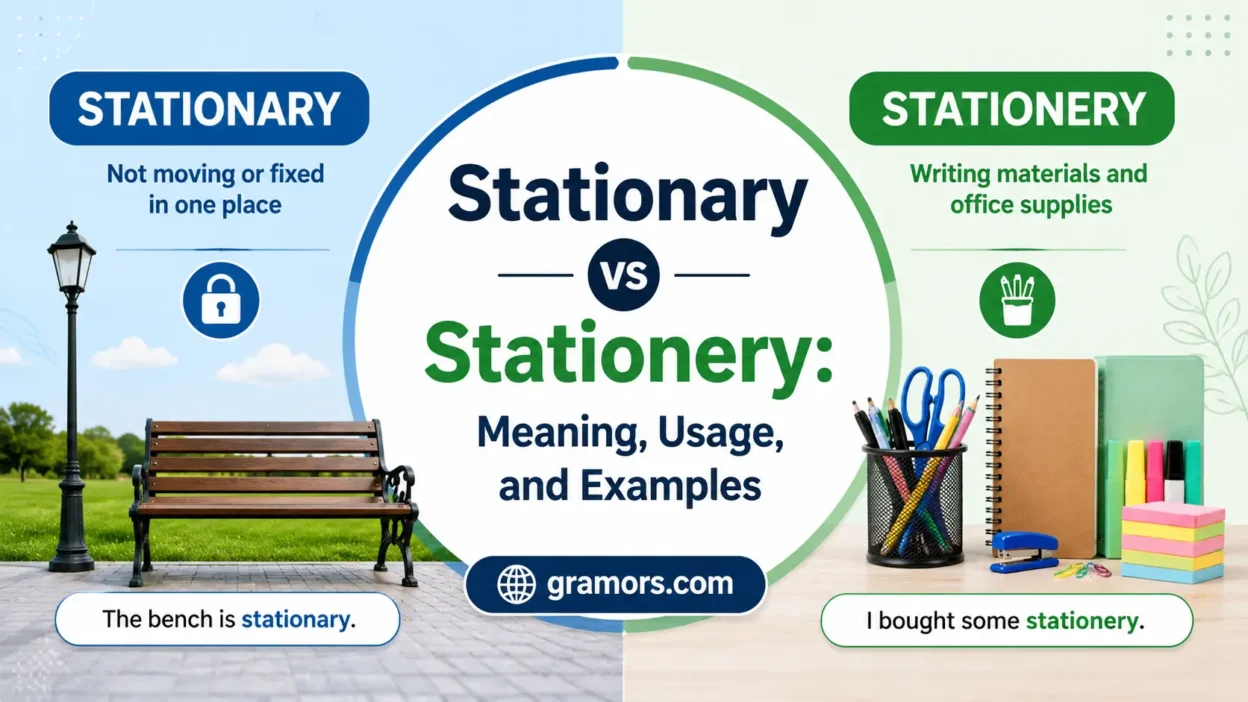
“Stationary” usually describes something that is not moving. “Stationery” refers to writing materials such as paper, envelopes, notebooks, and office supplies.
For example:
- “The car remained stationary.”
- “I bought new stationery for school.”
This distinction matters because the wrong spelling can make professional writing look careless or confusing.
Quick Answer
Use stationary when something is not moving.
Example:
- “The train stayed stationary for ten minutes.”
Use stationery when talking about writing materials or office paper supplies.
Example:
- “She ordered personalized stationery.”
Quick memory tip:
- StationEry has an “e” for “envelopes.”
Incorrect:
- “I bought stationary for the office.” ❌
Correct:
- “I bought stationery for the office.” ✅
Why People Confuse Them
The confusion comes from pronunciation and spelling.
In most American accents, “stationary” and “stationery” sound nearly identical. Since both words also look very similar, many people choose the wrong spelling while typing quickly.
The words are also historically connected to “station” roots, which adds to the confusion.
Here is the spelling difference:
- stationary
- stationery
In speech, these sentences may sound almost the same:
- “The bus remained stationary.”
- “The store sells stationery.”
But the meanings are completely unrelated.
Another reason for confusion is that people often encounter the words in different contexts online without noticing the grammar role.
Key Differences At A Glance
| Context | Best Choice | Why |
|---|---|---|
| Parked vehicle | stationary | Means not moving |
| Traffic delay | stationary | Refers to lack of motion |
| Office paper | stationery | Refers to writing materials |
| School supplies | stationery | Includes notebooks and envelopes |
| Scientific movement description | stationary | Describes fixed position |
| Business letter materials | stationery | Refers to branded paper products |
Quick Comparison
| Feature | stationary | stationery |
|---|---|---|
| Part of speech | adjective | noun |
| Main meaning | not moving | writing materials |
| Common contexts | traffic, science, movement | school, office, business |
| Example phrase | stationary bike | office stationery |
| Interchangeable? | no | no |
Meaning and Usage Difference
Stationary
“Stationary” is primarily an adjective.
It means:
- motionless
- fixed
- not moving
- staying in one place
Examples:
- “The vehicle remained stationary at the red light.”
- “The astronaut appeared stationary from a distance.”
- “Please stay stationary during the scan.”
This word commonly appears in transportation, science, sports, and technical descriptions.
Stationery
“Stationery” is primarily a noun.
It refers to:
- writing paper
- notebooks
- envelopes
- office paper products
- business letter materials
Examples:
- “The company ordered new business stationery.”
- “She keeps extra stationery in her desk.”
- “The wedding stationery matched the invitations perfectly.”
In business and office English, “stationery” is usually treated as an uncountable noun.
Natural:
- “We need more stationery.”
Less natural in standard usage:
- “We need stationeries.” ❌
Although the words sound alike, sentence meaning usually makes the correct choice obvious.
Tone, Context, and Formality
Both words are neutral in tone, but they appear in different situations.
“Stationary” often appears in:
- traffic reports
- technical writing
- scientific discussions
- sports descriptions
Examples:
- “The aircraft remained stationary during inspection.”
- “The object appeared stationary on the screen.”
“Stationery” appears more often in:
- offices
- schools
- branding
- business communication
Examples:
- “The law firm updated its stationery.”
- “Our office stationery includes branded envelopes.”
Neither word is especially formal or informal. The surrounding topic creates the tone.
Which One Should You Use?
Use stationary if the sentence involves:
- movement
- motion
- position
- vehicles
- objects staying still
Examples:
- “Traffic was completely stationary.”
- “The elevator remained stationary.”
Use stationery if the sentence involves:
- paper
- office supplies
- school supplies
- writing materials
- branded business materials
Examples:
- “I bought stationery for my new job.”
- “The teacher handed out stationery supplies.”
A practical rule is simple:
- If it relates to movement, choose stationary.
- If it relates to writing materials, choose stationery.
When One Choice Sounds Wrong
Using the wrong spelling changes the meaning immediately.
Incorrect:
- “The bus was stationery.” ❌
Correct:
- “The bus was stationary.” ✅
Why? Because the sentence describes movement, not office supplies.
Incorrect:
- “I ordered custom stationary for the company.” ❌
Correct:
- “I ordered custom stationery for the company.” ✅
Why? Because the sentence refers to printed office materials.
Another incorrect example:
- “The cyclist remained stationery during the race.” ❌
Correct:
- “The cyclist remained stationary during the race.” ✅
Professional writing often looks less polished when these words are mixed up.
Common Mistakes
Confusing motion with office supplies
Incorrect:
- “The car stayed stationery.” ❌
Correct:
- “The car stayed stationary.” ✅
Using the wrong spelling in business writing
Incorrect:
- “Please order more company stationary.” ❌
Correct:
- “Please order more company stationery.” ✅
Relying only on pronunciation
Because both words sound nearly the same, spellcheck mistakes are common.
Always check the sentence meaning instead of relying on sound alone.
Helpful memory tricks
A useful reminder is:
- StationEry has “E” for “envelopes.”
- StationAry relates to staying in one area.
These tricks work best when combined with sentence meaning.
Everyday Examples
Here are natural examples using both words correctly.
- “The police car remained stationary near the intersection.”
- “I bought new stationery before the school year started.”
- “Traffic was stationary for almost an hour.”
- “The company designed elegant holiday stationery.”
- “The bike stays stationary during the workout.”
- “She keeps extra stationery in her office drawer.”
- “Passengers had to remain stationary during turbulence.”
- “The hotel uses custom stationery with its logo.”
- “The robot remained stationary while charging.”
- “We ordered matching stationery for the wedding.”
- “The truck was stationary on the shoulder.”
- “Office stationery costs increased this year.”
Corrected comparisons:
- “The train remained stationery.” ❌
- “The train remained stationary.” ✅
- “I need stationary for class.” ❌
- “I need stationery for class.” ✅
Dictionary-Style Word Details
Verb
• stationary:
Not commonly used as a verb.
• stationery:
Not used as a verb.
Noun
• stationary:
Not commonly used as a noun in standard English.
• stationery:
Writing materials, office paper products, notebooks, envelopes, and related supplies.
Synonyms
• stationary:
- motionless
- still
- unmoving
• stationery:
- writing paper
- office supplies
- letter-writing materials
Example Sentences
• stationary:
- “The car remained stationary.”
- “The camera stayed stationary during filming.”
- “The athlete held a stationary position.”
• stationery:
- “She purchased personalized stationery.”
- “The office ordered new stationery.”
- “The stationery included matching envelopes.”
Word History
• stationary:
Derived from Latin and French roots connected to standing still or remaining in place.
• stationery:
Historically connected to stationers, who sold books, paper, and writing materials.
Phrases Containing
• stationary:
- stationary vehicle
- stationary position
- stationary object
• stationery:
- office stationery
- personalized stationery
- business stationery
Conclusion
The difference between stationary vs stationery becomes simple once you connect each word to its meaning.
Use stationary for things that are not moving.
Use stationery for writing materials and office supplies.
One final comparison makes the distinction clear:
- “The car remained stationary.”
- “The company ordered new stationery.”
When you focus on context instead of pronunciation, choosing the correct spelling becomes much easier.