Many English writers confuse “principal” and “principle” because the words sound almost identical. A single letter changes the meaning completely.
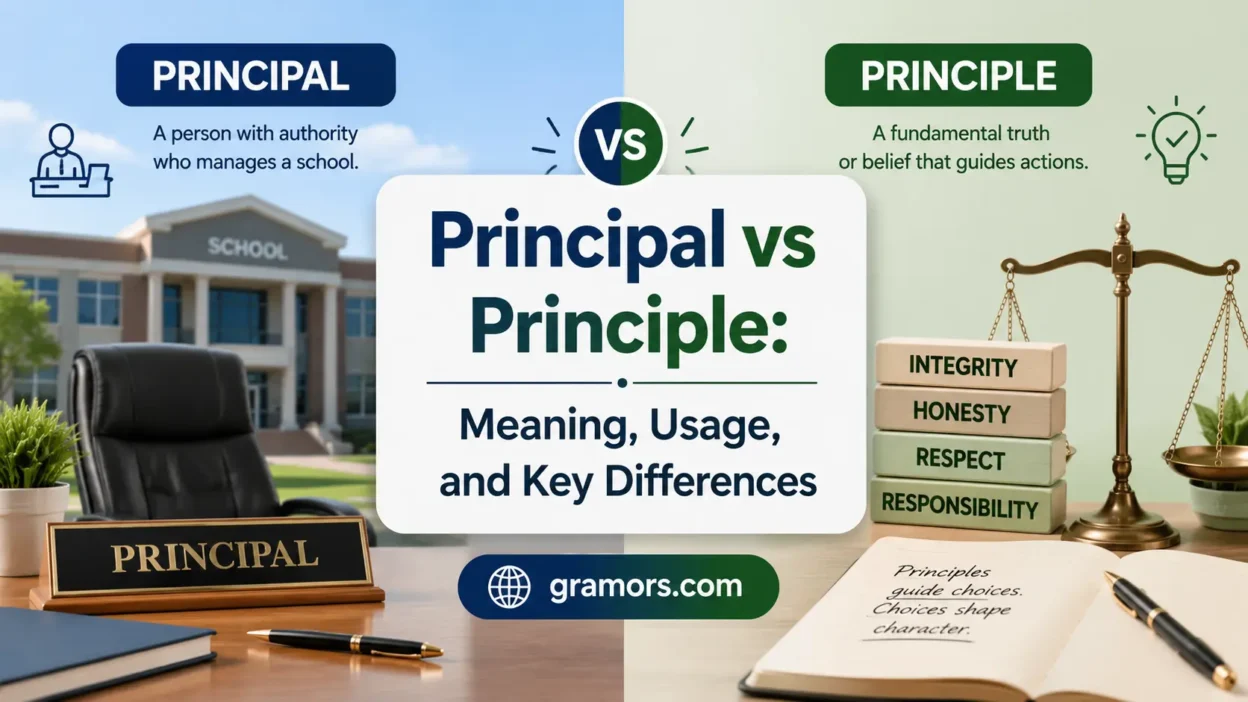
“Principal” usually refers to a person in charge, something most important, or a financial amount. “Principle” refers to a rule, belief, standard, or guiding idea.
For example:
- “The school principal spoke today.”
- “She acted on principle.”
The confusion matters because using the wrong word can make a sentence sound careless or unclear. This guide will make the difference between principal vs principle easy to understand and remember.
Quick Answer
Use principal when talking about:
- a person in charge
- something primary or most important
- a financial amount before interest
Examples:
- “The principal reason was cost.”
- “The school principal greeted the parents.”
Use principle when talking about:
- a rule
- a belief
- a standard
- a guiding idea
Example:
- “Honesty is an important principle.”
One quick memory trick helps many people:
- Principal has “pal” in it — “the principal is your pal.”
- Principle relates to principles, rules, and beliefs.
Also remember that “principal” can work as both a noun and an adjective, while “principle” is only a noun in standard English.
Why People Confuse Them
These words create confusion for several reasons.
First, they are homophones. Most English speakers pronounce them the same way.
Second, their spelling differs by only two letters:
- principal
- principle
Third, both words often appear in formal writing, including school documents, business reports, academic papers, and news articles.
Autocorrect also fails to catch many mistakes because both spellings are real words.
These incorrect examples are common:
- “The school principle announced new rules.” ❌
- “She has strong moral principals.” ❌
Correct versions:
- “The school principal announced new rules.” ✅
- “She has strong moral principles.” ✅
The confusion is not only about spelling. It also comes from grammar roles and sentence meaning.
Key Differences At A Glance
| Context | Best Choice | Why |
|---|---|---|
| School leader | principal | Refers to a person in charge |
| Main reason | principal | Means primary or most important |
| Loan balance | principal | Refers to the original amount |
| Moral belief | principle | Refers to a value or rule |
| Scientific law | principle | Refers to a guiding law or concept |
| Ethical decision | principle | Refers to standards or beliefs |
Quick Comparison
| Feature | principal | principle |
|---|---|---|
| Part of speech | noun and adjective | noun only |
| Core meaning | main, chief, person in charge | rule, belief, standard |
| Common phrases | principal reason, school principal | moral principle, guiding principles |
| Finance use | yes | no |
| Adjective use | yes | no |
Meaning and Usage Difference
The biggest difference is grammar and meaning.
Principal
“Principal” can function as both a noun and an adjective.
As a noun, it often refers to a leader or important figure:
- “The principal approved the schedule.”
It can also refer to money in finance:
- “She paid the principal on the loan.”
As an adjective, it means main, chief, or most important:
- “Safety is our principal concern.”
- “The principal source of income is online sales.”
Principle
“Principle” is only a noun in standard modern English.
It refers to:
- beliefs
- rules
- standards
- laws
- core ideas
Examples:
- “Freedom is a basic principle.”
- “The machine works on a simple principle.”
- “He refused to lie on principle.”
Unlike “principal,” “principle” does not function as an adjective.
This sentence is incorrect:
- “The principle reason was money.” ❌
Correct:
- “The principal reason was money.” ✅
Even though the words sound alike, sentence structure usually reveals which one belongs.
Tone, Context, and Formality
Neither word is automatically formal or informal. The context determines the tone.
“Principal” commonly appears in:
- education
- finance
- law
- business
Examples:
- “The principal approved the budget.”
- “The loan principal must be repaid first.”
“Principle” appears often in:
- ethics
- science
- philosophy
- politics
Examples:
- “The debate focused on constitutional principles.”
- “The experiment follows a basic scientific principle.”
Professional writing expects the correct word choice. Using the wrong one can look careless, especially in school, legal, or financial settings.
Which One Should You Use?
Use principal when the sentence involves:
- importance
- leadership
- finance
- something primary
Examples:
- “The principal objective is growth.”
- “The principal is meeting with parents.”
- “The principal amount remains unpaid.”
Use principle when discussing:
- beliefs
- morals
- standards
- rules
- systems
Examples:
- “She stood by her principles.”
- “It became a matter of principle.”
- “The design follows a simple engineering principle.”
A helpful memory trick is:
- The principal is your “pal.”
- A principle is a principle, belief, or rule.
Memory tricks help with spelling, but always check the sentence meaning too.
When One Choice Sounds Wrong
Some sentences become grammatically or logically incorrect when the wrong word appears.
Incorrect:
- “The school principle called my parents.” ❌
Correct:
- “The school principal called my parents.” ✅
Why? Because the sentence refers to a person in charge, not a belief or rule.
Incorrect:
- “Honesty is an important principal.” ❌
Correct:
- “Honesty is an important principle.” ✅
Why? Because honesty is a moral belief, not a leader or primary object.
Another important contrast:
- “principal difference”
- “difference in principle”
“Principal difference” means the main difference.
“Difference in principle” means disagreement about beliefs or standards.
The meanings are completely different even though the structure looks similar.
Common Mistakes
Many mistakes happen in repeated phrase patterns.
Confusing ethics with leadership
Incorrect:
- “She acted on principal.” ❌
Correct:
- “She acted on principle.” ✅
Mixing up adjective and noun roles
Incorrect:
- “The principle concern is safety.” ❌
Correct:
- “The principal concern is safety.” ✅
Finance confusion
Incorrect:
- “You must repay the loan principle.” ❌
Correct:
- “You must repay the loan principal.” ✅
School-title mistakes
Incorrect:
- “The principle welcomed new students.” ❌
Correct:
- “The principal welcomed new students.” ✅
Quick tip:
- If the sentence means “main” or “person in charge,” choose principal.
- If the sentence means “belief” or “rule,” choose principle.
Everyday Examples
Here are natural examples showing both words in everyday English.
- “The school principal announced a new policy.”
- “Trust is an important business principle.”
- “Her principal concern was employee safety.”
- “The company follows strict environmental principles.”
- “The bank reduced the loan principal.”
- “He refused the offer on principle.”
- “The principal actor arrived late to the interview.”
- “The teacher explained the basic principle of gravity.”
- “Our principal office is in Chicago.”
- “Fairness should be a guiding principle.”
- “The principal approved the field trip.”
- “The engineers tested the machine’s operating principle.”
Paired comparisons also help:
- “The principal reason was budget cuts.”
- “The decision was based on principle.”
Dictionary-Style Word Details
Verb
• principal: Not commonly used as a verb in modern standard English.
• principle: Does not function as a verb.
Noun
• principal:
- person in authority
- leading participant
- original loan amount before interest
• principle:
- rule
- belief
- doctrine
- law
- standard
Synonyms
• principal:
- main
- primary
- chief
- leading
• principle:
- rule
- belief
- doctrine
- standard
Example Sentences
• principal:
- “The principal approved the schedule.”
- “Safety is our principal concern.”
- “She paid the principal on the mortgage.”
• principle:
- “She refused on principle.”
- “The machine operates on a simple principle.”
- “Equal treatment is an important principle.”
Word History
• principal:
Derived from Latin roots connected to ideas like “first” and “chief.”
• principle:
Also comes from Latin roots connected to foundations, beginnings, and rules.
Phrases Containing
• principal:
- principal reason
- principal amount
- school principal
• principle:
- on principle
- matter of principle
- guiding principles
Also remember that “principled” is the adjective form related to “principle.”
Conclusion
The difference between principal vs principle becomes much easier once you focus on meaning and grammar.
Use principal for:
- leadership
- importance
- finance
Use principle for:
- beliefs
- standards
- rules
- guiding ideas
One final comparison makes the distinction clear:
- “The principal concern is safety.”
- “Safety is an important principle.”
When you focus on what the sentence actually means, choosing the correct word becomes much more natural.